
降息≠牛市,市場這次不吃那一套

Original source: Crypto Market Watch
Original title: Why did the market keep falling after the rate cut?
In the early hours of today in the East 8th District, the Federal Reserve announced—a 25 basis point rate cut, lowering the federal funds rate range to 4.00%–4.25%.
At the same time, the Federal Reserve also stated: Quantitative Tightening (QT) will officially end on December 1.
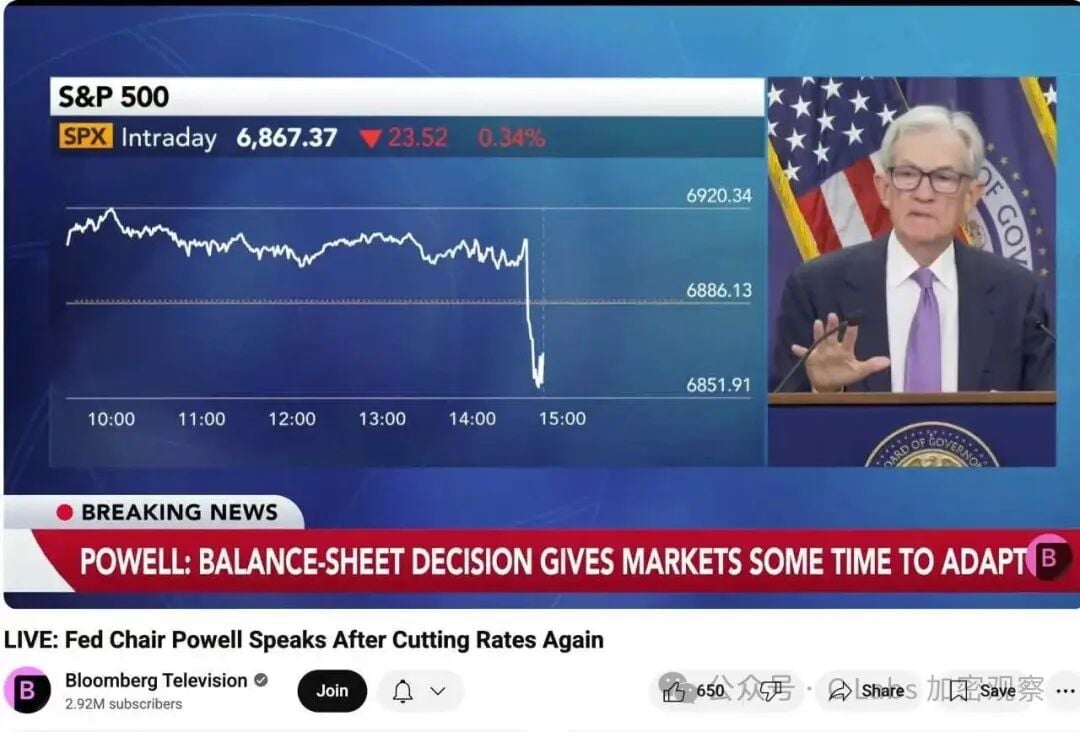
Logically, this should have been “bullish”: rate cuts, ending balance sheet reduction, and improved liquidity expectations. But the result left many people puzzled—why did the stock market, cryptocurrencies, and even gold not rise, but instead all fell?
01. The market’s “bullish expectations” have long been priced in
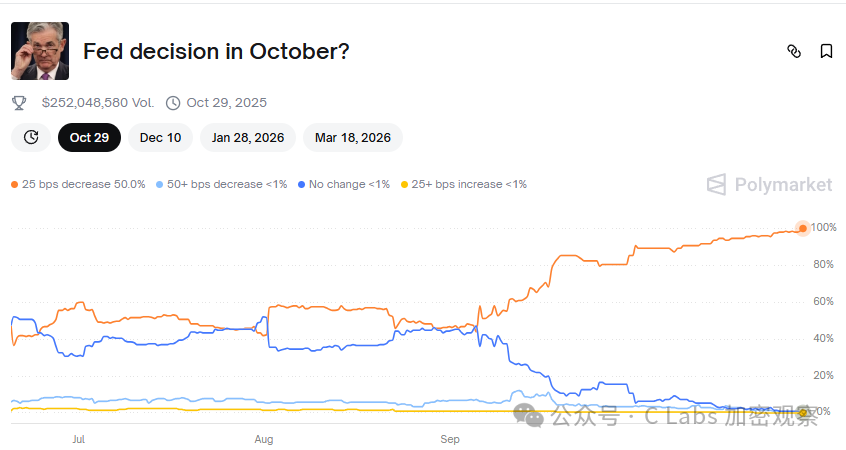
In fact, the market had already “bet” on this rate cut at the beginning of the month. According to CME FedWatch data, before the meeting, the market believed:
The probability of a 25bp rate cut was as high as 95%, and about 40% of investors expected the Federal Reserve to immediately announce the start of QE (balance sheet expansion again).
In the end, the Federal Reserve only chose a “mild” rate cut.
In other words:
This rate cut is not a “new bullish factor”, but “below expectations”.
When expectations are met but there are no surprises, the market often chooses to take profits. This is also a typical “Buy the rumor, sell the news” scenario.
02. Stopping balance sheet reduction ≠ starting liquidity injection
Many people see “QT ending” and think it means a “liquidity flood” is coming. But in fact, the Federal Reserve’s statement this time was very cautious:
“We will end balance sheet reduction, but will not start a new asset purchase program for now.”

That is to say:
From the “tightening” phase to the “wait-and-see” phase.
In the language of financial markets, this means:
Liquidity is no longer deteriorating, but it has not improved either.
And for investment markets to rise, just “stopping the fall” is not enough—“incremental funds” are needed. This is the biggest gap at present.
03. The rate cut has not been transmitted to the “actual funding rate”
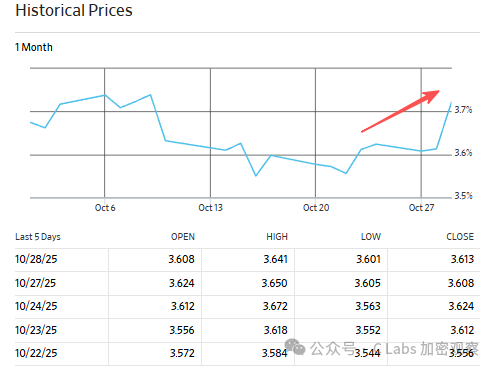
Theoretically, a rate cut will lower short-term rates and reduce funding costs. But this time is a bit special—although the nominal policy rate was cut by 25 points, medium- and long-term funding costs did not fall in sync.
For example, the five-year Treasury yield rose from 3.6% to 3.7%:
The ten-year Treasury yield soared above 4%:
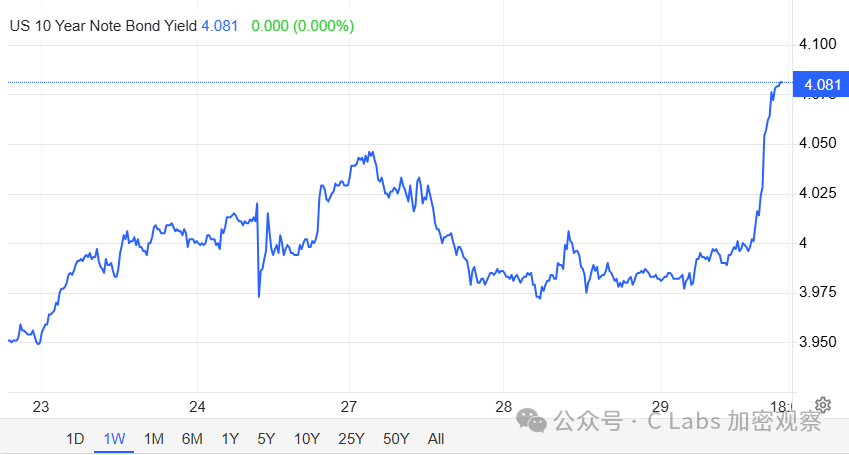
What does this mean? It means that real market liquidity is still tight, and investment institutions have not felt that “there is more money”. The Federal Reserve’s rate cut is still just “talk”, and has not really “flowed into the market”.
04. The hidden worry behind the “rate cut”: economic downward pressure remains high
From a more macro perspective, this rate cut by the Federal Reserve is actually a “defensive operation”. Recent US economic data shows:
-
Real estate and manufacturing have experienced negative growth for two consecutive quarters;
-
The job market has slowed, and the unemployment rate has risen again to 4.6%;
-
Corporate profit growth has almost stalled.
This means that the Federal Reserve has chosen to slightly ease monetary policy to cushion downside risks between “maintaining growth” and “controlling inflation”.
But this operation also sends a signal:
The US economy may have entered a “mild recession period”.
In this case, the market would rather lock in profits first than easily increase positions in risk assets.
05. Summary: Rate cut ≠ bull market, liquidity is the core variable
This rate cut, the market’s reaction actually gives the clearest logic:
Short-term policy easing ≠ abundant liquidity ≠ asset price increases.
What can really drive a full reversal in the stock and crypto markets is the central bank restarting asset expansion (QE), or fiscal stimulus combined with large-scale capital inflows.
Before that, a rate cut is only “neutral to slightly positive”—it can stabilize confidence, but is not enough to trigger a new bull market.
The market wants not a 25-point rate cut, but a real liquidity injection.
Before that, ‘risk assets’ still have to wait.

免責聲明:文章中的所有內容僅代表作者的觀點,與本平台無關。用戶不應以本文作為投資決策的參考。
您也可能喜歡
高盛對沖基金主管:「零日期權」壓制美股波動,科技和能源仍是最佳選擇
標普500已連續27個交易日日內波動低於1%,創疫情以來最長低波動紀錄。高盛警告,這場「平靜」背後是零日期權策略強行鎖住市場的結果,一旦催化劑出現,被壓抑的波動能量將集中釋放。與此同時,9月升息預期升溫、情緒降至年內低點、財政可持續性風險高懸——這鍋正在加熱的水,還要沸騰多久?
新一輪拋售風暴將至?AI牛市勁敵終現身——「全球資產定價之錨」突破5%超級關口
10年期美國國債收益率重新突破5%這一至關重要的關口後,更有可能開啟一段高位拉鋸、資產表現加速分化的時期,尤其是在能源衝擊及美國持續大幅擴張的財政赤字明顯緩和之前,迅速複製2023年末收益率大幅回落的條件尚不充分。

Anthropic又發文:AI時代的經濟會是什麼樣子?
Anthropic經濟學團隊發布AI經濟情境模型,圍繞三種劇本展開:溫和漸進增長、GDP倍增的重大變革、年增15%但知識工作者大量失業的極端情境。模型將工作視為「任務包」,分析AI對各類任務的增強與替代效應。Anthropic強調,2030年的經濟圖景並非定局,關鍵在於如何確保AI紅利廣泛共享。
「新聯準會通訊社」:沃什加息「沒有退路」,特朗普「信任」面臨考驗
Nick Timiraos認為,8月CPI超預期後,聯準會本週升息的機率已飆升,而沃什對通膨的強硬表態讓他幾乎「沒有退路」。在選舉前七週升息,沃什是否升息將直接檢驗川普對他的「信任」能維持多久。此前,沃什以「少說話、避免挑釁」的策略維持白宮與聯準會之間的平衡,這次會議後,沈默將不再是他的護盾。
加密貨幣價格
更多


