
Gold Rebound Stalls, Saudi Refinery Attack Pushes Up Crude Oil

Huitong Finance, October 28—— During the early US trading session on Wednesday (October 28), spot gold and silver prices declined. Renewed geopolitical tensions fueled by Iran and its regional allies pushed crude oil prices higher, while worries about persistently high inflation intensified ahead of the Federal Reserve’s interest rate decision.
During early US trading on Wednesday (October 28), spot gold and silver prices moved lower. Iran and its regional allies once again triggered heightened tensions, causing oil prices to rise, and concerns over sustained high inflation increased in the run-up to the Federal Reserve's rate decision. Gold gave back part of Tuesday's rebound as traders evaluated the possibility of further monetary tightening in December. Meanwhile, silver continued to face pressure amid concerns over industrial demand and high borrowing costs. Spot gold traded around $4,048.68 per ounce, down $12.22 or 0.30%. Silver was quoted near $53.974, dropping $0.435 or 0.80%.
Market positioning is mainly betting that the Federal Reserve will pause rate hikes on Wednesday. Traders calculate about an 84% chance that the Fed will raise rates at least once more before December. Despite widespread geopolitical uncertainty, high US Treasury yields, a resilient dollar, and expectations of continued Fed tightening combined to restrain sustained demand for gold.
The Federal Open Market Committee's two-day policy meeting concludes Wednesday. The rate decision will be announced at 2:00 PM Eastern Time, followed by a press conference with Fed Chair Kevin Walsh at 2:30 PM. Markets broadly expect policymakers to hold the federal funds target range at 3.75%-4.00%. Focus will shift to the meeting statement and the Chair's comments on inflation, employment, and prospects for another rate hike in December.
Remaining economic data for Wednesday: The US Energy Information Administration’s weekly crude oil inventory report will be released at 10:30 AM ET. On Thursday at 8:30 AM, initial estimates of Q3 GDP, September PCE inflation data, and weekly jobless claims will be published. If inflation shows signs of cooling or the Fed signals a dovish policy shift, Treasury yields could decline, weakening the dollar and lowering expectations of a December rate hike, thus supporting gold. Conversely, persistent inflation pressures and a hawkish Fed would reinforce expectations for further tightening and weigh on precious metals.
The Strait of Hormuz and US-Iran tensions remain critical triggers for volatility in global energy markets. Iran-backed Houthi forces have launched successive attacks, undermining recent signals of easing regional tensions. On Tuesday, the Houthis claimed a ballistic missile attack on Saudi Arabia’s Ras Tanura refinery—a core oil processing and export hub with a daily capacity of about 550,000 barrels. Saudi authorities have yet to confirm the incident or the extent of damage, and the impact on operations remains unclear.
Prior to this incident, Saudi, Turkish, and Pakistani diplomats held talks in Tehran, briefly sparking hopes of easing tensions and causing crude prices to drop nearly $2 per barrel on Tuesday. However, no clear US-Iran agreement has been reached; ongoing threats to shipping lanes and energy infrastructure continue to hinder restoration of full operation in the Strait of Hormuz.
Spurred by this new security crisis, crude prices rebounded sharply on Wednesday, reclaiming much of the previous day's losses. Despite diplomatic efforts, conflict has not subsided. Houthi attacks remain frequent, US-Iran negotiation prospects are uncertain, and the energy market continues to price in high geopolitical risk premiums.
For gold, escalating military conflicts provide safe-haven support, but surges in oil prices intensify inflation concerns, reinforcing expectations for further Fed rate hikes. The opposing forces have led to a limited reaction of gold prices to Middle East unrest. Silver faces monetary policy headwinds as well, and—due to its industrial nature—high energy costs and concerns over manufacturing slowdowns also weigh on silver prices.
Global equities were mixed as investors awaited the Fed decision and major tech earnings. On Tuesday, the Nasdaq and S&P 500 rose, reflecting renewed buying interest in AI-related stocks; risks linked to corporate funding needs and stretched valuations, however, persist. Asian equities posted mixed results; European markets focused on earnings, rising energy costs, and upcoming central bank policy decisions. The European Central Bank and Bank of Japan will both announce rate decisions this week. Investors will closely watch if central banks reinforce signals of long-term monetary tightening, especially as high oil prices continue to squeeze corporate profits and erode consumer purchasing power.
Gold Technical Analysis
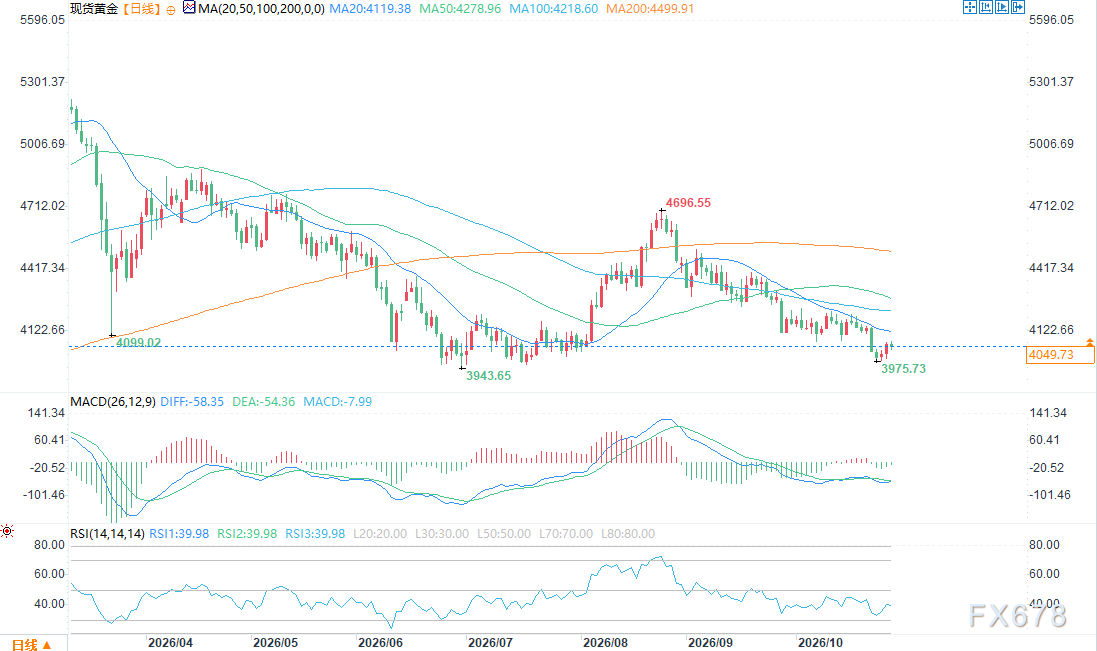
(Spot Gold Daily Chart Source: EasyTrader)
The next upside target for spot gold bulls: pushing prices above the $4,059.00-$4,079.00 resistance range. If this is breached, look for further moves toward $4,088.00 and then $4,200.00.
Short-term downside target for bears: break below $4,015.00. Deeper support at $3,975.00, followed by $3,936.00.
First resistance at $4,059.00, then $4,079.00. First support at $4,039.00, followed by $4,015.00.
Silver Technical Analysis
The next target for spot silver bulls: pushing prices above the $54.460-$55.770 resistance range; if firmly established, look for moves toward $60.000, and further to $63.000.
Bears’ downside target: a break below $52.410. Further downside at $51.390, then to $50.000.
First resistance at $54.460, then $55.770. First support at $52.410, followed by $51.390.
Disclaimer: The content of this article solely reflects the author's opinion and does not represent the platform in any capacity. This article is not intended to serve as a reference for making investment decisions.
You may also like
Global fund managers collectively shift! High yields and improved supply-demand resonate, making Japanese government bonds popular again
As signs of recovering domestic demand and a more favorable policy environment enhance the appeal of high yields, global fund managers are once again showing interest in the Japanese bond market.
AI Capital Rush! Global Bond Issuance Hits Historic Record
This year, global bond financing has reached $6.61 trillion, a 15% year-on-year increase, breaking the 2025 historical record two months early. The main driving force is the AI arms race—cloud computing providers and data centers have issued nearly $368 billion in bonds this year, six times more than last year, accounting for one third of the overall increase. Amazon has become the fourth largest bond issuer in the world, surpassing France and the UK. Citibank has warned that the capital demand from AI is pushing up the global neutral interest rate, which may structurally raise the long-term interest rate benchmark.
While Meta and Alphabet raise concerns in the market over AI cash burn, Microsoft (MSFT.US) counters with over $10 billion in cash flow and leads AI commercialization from story to profit.
Microsoft released its financial results for the first quarter of fiscal year 2027 (ending September 30, 2026) after the U.S. stock market closed on Wednesday Eastern Time. Revenue, earnings per share, and Azure growth all exceeded market expectations.
Wall Street "ponders" Walsh's speech: suggests further rate hikes, but not by much
At a press conference, Walsh, backed by strong economic data (GDP over 3%, double-digit investment growth), refused to characterize current financial conditions as "tight," which the market interpreted as an indication that further rate hikes are still needed, although likely to a limited extent. Despite two internal dissenting votes, a hawkish committee member voted in favor, suggesting that most expect a catch-up hike in December. The futures market has already priced in one rate increase each in December and next March.
Crypto prices
More


