
Stablecoin remittances cost 84% less than traditional transfers, report finds

Stablecoin-funded remittances continue to offer substantial cost savings over traditional money transfers, particularly in emerging markets, reinforcing one of the leading use cases for digital dollars as payment activity grows.
According to a new third-quarter report from Borderless.xyz, a stablecoin payments network, sending a $200 remittance through stablecoin-funded payment rails costs a median of 1%, or $2, compared with 6.36%, or $12.72, for traditional remittances, based on World Bank data.
The difference makes stablecoin-funded remittances roughly 84% cheaper, although the comparison uses Borderless’s third-quarter 2026 pricing and World Bank figures from the same period in 2025.
The savings are also substantial across emerging markets. In Sub-Saharan Africa, stablecoin-funded remittances cost 2.9%, compared with 8.46% for traditional transfers. In Latin America, the costs are 1.25% and 5.64%, respectively.
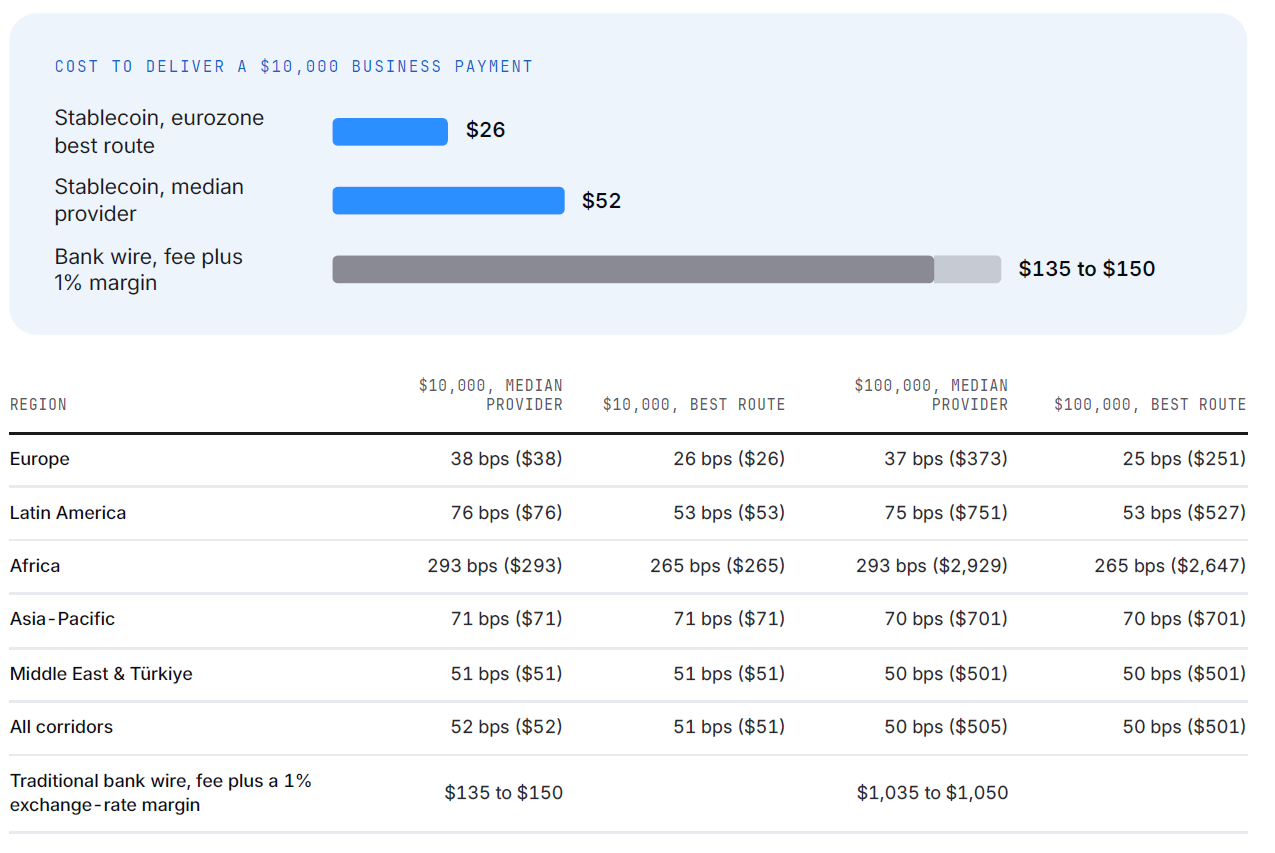
Business payments made through stablecoins are also significantly cheaper, according to the report. A $10,000 stablecoin-funded transfer to the eurozone costs as little as $26 when routed through the lowest-cost provider, compared with $52 across all corridors at the median provider.
By comparison, a traditional international bank wire costs between $135 and $150 for the same amount, including transfer fees and an assumed 1% foreign-exchange margin.
Stablecoins offer significant cost savings on larger business transactions. Source: Borderless.xyz
Stablecoin payouts settle in minutes, but reliability varies
Beyond cost savings, the Borderless report found that stablecoin-funded payments can reach recipients’ local bank accounts in minutes, depending on the payment network used.
In Brazil, payouts through the PIX network settled in a median of two minutes during the third quarter, while Mexico’s SPEI network took three minutes. Colombia’s PSE network also recorded a median settlement time of two minutes.
By comparison, traditional SWIFT transfers typically settled the next business day, with the slowest 10% taking three business days.
However, payment completion rates varied considerably. Mexico’s SPEI network successfully completed 98.6% of payouts, followed by Brazil’s PIX at 97.8%. Colombia’s PSE network completed 79%, while Costa Rica’s SINPE recorded a completion rate of just 73%.
The findings come as stablecoin transaction activity continues to grow. Standard Chartered recently highlighted rising transaction volumes despite relatively flat growth in the overall stablecoin market capitalization this year. The bank expects the market to reach $2 trillion by 2030, two years later than its previous forecast.
Disclaimer: The content of this article solely reflects the author's opinion and does not represent the platform in any capacity. This article is not intended to serve as a reference for making investment decisions.
You may also like
Bank of Canada: Inflation-growth tradeoff keeps policy on hold – RBC

Data: If ETH breaks above $2,537, the cumulative short liquidation intensity on major CEXs will reach $862 millions.

Strategic oil reserves near record lows and still to be tapped! The United States plans to provide up to 17 million barrels of crude oil.
Data released this week show that the size of the US Strategic Petroleum Reserve is only about 13 million barrels less than its original scale when the reserve system was established. The US Department of Energy's recent call for companies to participate in crude oil exchange programs is part of the action following the March agreement among IEA member countries to release a total of 400 million barrels from their reserves this year. At that time, the US pledged to release 172 million barrels from its strategic reserves, but there has been limited participation from companies in the exchanges since then. Analysts believe that recent supply disruptions caused by hurricanes and other factors may prompt the US government to make further use of its reserves.


Crypto prices
More


