
Bank of America warns that gold is unlikely to hold above $4,000 in the short term, and a real bottom requires waiting for three signals.

Bank of America commodity analysts remain cautious about the short-term outlook for gold. In a precious metals report published on Monday, the bank said that although gold-backed Exchange Traded Funds (ETF) continue to attract inflows, weak physical demand is still insufficient to sustain gold prices at higher levels.
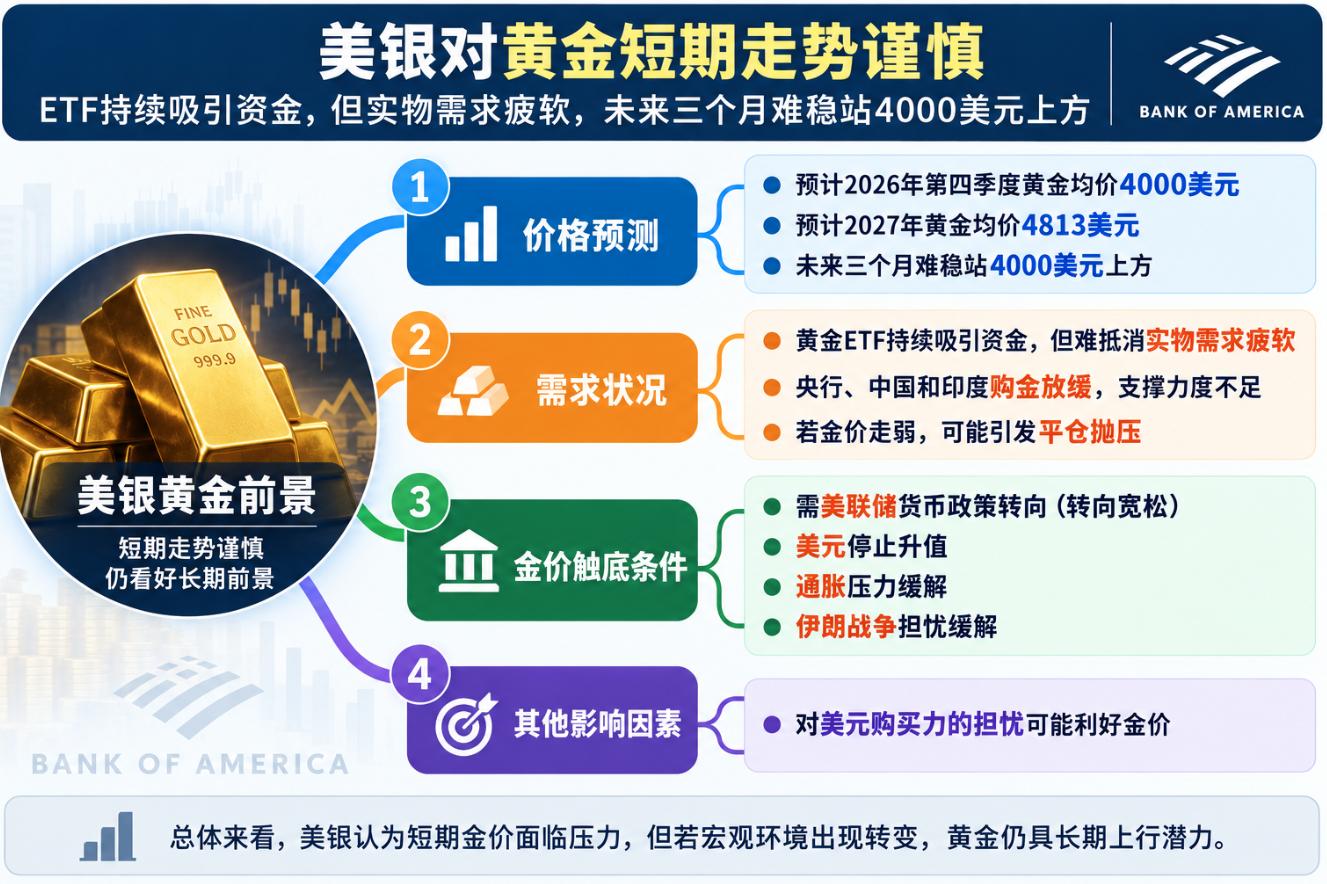
Bank of America expects gold to average $4,000 per ounce in the fourth quarter of 2026, with the average price potentially rising to $4,813 in 2027. The bank believes that gold prices are unlikely to hold above $4,000 for the next three months.
Earlier this month, Bank of America also predicted that persistently high energy prices and ongoing inflation concerns could push gold prices down to $3,750 per ounce in the fourth quarter.
ETF inflows fail to offset weak physical demand
Over the past two months, demand for gold ETFs has remained positive, but Bank of America believes that this may not be enough to provide sustained support for gold prices. If prices continue to weaken, investors may choose to close their positions, which would in turn increase selling pressure on the market.
More crucially, other major buyers in the gold market are slowing down their purchases. Indicators tracked by Bank of America show that gold buying activity from central banks, China, and India has all declined. Analysts believe this largely explains the recent resistance to further gains in gold prices.
Central bank demand may also become a new source of pressure before the end of the year. Bank of America points out that if the Middle East conflict escalates again, central banks may resume selling gold.
Analysts stated that about 90% of the increase in the value of central bank gold holdings comes from price appreciation rather than actual purchases. Therefore, a decrease in holdings is not surprising.
When will gold prices truly bottom out?
Bank of America believes that for gold to emerge from its current pressures, the macro environment first needs to change. A shift in Federal Reserve policy, a halt in the dollar’s appreciation, and an easing of concerns over inflation and the Iran war are all important conditions for gold prices to stabilize.
Analysts point out that based on correlation, causality, and principal component analysis, gold often rises alongside the stock market when the market is no longer concerned about rising interest rates. However, when the Federal Reserve turns hawkish, inflation rises, and the dollar appreciates, gold is under significant pressure.
Therefore, Bank of America believes that gold may not truly bottom out until the Federal Reserve ends its tightening cycle, the dollar stops appreciating, and worries about inflation and the Iran war risks subside.
However, a shift in monetary policy is not the only factor that could drive a rebound in gold prices. If the market renews concerns over the dollar’s purchasing power, gold could also gain fresh upward momentum.
Bank of America notes that while the US fiscal deficit has always been a hot topic in the gold market, a mere rise in the bond term premium is generally not enough to benefit gold. What matters more is whether there are substantial changes in fiscal policy and whether the market once again worries that the government may ease debt pressures by lowering real financing costs.
As an example, analysts note that if the US Treasury funds the government through short-term debt issuance and the Federal Reserve ensures low short-term interest rates, concerns over a devaluation of the dollar could flare up again. In Bank of America’s view, this would present a clear bullish scenario for gold.
Disclaimer: The content of this article solely reflects the author's opinion and does not represent the platform in any capacity. This article is not intended to serve as a reference for making investment decisions.
You may also like
24 Hour Crypto Recap: Here’s What Happened in the Market
AI investment is reshaping the bond market! Sunak: By 2027, the net issuance of long-term bonds by technology companies may surpass that of the US government
By 2027, tech companies are expected to become larger net issuers of long-term debt than the U.S. government.
Deposit and withdrawal services suspended, an exchange lists Blur (BLUR) as a warning asset
Crypto prices
More


