Bitget App
Trade smarter
Buy cryptoMarketsTradeFuturesStocksEarnInstitutionAI & More
Polkadot drops 9% to $1.10 as leveraged traders pull back

Polkadot drops 9% to $1.10 as leveraged traders pull back

AMBCryptoAMBCrypto2026/10/07 21:30

Polkadot [DOT] has had a rough day, being hit on all fronts. What’s going on?

The story behind DOT’s massive fall

Most of the damage happened fast.

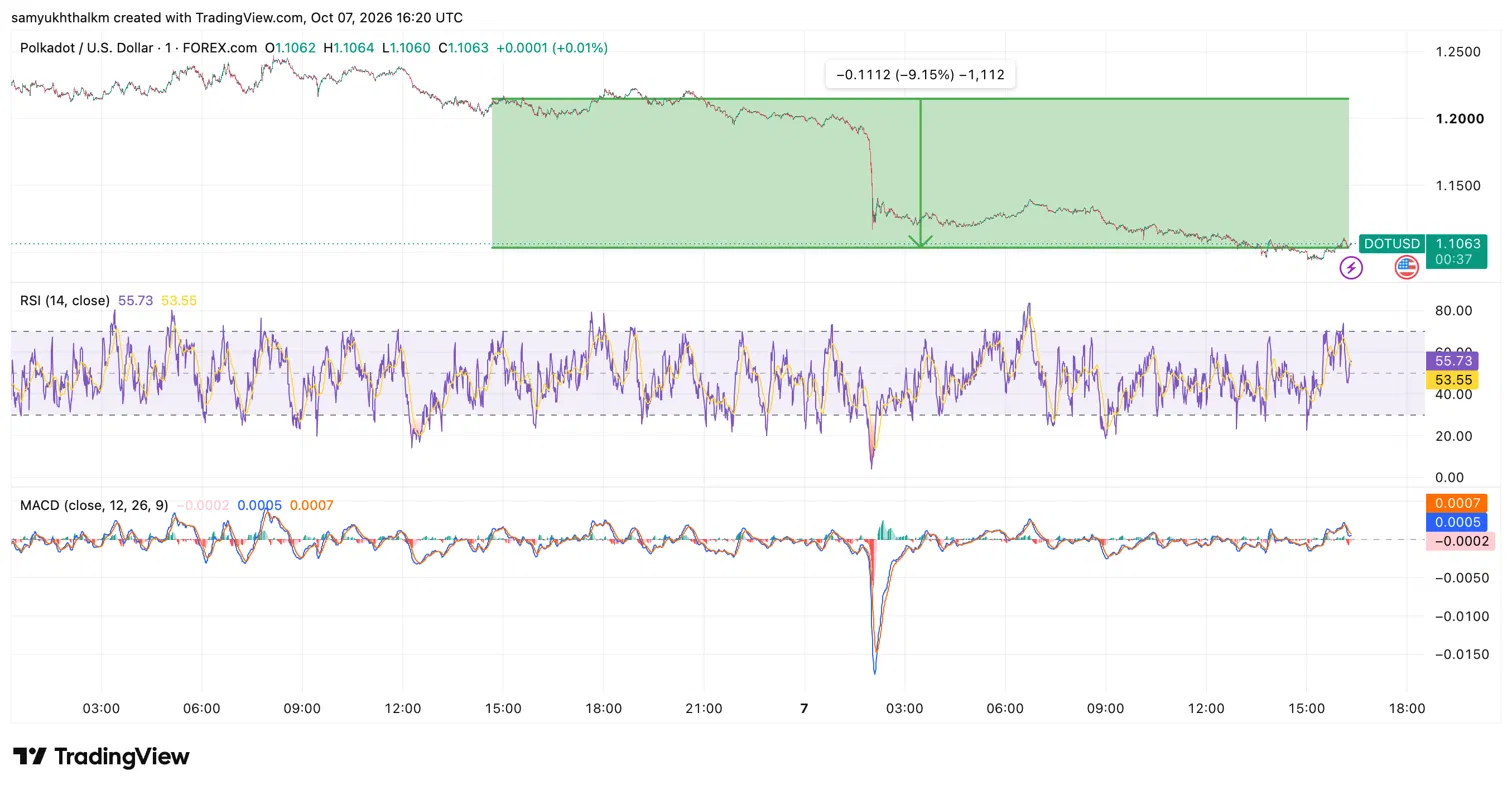
DOT was at $1.21 on October 6. It went on to drift lower into the night, then fell off a cliff. In a few minutes, it went from about $1.19 to near $1.12.

@media only screen and (min-width: 0px) and (min-height: 0px) { div[id^="bsa-zone_1774359638628-7_123456"] { min-height: 50px; transition: min-height 0.3s ease; } } @media only screen and (min-width: 640px) and (min-height: 0px) { div[id^="bsa-zone_1774359638628-7_123456"] { min-height: 90px; } }
AD

There was a small bounce to $1.14 a few hours later. It didn’t hold.

DOT has been leaking lower all day. At the time of writing, we were at $1.106; down about 9.15% from where the slide began.

Who got hit? The futures market will tell you.

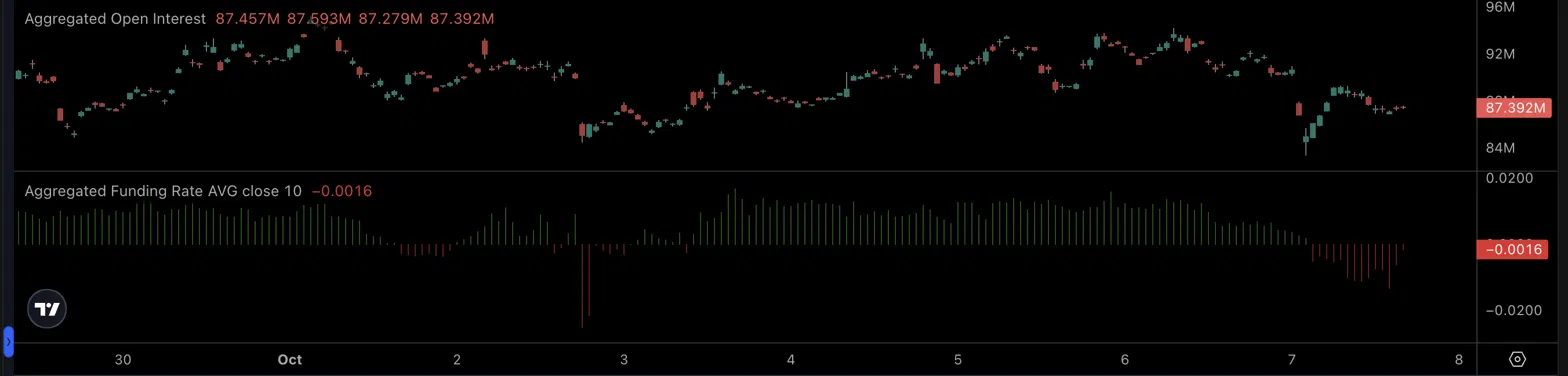
Open interest went from $91 million to about $85 million during the crash, meaning that leveraged positions got taken out in a hurry. But it has since gone back to around $87.4 million.

Funding rates also turned negative, dropping to -0.0016% at the time of this writing, despite being positive for most of the past week. Traders who were happy betting on DOT going up a few days ago are now paying to bet it goes down as a result of the recent trend.

There’s some news in the background…

This is Polkadot’s own stablecoin, along with a DOT/dotUSD liquidity pool funded with $2.5 million each in USDT and DOT. At the time of this writing, the proposal has been approved with about 98.4% Aye versus 1.6% Nay.

Polkadot has also been inviting developers to come and try its Devnet [a testing ground before mainnet].

The DOT sell-off came despite different ecosystem developments in the background, but this doesn’t mean that either was driving DOT’s short-term price action.

DOT’s market cap, meanwhile, is around $2 billion. That’s 96% below its 2021 peak of $52 billion, and still about 240,000x its yearly revenue.

A stablecoin could give the network more to do, but until then, traders can only watch how DOT trends.

Final Summary

  • Polkadot fell about 9% in the last day.
  • Polkadot’s on-chain revenue isn’t telling the whole story.
 

News Image 0News Image 1News Image 2
0
0

Disclaimer: The content of this article solely reflects the author's opinion and does not represent the platform in any capacity. This article is not intended to serve as a reference for making investment decisions.

Understand the market, then trade.
Bitget offers one-stop trading for cryptocurrencies, stocks, and gold.
Trade now!

You may also like

In September, Japanese investors withdrew from foreign bond markets for the second consecutive month.

Reuters, October 8 – In September, Japanese investors became net sellers of foreign bonds for the second consecutive month, driven by rising borrowing costs in the US and Europe, as well as increasingly attractive domestic yields that prompted them to withdraw from overseas bond markets. Data released by Japan's Ministry of Finance on Tuesday showed that Japanese investors were net sellers of 969 billion yen ($613 million) in foreign bonds last month, which was lower than the previous month's net sales of 1.16 trillion yen. They net sold 1.43 trillion yen in long-term foreign currency bonds—a six-month high—while purchasing about 457 billion yen in short-term notes. The increase in Japanese interest rates is beginning to attract some of the country's vast overseas investments back home, marking a significant shift in global capital flows. Year to date, Japanese investors have net sold about 5.08 trillion yen in foreign bonds, the highest since 2022. This capital outflow could support the yen’s exchange rate and put pressure on bond markets that have long considered Japan a major buyer. Soaring energy costs have heightened inflation concerns, prompting the Federal Reserve (FED) and the European Central Bank to raise interest rates in September, which has further pressured global bond markets. Earlier this week, Japan's benchmark 10-year government bond yield rose to 3.122%, its highest in 30 years, increasing the appeal of domestic bonds. In September, led by the Bank of Japan, Japanese institutions sold a net 2.49 trillion yen in long-term foreign bonds, a seven-month high. Life insurance companies and investment trust managers also recorded net sales of 288.6 billion yen and 200.1 billion yen respectively. However, trust accounts net purchased 1.2 trillion yen in long-term foreign currency bonds, highlighting divergent investment strategies among Japanese institutional investors. Another Bank of Japan report showed that in the first eight months of this year, Japanese investors net sold 4.74 trillion yen in US Treasuries, while net purchasing 355.85 billion yen in European bonds. Within Europe, Japanese investors net bought 329.82 billion yen in Italian bonds, while net selling 208.59 billion yen and 94.25 billion yen in French and German bonds, respectively. (1 US dollar = 158.1400 yen)

路透社•2026/10/08 05:26
In September, Japanese investors withdrew from foreign bond markets for the second consecutive month.