
MRVL Targets 10x Revenue Growth in Five Years, AMD Ushers in a Second Spring for CPUs

The hardware architecture of the entire AI data center is currently being redesigned, with CPUs, custom chips, optical interconnects, switches, NICs, memory interfaces, and storage controllers all entering a new wave of explosive demand alongside GPUs.
On October 6, Marvell (MRVL) significantly raised its long-term targets at its Investor Day. The company expects revenues to reach approximately $20 billion in fiscal 2028, and further rise to between $70 billion and $90 billion in fiscal 2031, with the midpoint around $80 billion.
By comparison, Marvell's fiscal 2026 revenue is only about $8.2 billion. In other words, the company is essentially telling Wall Street: In the next five years, Marvell could grow from a chip company with just over $8 billion in annual revenue to an AI infrastructure giant with nearly $80 billion in revenue.
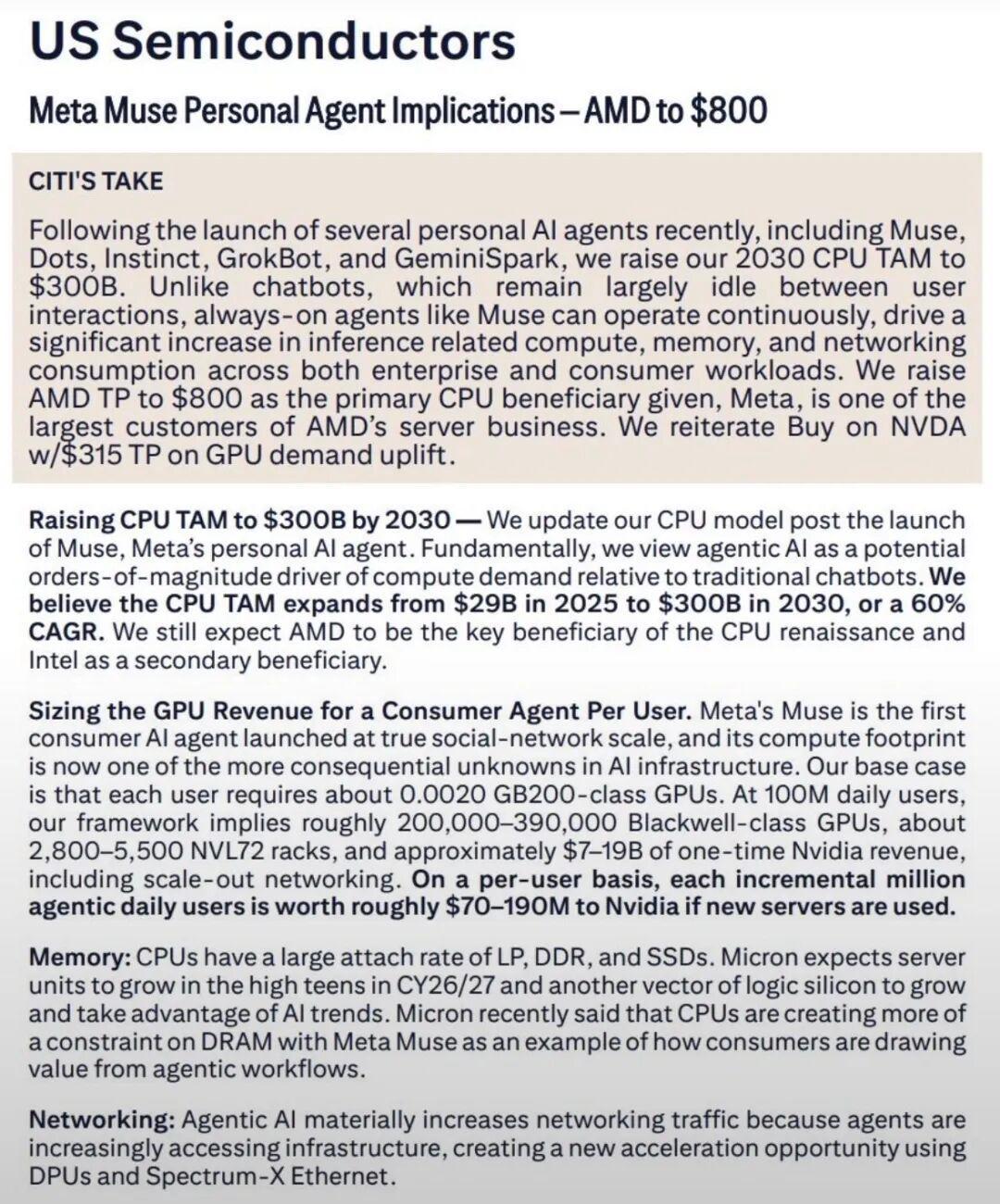
Meanwhile, Citi directly increased the potential total addressable market (TAM) for the global CPU market in 2030 to $300 billion, compared to about $29 billion in 2025, representing more than a 10-fold expansion in five years, and raised AMD's target price sharply from $575 to $800.
On the surface, one story is about Marvell, the other about AMD, but the underlying reason is exactly the same: AI is moving from the first stage of “training models” to the second stage of “letting AI truly start working.”
The distinction between these two phases will determine where the next wave of money in the AI industry chain will flow.
In the past three years, the simplest way to make money in AI was to buy GPUs. OpenAI, Meta, Google, and Microsoft all need ever-larger models, requiring more and more NVIDIA GPUs, making the GPU the biggest bottleneck in the entire AI industry.
However, as we enter the Agentic AI era, the situation starts to change.
Traditional ChatGPT-style chatbots are mostly idle. You ask a question and it runs a model once and stops. If you don’t ask, it hardly consumes any new inference resources.
But the new generation of personal AI agents like Meta Muse are entirely different. They have their own virtual machines and browsers, can help users browse the web, fill out forms, handle customer service, make appointments, invoke various software, and continuously execute tasks in the background.
In other words, in the future, one AI user will no longer correspond to just a large model that runs for maybe a few dozen seconds at a time, but could have a “digital employee” that is online long-term.
This will entirely change the way computing is done inside AI servers.
Citi provides a crucial data point: the CPU to GPU ratio during the training phase is about 1:8; during the inference phase, it may rise to 1:4; and as we enter the Agentic AI phase, the ratio could further approach 1:1, or even higher.
The reason is not complicated: GPUs are best at large-scale matrix computations, but once an AI agent truly begins to work, in addition to running the model, it must handle task scheduling, web browsing, database reads, API calls, security permissions, operating systems, memory management, data transfer, and coordination among various AI models.
Many of these tasks are not what GPUs excel at—they require CPUs, networks, and various specialized chips.
This is also why Citi suddenly sees the CPU TAM growing to $300 billion.
What this really expresses is not that “CPUs will replace GPUs.” Quite the opposite—it is that as more GPUs are installed, the system will require more CPUs, more DRAM, faster networks, and more data center interconnect devices as well.
Thus, the AI industry is shifting from the old straightforward “GPU arms race” to a competition around entire server architectures.
Looking again at the numbers given by Marvell on Investor Day, it’s easy to see why management dares to raise its long-term targets so dramatically.
Marvell expects the total addressable market it can participate in to reach about $400 billion by 2030. The last time the company announced its long-term TAM, it was less than $100 billion—that’s a fourfold increase in just a few years.
Among these:
The custom chip market is expected to reach about $235 billion, which will be Marvell’s largest potential market in the future.
The AI data center interconnect market is expected to reach about $65 billion and is projected to be one of the fastest growing businesses.
The switch and storage-related markets are expected to reach about $85 billion.
Communications and other businesses are expected to have a market opportunity of about $15 billion.
The real takeaway behind these numbers isn’t the $400 billion figure itself, but Marvell’s belief that the fastest-growing component in AI data centers is shifting from pure Compute to Connectivity.
Many ordinary investors are easily misled into thinking the most valuable asset in an AI data center is the GPU.
In reality, as an AI cluster scales from thousands of GPUs to tens or even hundreds of thousands of XPUs, one of the biggest engineering challenges becomes: how is all the data transferred between these chips?
No matter how fast the GPU computes, if the data can’t be delivered, the GPU still has to wait.
AI systems are thus constantly facing increasingly severe physical bottlenecks, including insufficient bandwidth, high latency, excessive power consumption due to copper connections, and ever-longer data transmission distances.
This is precisely the market Marvell wants to conquer most.
Marvell projects that in fiscal 2031, with a revenue midpoint of $80 billion, about $37.5 billion will come from Interconnect, $30 billion from Custom Silicon, about $10 billion from switches and storage, and the remaining approximately $2.5 billion from traditional communications and other businesses.
That is, Marvell’s largest business in the future may not even be AI compute chips themselves, but enabling high-speed connections among all chips in the AI data center.
This is the easiest part for the market to underestimate from this Investor Day.
In the past, investors looking at AI semiconductors were used to asking: “Who can challenge NVIDIA’s GPU?”
But the real question for the future may be: “For every additional GPU or XPU, how many more other chips are needed beside it?”
If the answer is each GPU also requires CPUs, NICs, switch chips, optical DSPs, Retimers, memory controllers, storage controllers, and all kinds of dedicated ASICs, then the greatest growth opportunity in the AI industry chain won’t just be in GPUs.
This is exactly what Marvell is betting on.
The company already supplies custom chips to all four major US Hyperscalers, and more projects aren’t about directly making a large XPU to replace NVIDIA’s GPU, but about so-called XPU Attach—adding all kinds of specialized chips around the AI accelerator.
For example, high-speed NICs, memory interfaces, storage controllers, AI infrastructure management chips, and inference acceleration chips.
Marvell’s management has even provided a very intuitive calculation: in the future, each XPU may be surrounded by one or two dedicated chips, and the unit cost of some products could reach about $1000.
When cloud computing companies deploy millions of AI chips per year, even these seemingly inconspicuous “side chips” beside each XPU could eventually become a market worth billions of dollars.
This is why Marvell raised its fiscal 2029 Custom business target from over $10 billion to more than $12 billion, and expects to reach about $30 billion in fiscal 2031.
More importantly, Marvell is no longer just making one chip for one customer.
The company has made it clear that its custom business now covers all four major US Hyperscalers, and that future revenue will be increasingly diversified among different customers, different XPUs, and different XPU Attach products.
The partnership Marvell signed with Google this year is a very typical example.
The scope of this cooperation is not just a single AI chip, but covers AI inference accelerators, storage controllers, network interface controllers, memory interface controllers, Near-Memory Compute, and several other products.
According to the agreement, if the related product purchases reach the agreed performance benchmarks in the future, the total potential purchase volume for this collaboration could reach up to about $120 billion.
It is important to note that this $120 billion is not a $120 billion order that has been signed and guaranteed for purchase today, so it should not be counted as Marvell’s current order backlog.
But the message it sends is still extremely important: Google is willing to tie such a sizable long-term procurement commitment to Marvell, which already shows that large cloud computing companies of the future will not just need a single ASIC, but a complete chip platform centered around AI infrastructure design.
U.S. Stock Investing Network believes this is where Marvell fundamentally differs from the past.
Previously, the biggest question about Marvell was whether it was truly a platform company with long-term AI growth potential, or just benefitting temporarily from a few large customer ASIC projects during the peak of AI capex.
This Investor Day, the company essentially gave its answer.
Fiscal 2026 revenue is about $8.2 billion, fiscal 2028 about $20 billion, fiscal 2031 target between $70 billion and $90 billion, midpoint $80 billion; if the $80 billion is achieved, it's nearly a 10x revenue growth over five years, with a annual compound growth rate near 58%.
The company also gave a non-GAAP EPS target of over $30 in fiscal 2031, compared to only $2.84 in fiscal 2026.
This is no longer a normal growth scenario for a traditional semiconductor company, but rather a bet that the entire AI infrastructure market will continue to expand rapidly for the next five years.
So the real question investors should focus on is: are Marvell’s targets credible?
The answer is—the direction is very clear, but investors should still maintain a cool head regarding the numbers.
The biggest risk comes first from Hyperscaler capital expenditure.
Marvell’s entire long-term model is built on the continued rapid growth in global data center capex. The company expects global data center capex to approach $3 trillion by 2030, with the top ten Hyperscalers continuing to increase their share of worldwide investment.
As long as Microsoft, Google, Meta, Amazon, and other AI giants continue to increase annual capex, Marvell’s market will continue to grow; but if AI investment returns fall in two or three years and Hyperscalers suddenly slow their data center buildouts, Marvell’s numbers for 2031 will be visibly impacted.
The second risk is competition.
The biggest rival in custom ASICs is still Broadcom (AVGO), and the AI networking market faces competition from NVIDIA’s own network products and other high-speed interconnect vendors.
A $400 billion TAM does not mean Marvell will capture it all; ultimately, market share determines actual profits.
The third risk is valuation.
When the market starts to price in revenues for 2030 or even 2031, stock prices can easily outrun profit growth. No matter how promising a company’s next five-year story sounds, if today’s valuation has already factored in most of the future growth, the stock may still experience significant volatility.
Therefore, U.S. Stock Investing Network believes that what is truly worth understanding for investors in this round of AI growth is not just simply looking for “the next NVIDIA.”
The real and bigger change is that AI is advancing from the model training era into the Agent era, and in the Agent era, what’s needed isn’t just more GPUs, but a whole, more complex data center.
GPUs are responsible for compute, CPUs handle organization and scheduling, DRAM is for data storage, the network is for data transport, optical modules and DSPs break through distance and bandwidth limits, switch chips enable communication among thousands of XPUs, and custom ASICs achieve ever higher efficiency and lower power for dedicated tasks.
As AI goes from being a chat window you open occasionally to a digital employee that works for you 24/7, the hardware consumption per AI user will be completely different.
This is why Citi dares to see the CPU market at $300 billion by 2030, and why Marvell is bold enough to raise its 2031 revenue target from today’s $8.2 billion to $70–90 billion.
If this round of the AI investment cycle can indeed continue to around 2030, then the focus of future research will no longer be “who else to buy besides NVIDIA.”
Instead, it will be: for every additional dollar invested in a GPU, how many more dollars will flow into CPUs, custom chips, optical communications, networks, memory, and storage.
This could be the next major wealth redistribution in the AI industry.
Launch of the “My Watchlist” feature
Enter the US stock ticker you are following to establish your own stock watchlist. Our quantitative AI system will continue to monitor:
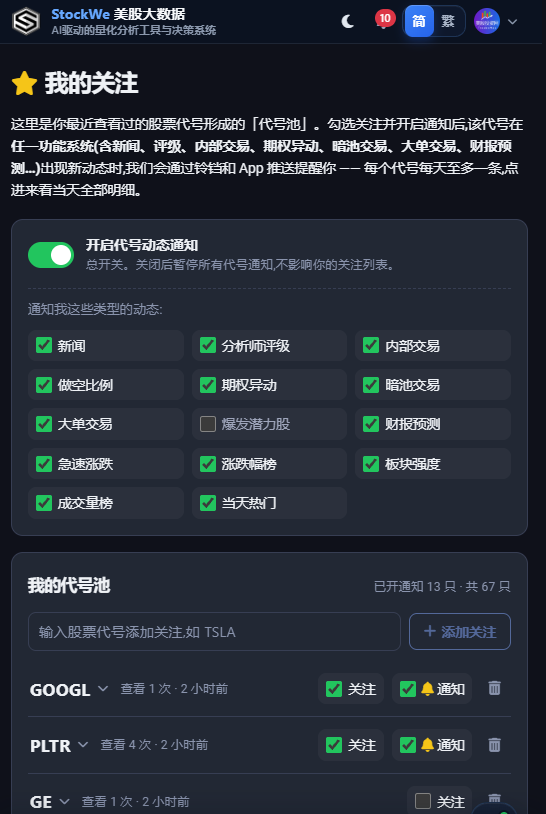
Key updates such as news, analyst ratings, insider trades, short interest changes, option anomalies, dark pool trades, block trades, earnings forecasts, and rapid price swings.
For example, if you track NVDA, you can immediately see today’s news, whether there are any option anomalies, changes in dark pool and block trades, all at a glance.
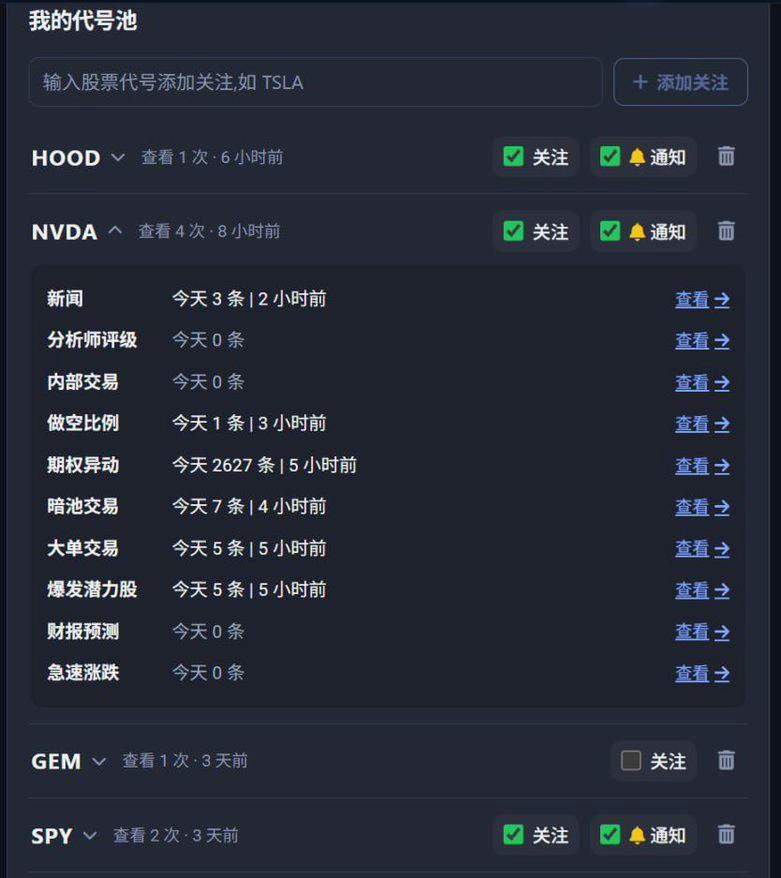
More importantly, once you enable APP notifications, any new developments for your watched stocks will be pushed directly to you.
Previously, you had to hunt for information yourself; now you can let the system track the stocks you want, 24/7 continuous monitoring for you.
For long-term holders, this is an individual stock alert system;
For swing traders and option investors, it’s a real-time anomaly radar.
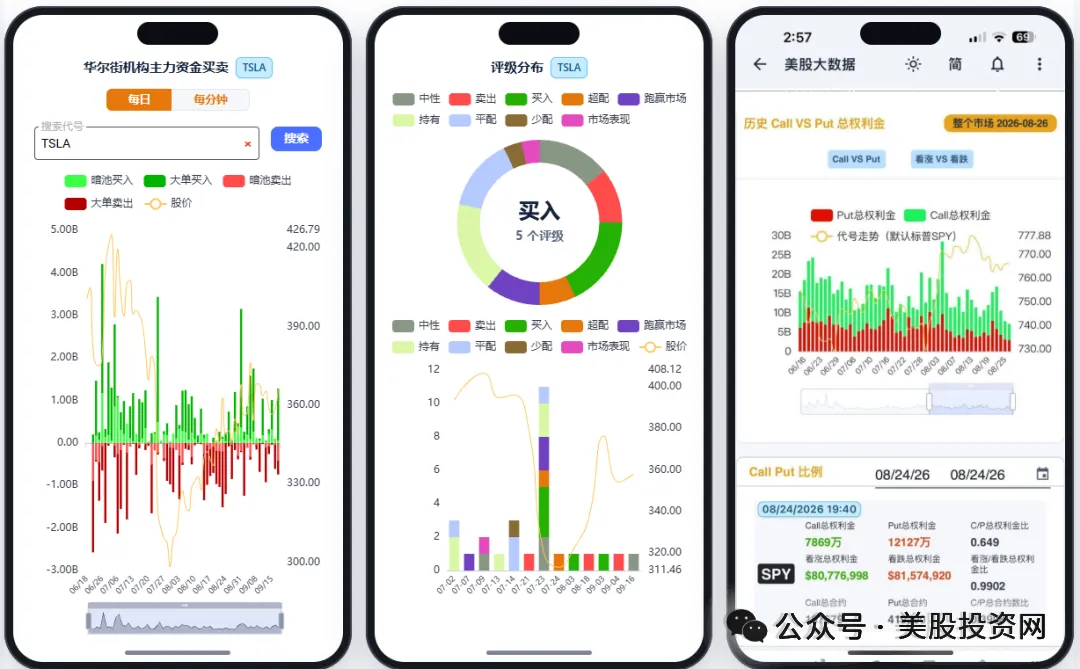
Input a ticker so you’ll never miss another important change.
Click the original link to download the APP





Disclaimer: The content of this article solely reflects the author's opinion and does not represent the platform in any capacity. This article is not intended to serve as a reference for making investment decisions.
You may also like
Pi Network upgrades to Protocol 28 – But PI still can’t shake its slump
Marvell: Surging Forward Guidance – Is It “Confidence” or Just “Wishful Thinking”?
Hertz Global stock jumps 15.08% to $2.06, but remains below the $2.13 50-session EMA
Crypto prices
More


