
Brent Crude Falls Below $99, UBS: Negotiations Themselves Can No Longer Be Ignored, Oil Prices May Remain Under Short-term Downward Pressure

Brent crude oil saw a sharp decline this week as expectations of U.S.-Iran diplomatic engagement and the partial restart of Saudi oil pipelines simultaneously boosted market sentiment, providing a temporary relief to supply tightness.
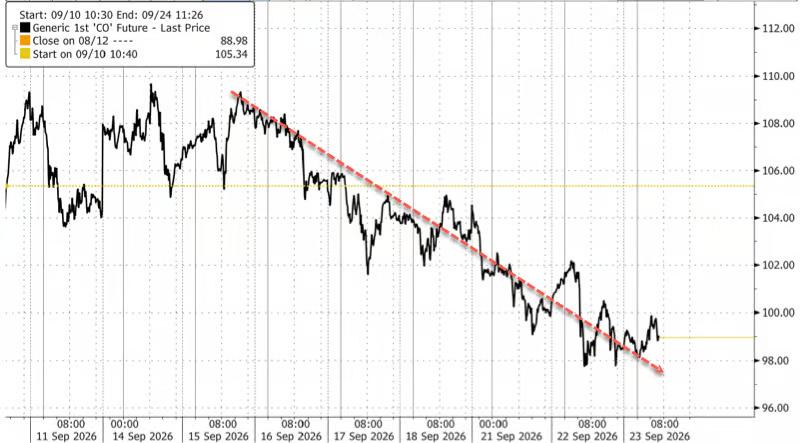
On Wednesday, Brent crude briefly fell to $97.77 per barrel, representing a cumulative drop of nearly 11% from this month's high of $109.65. Saudi officials stated that the east-west oil pipeline could partially resume throughput within days, and exports from Yanbu port would also restart; meanwhile, the U.S. and Iran held a three-hour meeting during the United Nations General Assembly, with Trump describing the talks as "very smooth."
UBS energy expert Dominic Ellis warned that the mere fact that negotiations are taking place cannot be ignored and is expected to continue to put short-term pressure on oil prices. However, if the two sides achieve substantive breakthroughs, Brent could quickly drop back to the $80 range.
The retreat in oil prices provided some relief at U.S. pumps. According to AAA, the national average price for regular gasoline fell to $4.474 per gallon on Wednesday. However, oil prices had still surged 9.3% earlier this month, and the current limited pullback offers little political relief to the Trump administration—oil prices remain well above the politically sensitive $4 per gallon threshold.
Saudi Pipeline Restart Expectations Ease Near-term Supply Pressure
Saudi Arabia announced that crude flows through its east-west pipeline are expected to partially resume within the next few days, with oil loading operations at Yanbu port to restart accordingly. Some Asian buyers have already been scheduled to resume cargo loadings at Yanbu, relieving some of the tightness in the physical market.
According to local media, the full repair of the pipeline could take up to eight weeks. Dominic Ellis from UBS pointed out that even a partial restart is enough to alleviate the most urgent supply bottlenecks in the crude oil market. Since peaking in mid-month, Brent crude has fallen nearly 11%, with this week's drop at about 3.8%.
U.S.-Iran Meeting in New York: The Negotiations Themselves Signal to the Market
According to CCTV News, on September 22 local time, Iranian Foreign Minister Araqchi and U.S. Special Envoy Witkoff met in New York during the 81st United Nations General Assembly.
President Trump said U.S. officials held "very smooth" talks with Iranian representatives on Tuesday during the UN meeting in New York. U.S. Special Envoy Steve Witkoff and Jared Kushner attended the three-hour-long meeting. Afterward, Witkoff said he "felt very good," and posted on platform X expressing hope that these talks "will prove to be constructive and hopeful."
The Iranian side also acknowledged contacts with the U.S. via intermediaries and said it had set conditions for resuming transit through the Strait of Hormuz, stating that if relevant conditions are met, a restart could happen within seven days at the soonest.
UBS: Downward Pressure May Persist, But Negotiation Prospects Remain Uncertain
Dominic Ellis of UBS maintained a cautious outlook on the talks in a client report. He noted that critics would point out similar statements from the U.S. in the past did not lead to concrete diplomatic progress, and that the United States has already rejected Iran’s precondition of lifting the blockade immediately—which is a prerequisite for Iran to reopen the Strait of Hormuz.
Nevertheless, Ellis emphasized, “the mere fact that negotiations are taking place is a development that cannot be ignored and may continue to exert downward pressure on oil prices unless there are explicit signals of stalled progress.” At the same time, he cautioned that if a breakthrough is made, Brent oil prices could quickly return to the $80 zone.
UBS's base case suggests that in the run-up to the U.S. midterm elections in November, the administration has a strong motivation to leverage the ‘carrot’ rather than the ‘stick’. Trump’s recent supportive comments on the U.S. diesel export ban contrast with the Interior Secretary Burgum’s remarks last week that the ban “may not achieve the desired effect,” highlighting growing White House anxiety over high domestic fuel prices. Ellis believes pursuing diplomacy with Iran might be the most convenient way for the Trump administration to lower oil and refined product prices in the short term.
However, in the medium term, UBS judges that Iran’s conditions are unlikely to be accepted by the U.S. “We would not be surprised if the situation returns to the low-intensity conflicts seen in the past month.”
Refining Crisis Shadow Remains, Political Pressure Unresolved
Although the drop from triple-digit oil prices has provided some relief at the pumps, Goldman Sachs energy analyst Nikhil Bhandari stated in a report on Tuesday that the global refining crisis will persist until 2027, putting continued pressure on gasoline and diesel prices.
For the Trump administration, oil prices remain far above the politically sensitive $4 per gallon mark. Whether diplomatic progress can be translated into a substantial agreement will be a key variable in determining market direction and in whether political pressure can truly be alleviated.
Disclaimer: The content of this article solely reflects the author's opinion and does not represent the platform in any capacity. This article is not intended to serve as a reference for making investment decisions.
You may also like
Cryo Cell Stock Surges 17.85% as Bullish Trend Faces Momentum Warning
Cosmos Balance Canada partnership aims to advance tokenized deposits in banking
British Pound cracks as US growth burst boosts USD
Crypto prices
More


