
Former U.S. Congressman Says Individuals Should Hold Gold, World's Largest Asset Bubble Approaching Reckoning Moment

Huitong Net, September 10th—— On Wednesday, the U.S. Treasury officially launched an expanded long-term bond repurchase program, raising the purchase cap to $6 billion in an attempt to stabilize the bond market. However, the market did not respond positively; the 10-year U.S. Treasury yield rose to 4.85%, and the gold price climbed back above $4,400. Former Congressman Ron Paul pointed out that the credibility of government book-keeping of gold reserves is questionable, advocating that individuals should hold physical gold themselves. He also believes that the government's bond repurchase could evolve into a second round of quantitative easing, warning that the world is currently in the largest asset bubble in history, and debt and poor investments will ultimately face liquidation.
On Wednesday morning local time (September 9th), U.S. Treasury Secretary Scott Bessent announced that the cap for the government's long-term bond buybacks would be doubled, to a maximum of $6 billion. Bond buybacks involve the government buying back outstanding Treasury bonds to improve liquidity and lower government financing costs. However, after this policy was implemented, the market did not calm down; the 10-year U.S. Treasury yield rose by about 0.06 percentage points to 4.85%, and spot gold price held steady above $4,400.
Former Congressman Ron Paul, who has long studied the monetary system, gave a strong warning about the current monetary and fiscal system, drawing his views from decades of observation and experience.
Controversy over Fort Knox Gold Ledger, Advocating Public Self-holding of Physical Gold
For decades, Ron Paul has focused on money and gold, and his core view has remained unchanged. He stated,
In August this year, his son, Senator Rand Paul, stayed in the U.S. Gold Reserves Vault at Fort Knox for nearly two hours, publicly confirming that physical gold is indeed stored there. According to the U.S. Mint, the total gold reserves amount to about 147 million ounces, and officially, Congress conducted an audit of the vault in 1974 and performs regular audits. Critics argue that this is not an independent, public bar-by-bar inventory.
Ron Paul did not predict a specific gold price level; his core logic is simple: holding physical gold oneself is far more reliable than trusting others' ledger entries. When asked under what circumstances he would sell his gold, he quoted a friend from the numismatics industry, saying that a true gold believer would not sell gold, and he himself would not either. He also believes that simply raising the statutory price of gold cannot solve the system's underlying problems. Britain tried a similar strategy in the 1920s, which ultimately failed.
Risks Lurking in U.S. Bond Repurchases, Beware of a Second Round of Quantitative Easing
Speaking on the Treasury's bond market intervention, Ron Paul questioned whether the buyback plan would eventually evolve into a second round of quantitative easing. He wondered where the government would find such a huge sum of money. After 2008, the Federal Reserve implemented quantitive easing, with the central bank printing money to purchase bonds—a policy that ended officially several years ago.
He is even more concerned that the Federal Reserve no longer focuses on M1 and M2 money supply indicators. He said that many people care about the growth rates of M1 and M2, and changes in money supply, but now authorities say such metrics are outdated analytical frameworks. However, some, including himself, still believe that total money supply is an important reference. He predicts that such debt market interventions will intensify, and that this approach will inevitably fail, forcing authorities to step up interventions. It will become more and more difficult to disguise the fragility of the monetary system through these operations.
Treasury Secretary Scott Bessent had previously stated in Texas, regarding foreign exchange intervention, that the policies are now under his direction. Ron Paul interpreted this as a publicity tactic, essentially signaling to markets that everything is under control and that he has decision-making power. However, Paul is highly skeptical about current monetary policy-making.
Government-Enterprise Ties Raise Risks, Massive Debt Bubble Will Eventually Burst
Ron Paul pointed out a new development that deserves vigilance: Since 2025, the U.S. government has taken stakes in more than 30 private companies, a model he calls corporatism—where firms are nominally private but effectively guided by the government. He said that government agencies and administrative departments directly acquire shares in corporations and become part-owners. Using early railroad companies as an example, he said that those accepting government funding and regulation mostly went bankrupt, while those refusing government support survived.
Currently, American society frequently discusses “affordability.” He believes such discussions miss the point; people often lament that oil and goods are unaffordable, but rarely realize the root issue is not consumption capacity, but currency devaluation. Brent crude prices topped $100 per barrel for the first time since July, up around 65% for the year; diesel hit record highs; 30-year mortgage rates rose to 6.85%, the highest in over a year. Gulf region geopolitical conflict will transmit through energy prices to mortgages, raising costs across society.
Commenting on the current system, Ron Paul said that this is, in all likelihood, the largest asset bubble in human history. When debt and poor investment accumulate to a certain extent, a market reckoning is inevitable.
Conclusion
Ron Paul's views are rooted in family memory and the experience of the collapse of the Bretton Woods system. He insists on ideas of sound money and freedom. The U.S. Treasury’s bond market rescue has produced limited effects, indirectly confirming the current debt system's fragility. Central banks in many countries continue to increase gold holdings, but Ron Paul reminds investors that balance sheet reserves do not equal physical possession. At the same time, investors should be wary of the inflationary risks that come with sustained government market intervention. Massive debt, distorted investments, and geopolitical disruptions add up to a liquidation risk to the asset bubble, which should remain a focus for all market participants.
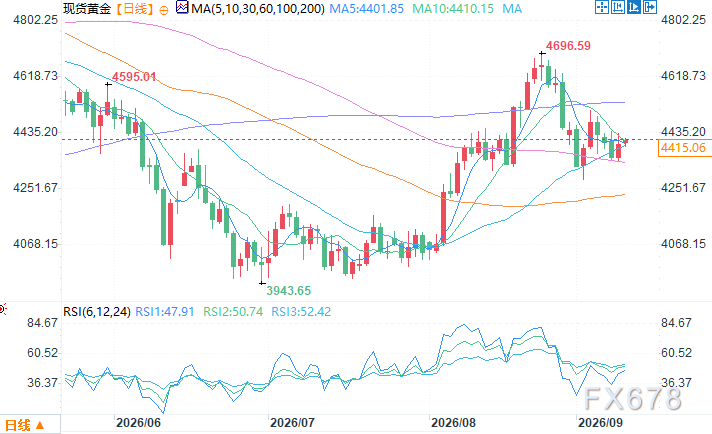
Spot gold daily chart Source: Yihuitong
As of 10:31 AM Beijing time on September 10, spot gold was quoted at $4,414.06 per ounce
Disclaimer: The content of this article solely reflects the author's opinion and does not represent the platform in any capacity. This article is not intended to serve as a reference for making investment decisions.
You may also like
ECB Rate Hike Almost Certain Tonight; Market Focuses on Future Policy Path and Lagarde's Tenure
The European Central Bank will announce its interest rate decision at 20:15 Beijing time on Thursday, and the market generally expects the bank to raise interest rates by 25 basis points.

Solana price holds above key EMAs as trading volume drops and rally pauses
U.S. equity risk premium hits lowest level since 2002, JPMorgan: Impact of rising interest rates will be more painful than in the past two decades
The buffer for risk in the US stock market is running thin. JPMorgan warns that the equity risk premium of the S&P 500 has fallen to 2.1%, its lowest level since 2002, more than 100 basis points below its historical average. The era of low premiums hides three major risks: a systemic increase in the stock market's sensitivity to interest rate shocks; global investors have overweighted equities to a twenty-year high, facing rebalancing pressure; and the strengthening positive correlation between stocks and bonds is causing risk parity strategies to continuously fail. If real interest rates rise further, this silent repricing of valuations may erupt violently.
UK Crime Agency Maps How Crypto Laundering Routes Shift Between Platforms
Crypto prices
More


