
Gold and Silver Prices Rise: Hormuz Strait Risks Offset Interest Rate Pressure

Huitong Network, September 9— During early US trading on Wednesday (September 9), spot gold and silver prices rose. Escalating US-Iran tensions, Brent crude oil breaking above $100 per barrel, together with a weaker dollar, have driven safe-haven buying ahead of this week's US inflation reports. At the time of writing, spot gold was trading near $4413.82 per ounce, up 1.34%; spot silver stood at $67.180, up 2.21% intraday.
During early US trading on Wednesday (September 9), spot gold and silver prices were on the rise. Continuous escalation of US-Iran conflicts, Brent crude oil surging above $100 per barrel, and a weakening dollar all fueled safe-haven demand prior to the release of this week's US inflation reports. Spot gold was trading near $4413.82 per ounce, up 1.34% intraday; spot silver stood at $67.180, up 2.21% during the session.
The market currently sees a tug-of-war between bulls and bears: on one hand, there is safe-haven demand driven by geopolitical risks, while on the other hand, the Federal Reserve still maintains a hawkish stance. Market pricing shows about a 60% probability that the Fed will raise rates by 25 basis points at the September 15-16 policy meeting; the 10-year US Treasury yield is near 4.81%, a new high since October 2023. The US Producer Price Index (PPI) is set to be released on Thursday, while the Consumer Price Index (CPI) arrives on Friday; inflation concerns reignited by oil prices have heightened the market significance of both releases.
In the short term, gold faces both favorable and unfavorable factors, but the environment overall leans bullish: higher oil prices and rising US Treasury yields increase the opportunity cost of holding precious metals; however, inflows of safe-haven funds, a weaker dollar, and concerns over Gulf oil shipping routes offset the negative pressure of higher rates.
Both gold and silver have seen a rebound, but have yet to break through critical technical resistance levels, meaning the upward trend is not yet fully restored. Gold rebounded from the $4347 support level and is testing resistance at $4422; silver has held above $64.73 support, but remains under pressure below $67.21. This performance reflects that the market is buying on dips, taking advantage of geopolitical risk; yet, the follow-up on inflation data will determine whether this rally can continue, or if rate hike expectations from the Fed will stall the momentum.
The Strait of Hormuz is the core geopolitical variable influencing oil prices, inflation expectations, and safe-haven demand. The US military stated that on Tuesday, US forces sank five Iranian oil tankers attacking US Navy ships; in retaliation, Iran struck US military targets in Jordan. Both the US and Iran are trying to assert control over the Strait of Hormuz, through which about one-fifth of the world's oil was transported prior to the outbreak of war. A string of conflicts has pushed Brent crude up to $100.72, and WTI crude was quoted at $95.25 in early trading.
For gold, geopolitical shocks have dual impacts: the Strait of Hormuz crisis boosts safe-haven buying, but higher energy prices also raise inflation expectations, keeping US Treasury yields elevated and sustaining rate hike risks for next week's Fed meeting.
Prior to the US equity market open, global stock markets performed mixed to weak overall. Oil prices surging above $100, together with three-year highs in US Treasury yields, weighed on US index futures. Bond market volatility is pressuring rate-sensitive stocks, though the energy sector receives some relative support. European and Asian markets are also suppressed by higher oil prices and yields, cooling risk appetite as traders await the outcome of US inflation data.
Major external markets: New York WTI crude strengthens, around $95.25 per barrel; Brent crude is at about $100.72. The benchmark 10-year US Treasury yield is near 4.81%, and the US dollar index is weakening.
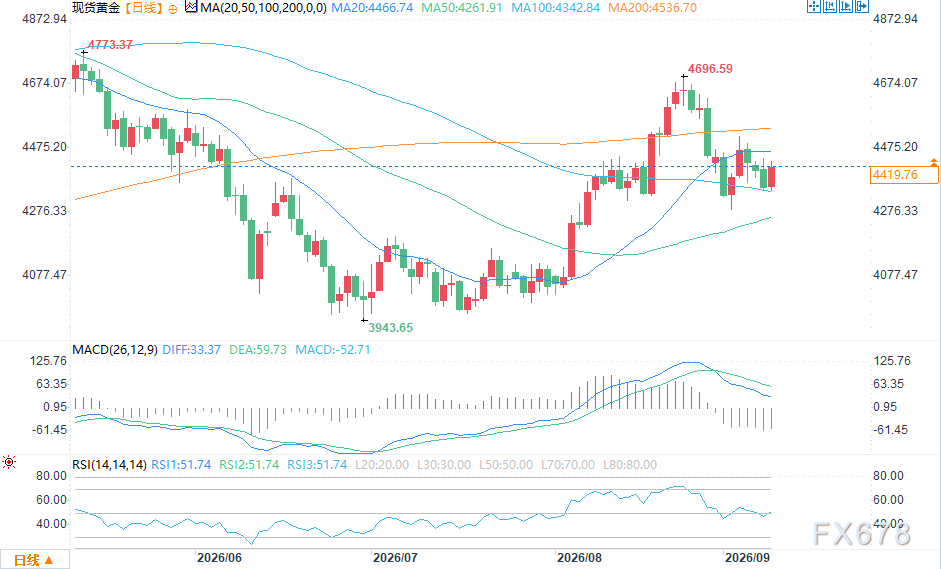
The next upside target for spot gold bulls is to hold above the $4422.00 resistance; a valid break would look towards $4465.00, with the subsequent target at $4512.00.
Short-term downside targets for the bears: if the price breaks below the $4347.00 support, it would next aim for $4290.00, and then $4263.00.
First resistance at $4422.00, followed by $4465.00; first support at $4347.00, then $4290.00.
The next upside target for spot silver bulls is for the price to stand above $67.21; breaking through this level looks to $68.74, with a further target at $70.76.
The bear's downside target: breaking below $64.73 support, with a deeper downside target at $62.57.
First resistance at $67.21, followed by $68.74; first support at $64.73, then $62.57.
Disclaimer: The content of this article solely reflects the author's opinion and does not represent the platform in any capacity. This article is not intended to serve as a reference for making investment decisions.
You may also like
US energy stocks remain "cheap" after surging: High oil prices may lead to a valuation recovery
The Energy Select Sector SPDR ETF, which tracks US energy stocks, has surged over 43% year-to-date, far outperforming other S&P 500 sectors. Despite this, the energy sector remains one of the lowest-valued sectors within the S&P 500. High oil prices have led to excess profits for energy stocks; although Wall Street previously viewed this round of earnings growth as a temporary phenomenon, if elevated oil prices persist longer than expected, the valuation recovery of energy stocks may have only just begun.
Besant brings Peashooter to tank battle, US Treasury repo hits a wall, 10-year US Treasury yield at three-year high
U.S. Treasury bonds are currently facing multiple pressures, including high oil prices intensifying inflation, rising expectations of Federal Reserve rate hikes, soaring fiscal deficits, and large-scale corporate bond issuances. At the same time, the $6 billion buyback scale has fallen short of market expectations. While Bessent had previously made lowering long-term yields a policy goal, on Tuesday he admitted that it's impossible to change the "equilibrium" price of government bonds. Analysts pointed out that buybacks cannot stop the fundamentals-driven yield trends, likening it to "the Treasury bringing a pea shooter to a tank battle."
Scott Bessent’s Treasury to buy back $6 billion in debt after defending yen intervention

Crypto prices
More


