
The Federal Reserve tries to play down the fact that last year the value of global official gold reserves surpassed US Treasuries, marking a definitive strategic shift among global central banks.

Huitong Net, September 7—— An ancient saying reveals the truth: if you need to work hard to explain that something is unimportant, it proves it is already in the spotlight. The US Federal Reserve's recent research note attempts to downplay a milestone event: in 2025, the value of global official gold reserves will formally surpass the scale of foreign official holdings of US Treasuries. While the Fed tries to offer technical arguments, global central banks have made their choice with real money. This is not just a numerical crossover, but a profound restructuring of the global reserve asset allocation logic, marking gold's shift from a marginal asset to a core strategic position.
As the saying goes, the more one tries to conceal, the greater the weight it highlights. When the Fed recently published a rare research note, attempting to "contextualize" the milestone of gold surpassing Treasuries, it precisely confirmed the monumental impact of this event on the existing financial order.
This historic turning point was first detected in 2025 by AzuriaCapitalLLC founder Tavi Costa, and was quickly recognized by authoritative institutions such as the International Monetary Fund.
The Fed's Justifications vs. Unconscious Evidence from Reality
The timing of the Fed's research note is quite delicate, coinciding with the US Treasury's announcement to double the amount of long-term Treasury purchases through a buyback program. Although this has not been officially labeled as yield curve control, the motive behind the move is obvious. If there was sufficient private and institutional demand for long-term Treasuries, the government would have no need to intervene and inject liquidity. This action, in fact, indirectly confirms the market's lack of confidence in long-term Treasuries, starkly contrasting the surging demand for gold.
In response to the fact that gold reserves have surpassed Treasuries, the Fed puts forward two seemingly reasonable technical explanations: on the one hand, the rise in the value of gold mainly comes from price appreciation, not an explosion in central bank purchases; on the other hand, global gold reserves include substantial historical holdings from the Bretton Woods era. These technical arguments do point out some statistical nuances, but cannot obscure the core fact:
Central Banks Vote with Actions: Gold's Strategic Status Is Unshakable
The crossover in numbers may be attributed to price factors, but central banks' actual moves can't be ignored—they are endorsing gold's strategic status with continued purchases. According to the World Gold Council’s "2026 Central Bank Gold Reserves Survey", in the past four years, global central banks bought about 1,000 tons of gold annually—a pace twice the average of the prior decade. This fully demonstrates that central bank gold purchases are not short-term speculation, but the execution of long-term strategies.
Even more noteworthy are market expectations. The survey shows a record 45% of central banks surveyed expect to increase their gold reserves in the next 12 months, and as many as 89% believe that global central bank gold holdings will continue to rise. Looking further ahead, 84% of respondents expect gold’s share in global reserves to increase further in five years; at the same time, 74% believe the dollar’s share will decrease. These figures are not nostalgic memories of the Bretton Woods system, but forward-looking strategic plans by major financial institutions based on future risk assessments—a clear expression of strong confidence in gold.

Beyond the Currency Competition: Reshaping the New Landscape of Global Financial Assets
Of course, it is important to recognize that gold's overtaking in reserve value does not mean the dollar is about to lose its dominant status as the reserve currency, nor does it mean Treasuries suddenly lose their place as the world’s deepest and most liquid financial market assets. The foundational status of the Treasury market remains solid in the short term, but that's not the crux of the issue.
The core significance of this transformation lies not in gold simply replacing the dollar, but in the fundamental change in global central banks' approach to asset allocation. Central banks increasingly regard gold as a strategic monetary asset that stands alongside dollar reserves, and in some marginal areas, gradually replaces traditional dollar reserves. The Fed may try to use technical analysis to dilute the psychological shock of this milestone, but cannot deny the deeper logic behind this trend:
Conclusion
In summary, the Fed's attempt to explain the milestone of gold surpassing Treasuries with technical arguments is ultimately weak. Although the dollar’s status as the reserve currency is hard to shake in the short term, the continued increase of gold holdings by global central banks marks a shift in reserve asset allocation from a single-minded reliance on the dollar to a diversified strategic transformation. Gold's role as a strategic monetary asset is now established; its equal treatment with, and even marginal substitution for, dollar reserves has become an irreversible trend of the era. This contest over value and trust will ultimately reshape the future landscape of global finance.
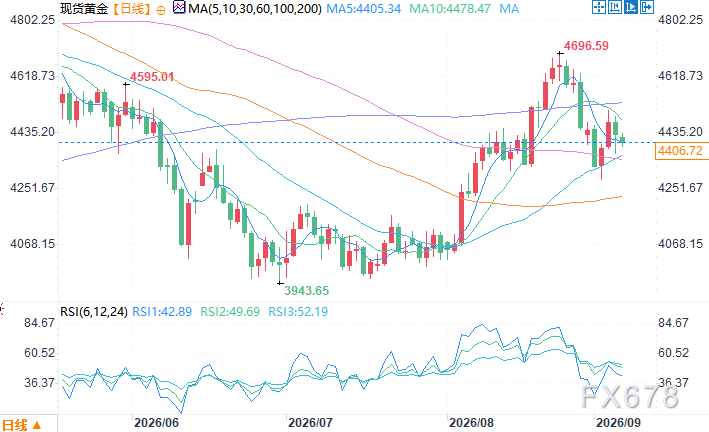
Spot gold daily chart Source: EasyHuitong
As of 10:27 AM on September 7, spot gold was priced at $4,407.72/oz
Disclaimer: The content of this article solely reflects the author's opinion and does not represent the platform in any capacity. This article is not intended to serve as a reference for making investment decisions.
You may also like
A strong nonfarm payroll provides "rate hike" ammunition—will the CPI push the Federal Reserve to pull the trigger? September rate hike scenario faces a critical test
The latest statements from Federal Reserve Chairman Waller and one of the Fed's Board members, Waller, indicate that the burden of proof has shifted—only a significant downside surprise in CPI could prevent the Federal Reserve from returning to rate hikes.

Alex Jones warns of possible XRP restrictions, Vet highlights self-custody security
G7 Sounds the Alarm on Post-Quantum Security

HYPE trades near $86 as ETF inflows slow, institutional exposure rises
Crypto prices
More


