
Nvidia completes the inference loop: collaborates with Equinix and Together AI to open model inference to enterprises


Hard AI
Author | Zhao Ying
Editor | Hard AI
The AI infrastructure arms race is giving rise to a huge and complex structure of off-balance-sheet risk exposure, which is almost invisible in traditional financial statements.
Morgan Stanley’s latest research report points out that hyperscale cloud providers and chip giants such as Google (GOOGL), Meta, Amazon (AMZN), Microsoft (MSFT), Oracle (ORCL), and Nvidia (NVDA) now have more than $1.3 trillion in long-term commitments—of which procurement commitments exceed $640 billion and lease commitments are about $675 billion. These commitments mostly fall outside the balance sheet, making it difficult for investors to accurately assess the true leverage levels of these companies, whose off-balance-sheet leverage growth has far outpaced on-balance-sheet leverage.
From a cash flow pressure perspective, the scale of commitments at some companies is striking: Meta’s total lease and procurement commitments are about 1.7 times its expected operating cash flow over the next 12 months, while Oracle’s ratio is more than 7 times. These commitments are often deeply tied to infrastructure financing, and if AI demand expectations reverse, there will be very limited room for renegotiation.
If computing demand consistently exceeds supply, these contracts will serve as a competitive advantage for locking in scarce resources. But if the expected demand is revised downward, many commitments have already been embedded in developer, supplier, private credit, and public bond financing structures, making renegotiation or exit difficult.
01
Procurement commitments: sixfold growth in five years, a double-edged sword for locking in the supply chain
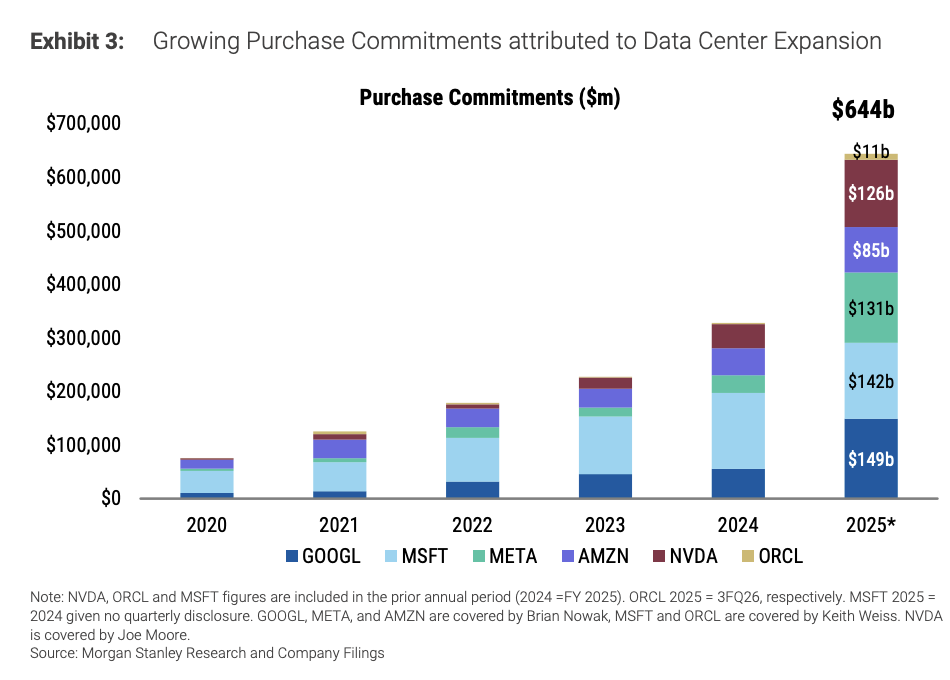
Procurement commitments are the most direct off-balance sheet pressure. The AI data center expansion wave has caused a sharp rise in procurement commitments for hyperscale cloud providers and Nvidia.According to Morgan Stanley’s statistics, the latest disclosed procurement commitments from these six companies have exceeded $644 billion, a more than twofold increase over a year ago and roughly a sixfold increase compared to five years ago. These commitments include GPU, memory, land, power, data center shell leases, and other infrastructure components.
According to US GAAP and SEC regulations, companies are required to disclose "unconditional purchase obligations," i.e., irrevocable commitments to pay for fixed or minimum quantities of goods or services. However, before the delivery of the goods or services, these obligations are typically not recognized on the balance sheet and are only disclosed in the footnotes.
Nvidia's situation is particularly noteworthy. To secure foundry capacity and memory supply, Nvidia has moved to purchase inventory significantly in advance. As of January 2026, its inventory and related procurement commitments have risen to about 32% of the market's expected FY27 revenue, compared to a historical range of just 15%–20%. Morgan Stanley points out that this strategy puts Nvidia in a favorable position to meet demand, but also amplifies downside risk should demand soften.
02
Compute capacity arrangements: massive commitments off the balance sheet
Cloud capacity arrangements are another key structure. Suppliers commit to providing compute resources for a certain period, while customers agree to minimum consumption. As long as contracts don’t specify a particular GPU or rack and customers can’t control the use of specific assets, many compute agreements are not treated as leases.
This means that minimum payments may not qualify as lease liabilities. Only when customers actually use the capacity and receive invoices do related costs appear in the profit and loss statement or as payables.
In terms of disclosures, Nvidia has $27 billion committed in cloud service agreements and Oracle has $10 billion arranged in cloud capacity. Meta does not provide a specific figure but mentions that its $131 billion in contract commitments includes third-party cloud capacity arrangements. Take-or-pay agreements also fall into this category:The buyer must either purchase a minimum volume of services or pay the minimum amount. Suppliers can use these contracts to support infrastructure financing, while the customer sacrifices exit flexibility.
"Take-or-Pay" contracts are a typical form of this arrangement, requiring the buyer to pay a minimum amount regardless of actual usage. An example is the agreement between Microsoft (MSFT) and CoreWeave (CRWV)—CRWV discloses that most of its revenue comes from long-term, take-or-pay contracts and that these serve as underlying assets to back its data center financing debt. This means that if demand expectations change, renegotiating these contracts is extremely difficult because they are already embedded in third-party financing structures.
03
Lease commitments: $675 billion yet to enter the balance sheet
Leasing itself is not new. Both operating and finance leases are recorded on the balance sheet once they begin. As of the latest disclosure, MSFT, ORCL, META, AMZN, and GOOGL already have about $82 billion in finance lease liabilities and $175 billion in operating lease liabilities on their books.
The truly large amount lies in leases yet to start: about $675 billion, an increase of $435 billion from the previous year's $240 billion. Many of these are long-term data center shell leases, signed to support developer financing, but remain off the balance sheet until the lease actually commences. As data centers are delivered, these will gradually be brought on balance sheet.
Of these, Oracle’s yet-to-start lease commitments amount to $261 billion, Microsoft $155 billion, Meta $104 billion, Amazon $96 billion, and Google $59 billion. Google and other companies disclose that their outstanding lease commitments will be brought onto the balance sheet gradually by 2031.
In addition, accounting rules allow various types of lease payments to remain off-balance-sheet, such as variable lease payments (like electricity, maintenance, etc.), renewal options (only included when it is "reasonably certain" to be exercised), residual value guarantees (RVGs), and third-party lease endorsements and guarantees. For example, variable lease payments already account for 30% of Google’s total lease costs, about 25% for Meta, over 10% for Amazon, and with further new data center leases beginning, these ratios are expected to climb further.
04
Guarantees and residual value guarantees: putting risk in the “possible” drawer
A residual value guarantee is when a lessee promises that the end-of-lease value of an asset will not fall below a certain level; if it does, the lessee pays the difference. It is similar to a contingent liability, but is only included as a lease liability if payment is deemed probable. Such structures already exist in Meta’s transaction with Blue Owl Capital.
For third-party lease endorsements, Google (Alphabet) is unique in scale. According to Morgan Stanley, Google has currently provided about $17 billion in lease endorsements to bitcoin mining companies building data centers, involving Cipher, Hut 8, TeraWulf, and Flash Compute across four projects, and covering over 1,000MW of compute capacity. These endorsements are usually matched to project-level construction debt and are effective upon lease commencement, amortizing gradually over time.
According to US GAAP, the above endorsements are not recognized on the balance sheet until it is "probable" that payment will occur. However, rating agencies are more cautious. S&P has stated that once the endorsement becomes effective (i.e., lease commencement), it will adjust Google’s reported debt; and in a credit Q&A in December last year, S&P indicated that, when guarantees have key importance for the counterparty’s financing, it may adjust net-of-tax debt accordingly (e.g., $100 contingent guarantee corresponds to about $79 debt adjustment).
05
Power purchase agreements: billions in implicit cash outflows
Data centers lack more than just GPUs—they are also short on power.
To meet the power demands of AI data centers, hyperscale cloud providers are rapidly signing long-term power purchase agreements (PPAs), with contract terms as long as 20 years. These contracts typically secure a fixed supply of electricity at a fixed price, ensuring energy producers recoup costs and make a reasonable profit, while also providing credit support for infrastructure financing.
Typical cases include: Microsoft’s 20-year PPA with Constellation Energy to support the Three Mile Island nuclear plant restart; Google’s cooperation with NextEra Energy to restart the Duane Arnold nuclear plant in Iowa; Meta’s 20-year agreement with Vistra Corp involving more than 2,600MW of zero-carbon electricity. According to Morgan Stanley utility analyst David Arcaro, Meta’s single PPA with Vistra alone will cost an estimated $7–8.6 billion over 20 years, or about $350–430 million per year.
In accounting treatment, PPAs may be classified as leases, purchase commitments, or derivatives depending on contract terms, leading to inconsistent disclosures. Google disclosed a 20-year, $990 million PPA signed in January 2026 that will be treated as a lease. Meta, however, stated that some of its PPAs cannot reliably disclose future liability amounts as there are no fixed or minimum usage commitments.Morgan Stanley notes that, regardless of accounting treatment, before power is delivered or the lease commences, these commitments are not recognized on the balance sheet, resulting in a large amount of opaque future cash outflows.
06
SPV is not magic: most chip financing will still become a debt risk
Highly-rated cloud vendors can buy chips with cash and public debt, while high-yield or unrated AI infrastructure companies rely more on asset-backed structures. Common practices include: SPV loans backed by take-or-pay compute contracts, customer prepayments, chip leasing through SPVs, and other supply chain financing or securitization arrangements.
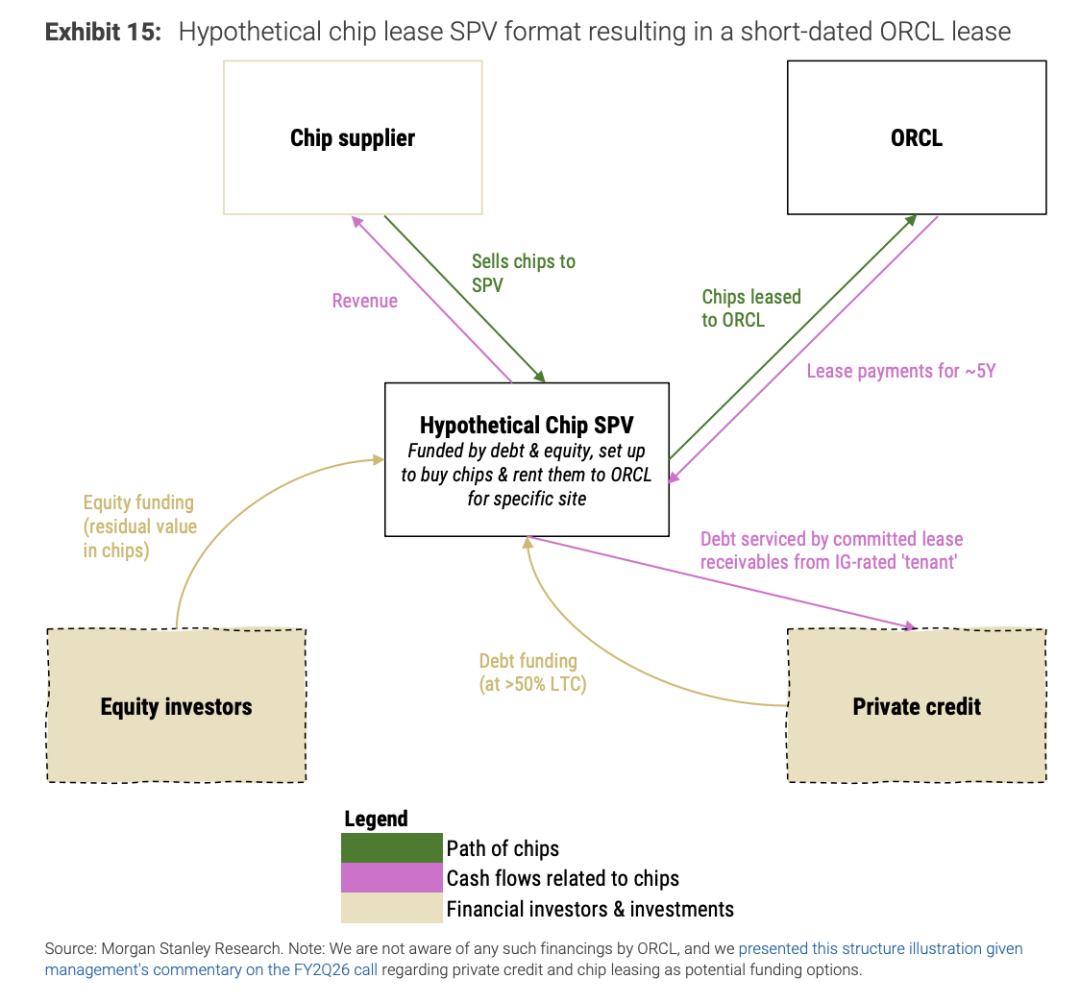
The key issue is not whether an SPV exists, but who bears the risk. If the SPV’s debt is unconditionally guaranteed by the parent, it still appears on the parent’s balance sheet. If recourse is limited and there are long-term purchase contracts with highly creditworthy customers, it is more likely to stay off-balance-sheet for accounting, but rating agencies may still treat it as debt-like due to economic dependence and potential parent support.
Customer prepayments help reduce short-term cash flow pressures for GPUaaS providers and may be recorded as deferred revenue—not treated as debt, but still factored into credit assessment. Chip leasing is more direct: post-lease commencement, it appears on the balance sheet; before that, it remains off.
This is also the most critical risk to watch in the AI capital cycle: the money is already committed, but the risk is scattered across procurement obligations, uncommenced leases, variable payments, PPAs, guarantees, SPVs, and rating adjustments. When analyzing AI companies, don't just look at debt on the balance sheet. In coming years, numbers in the footnotes may reveal before the debt section who is making the boldest bets on AI demand.


Disclaimer: The content of this article solely reflects the author's opinion and does not represent the platform in any capacity. This article is not intended to serve as a reference for making investment decisions.
You may also like
Ripple’s David Schwartz calls breakaway Bitcoin fork an attack after BIP-110 split
BTC Price Hits $81,400 as ETF Inflows Return, but RSI Flashes Overbought
SUI price climbs 7.5% as Kravata launches payments for 5M LatAm users
Gold, silver rally as Fed’s Waller cuts September hike odds - Kitco PM Report
Crypto prices
More


