
U.S. Treasury yields retreat and the dollar weakens, gold returns to around $4,400, awaiting non-farm payroll data

Huitong Network, September 3— Gold rebounded after nearing a one-month low, supported mainly by simultaneous pullbacks in the US dollar and US Treasury yields. However, the Middle East situation has driven up energy prices, suppressing expectations for inflation and the Federal Reserve's room for rate cuts. Currently, the market expects the probability of a Fed rate hike this month to rise to 62.3%. With the US August nonfarm payrolls report about to be released, gold remains in a short-term tug-of-war between bulls and bears.
International gold prices rebounded during the Asian session on Thursday from near a one-month low, with spot gold returning to around $4,400. Previously, gold prices were under pressure, mainly due to the strong dollar and the rapid rise in US long-term Treasury yields. As the US Dollar Index and Treasury yields pulled back from recent highs, the actual holding cost of gold decreased, attracting some dip buyers back into the market and providing short-term support for gold prices.
US Treasury yields had previously risen to multi-year highs before retreating. New York Fed President John Williams stated that the recent rise in long-term Treasury yields is not mainly due to inflation expectations getting out of control again, but rather reflects the continued resilience of the US economy. Economic growth, investment demand, and geopolitical factors may all drive long-term rates higher, while inflation trends themselves are gradually cooling down.
This statement has a dual implication for gold. If yields are rising mainly due to growth expectations rather than worsening inflation expectations, gold’s inflation-hedge demand may be limited. But on the other hand, if the market consequently reduces concerns over further aggressive Fed tightening, the upside for real interest rates and the US dollar may be constrained, providing some breathing room for gold.
Another core variable in recent gold price moves comes from the Middle East situation. After the US launched a new round of airstrikes on Iran-related targets, Iran responded by striking US-related targets in Bahrain, Kuwait, Jordan, and Iraq, reigniting market fears of further regional escalation. Meanwhile, ongoing security risks in the Strait of Hormuz remain a focal point for the energy market.
Rising energy prices are impacting gold through another channel. Higher crude oil prices could push global inflationary pressures back up, forcing the market to reassess the path of monetary policy over the coming months. While gold is often seen as a key asset against inflation risk, it does not generate interest income. As market interest rates remain high, the opportunity cost of holding gold also increases accordingly.
Investors currently estimate the likelihood of a Fed rate move this month at around 62.3%, noticeably higher than at some previous points. If this expectation continues to heat up, the US dollar and Treasury yields may regain upward momentum, exerting pressure on gold. Conversely, if US employment data clearly weakens and the market returns to betting on easier monetary policy, gold could find new upside catalysts.
The US August nonfarm payrolls data will be one of the most important macro events in the near term. Labor market performance will not only directly affect the Fed's assessment of economic resilience but will also transmit to gold via three channels: the dollar, Treasury yields, and real interest rates. If job growth is significantly below market expectations and unemployment rises, investors may add bets on policy easing, giving gold potential for continued rebound; if the jobs data is strong, it may reinforce prospects for high rates to be sustained longer, thus capping gold's rebound space.
Currently, the gold market is in a phase with a high concentration of macro variables. On one hand, geopolitical risks continue to provide safe-haven demand; on the other, higher energy prices may push up inflation and limit room for monetary easing. Meanwhile, Fed officials' emphasis on the US economy's strength also means the market cannot simply interpret current high yields as a precursor for a policy pivot.
From the daily structure perspective, spot gold rebounded near $4,380 after a quick previous decline and is still trading above the 100-day simple moving average, with the medium-term structure remaining intact. However, gold is still below the middle Bollinger Band, indicating that bulls have not yet regained trend control in the short term. The 14-day RSI is around 50, signaling neutral market momentum, suggesting that subsequent direction will depend heavily on macro data catalysts. On the upside, focus on resistance around the $4,450 Bollinger Band midline. If effectively breached, look for a further test of the upper Bollinger Band near $4,685. On the downside, watch the 100-day moving average support near $4,360; a break here could see gold retest the lower Bollinger Band near $4,215.
On the 4-hour chart, after a continuous decline, gold has seen technical rebound and short-term bearish momentum has slightly weakened, but the current rebound still lacks clear trend confirmation. Further declines in the dollar and Treasury yields will favor gold's rebound to $4,450. If there is an effective 4-hour break of $4,450, the short-term technical structure could further improve. Conversely, if the price falls back below the $4,380–$4,360 support area, this rebound may be mostly short-covering, with further downside risk toward $4,300 or even $4,215. Thus, the short-term gold bull-bear boundary remains near $4,360, while the focus on the upside is whether $4,450 can be effectively broken.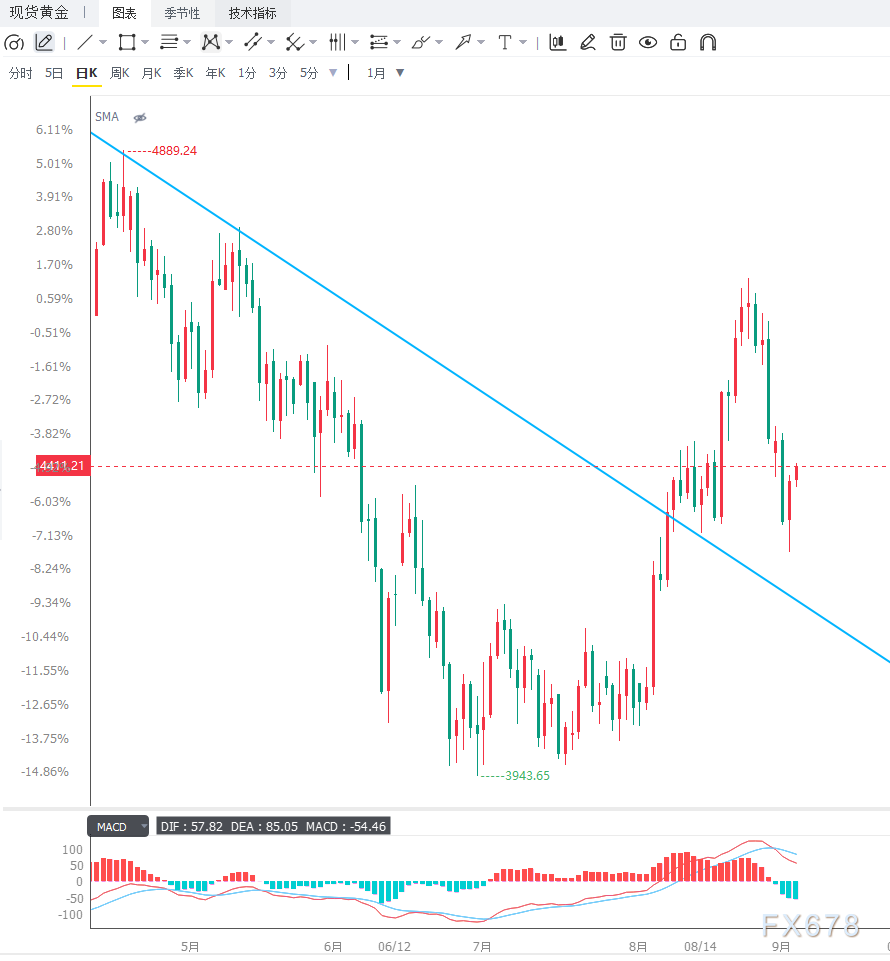
Gold’s current rebound is still largely a technical correction after the dollar and Treasury yields retreated; although safe-haven demand driven by the Middle East remains, inflation pressure from rising oil prices may limit the Fed’s scope for a policy pivot, so it remains difficult for gold to form a unilateral rally in the short term. In the future, the market focus will be on the US August nonfarm payrolls data and the linkage between the dollar and Treasury yields. If softer labor markets drive yields lower, gold could retest $4,450 and further expand its rebound space; if employment remains strong and high-rate expectations are enhanced, gold may test support at $4,360 again. Ahead of macro data releases, gold will likely maintain high volatility, and special attention should be paid to price risks from sharp, opposite swings in the dollar and yields after data is released.
Disclaimer: The content of this article solely reflects the author's opinion and does not represent the platform in any capacity. This article is not intended to serve as a reference for making investment decisions.
You may also like
B HODL stock performance jumps 67% while Bitcoin treasury sits 29% underwater
Coldcard Bitcoin theft: hacker moves 10% of $114.7M, 90% still untouched
Solana trades near $100 with key support at $94.83 as bulls eye breakout
Gold climbs as Yen-led US Dollar decline outweighs hawkish Fed expectations
Crypto prices
More


