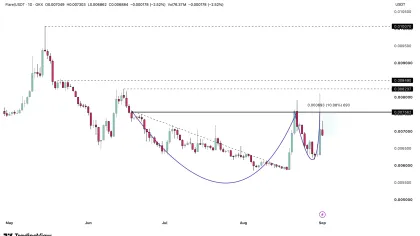
The broader market pressure has hit Polygon [POL] the hardest. As a result, the altcoin experienced strong downward pressure, breaching the $0.1 support and falling to a low of $0.093.
As of this writing, POL was trading around $0.094, down 8.9% on the daily charts. However, altcoin’s trading volume climbed 54.8% to $87.6 million.
The rising volume during a price pullback often suggested increased activity on the sell side as investors reduce their exposure.
Polygon is under intense selling pressure
As POL continued to slip, investors across the market have continued to exit their positions. Firstly, on the spot side, the Spot netflow turned positive after early dropping.
As of press time, Spot netflow was around $849k. A positive netflow suggested that more funds entered exchanges.
Often when holders cash out during a downtrend, it reflects fear and lack of confidence. Often, increased profit realization during a period of extended weakness has preceded more losses.
Derivatives are even more bearish
On the derivatives market, sellers are even more aggressive. According to Coinalyze data, Polygon Perpetuals recorded 46.79 million in sell volume compared to 43.2 million in buy volume.
At the same time, delta dropped to the negative zone, falling to -9.8 million, while net buying was also negative at -98 million.
With both the Delta and net buying holding negative, it suggests that most traders closed their Perps positions.
On the Futures side, the same pattern was observed. Polygon saw $23.6 million in Futures outflows compared to $22.1 million in Futures inflows.
The Netflow dropped to -$1.55 million, a trend that has held over the past five days. The period of higher outflows has coincided with price decline.
What’s next?
Driven by intense selling pressure, Polygon’s downside momentum has strengthened significantly. For that reason, the altcoin’s MACD formed bearish pressure, falling to 0.007, confirming weakening bullish momentum.
At the same time, the positive index of ADX DI also continued to decline, falling to 35. A falling DI+ while the ADX is rising and D- indicates weakening upside while downside is strengthening.
With these two indicators falling, the signal is the likelihood of the prevailing trend continuation. Therefore, if bears continue to exert more pressure, Polygon will fall below $0.09 with $0.082 as the next support.
However, to invalidate this bearish pressure, POL needs a daily close above $0.1 and to reclaim $0.12 resistance
Final Summary
- POL dropped 8.9%, breaching $0.1 support, falling to a low of $0.092, as bears eye a drop to $0.082.
- Polygon continued to decline, mostly driven by strong selling pressure across the market.