
web3: After LINK surpassed $9, whale accumulation increases market attention

LINK has ended its consolidation range since June, rebounding from a low near $7 and breaking above the $9.04 resistance level, now hovering around $9.45. With the price moving above the previous range high, the market is now watching whether this upward move can continue, instead of being just a short-term spike.
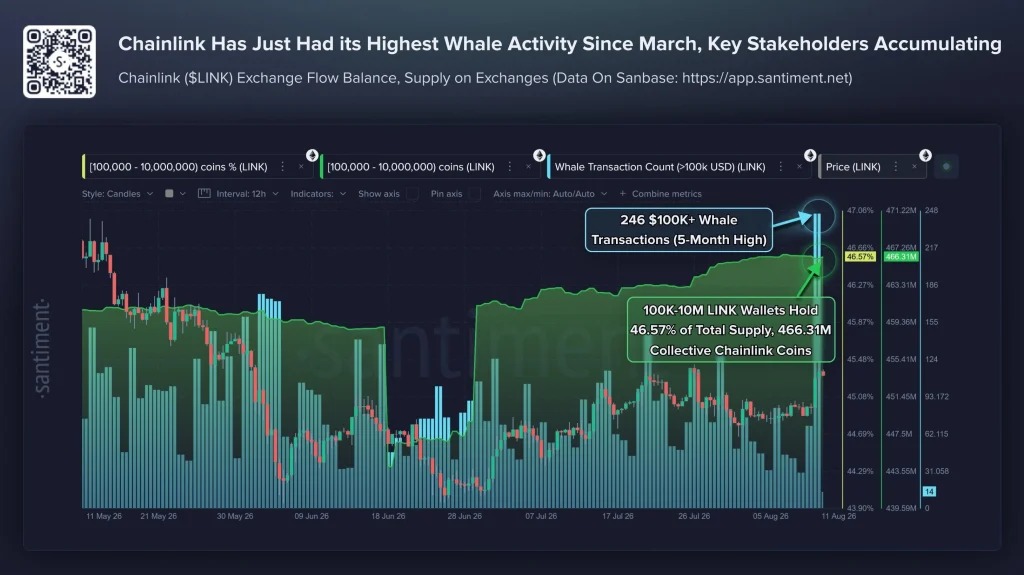
Whale transactions reach 5-month high
On-chain data platform Santiment shows that LINK transactions over $100,000 have reached 246, the highest level since March. Meanwhile, addresses holding between 100,000 and 10 million LINK now control about 46.57% of the token supply, equivalent to around 466.31 million LINK.
The increase in activity among large holders coincided with LINK approaching and breaking through the $9.04 resistance, rather than during the previous decline. This suggests that significant capital participation has mostly come after the price has started to recover.
Capital inflows remain strong
From a technical indicator perspective, the CMF (Chaikin Money Flow) is at 0.18, indicating capital is still flowing in on net. The Relative Strength Index (RSI) has risen to 71.40, reflecting strong short-term momentum but also suggesting the market is turning somewhat overheated.
This combination usually means buying interest remains, but short-term consolidations or partial retracements can also occur. For the current trend, $9.04 has shifted from previous resistance to the first key support level. If price continues to hold above this level, the breakout structure is more likely to be confirmed by the market.
$9.97 becomes the next resistance level
Looking ahead, the market is first watching the $9.97 level, which is LINK’s next major short-term resistance. If price breaks through further, the $10 mark will become an even more closely watched psychological threshold.
If buying continues, $10.80 will be the next higher resistance area. If the trend pulls back, then the $8.58 to $8.49 range is the support band to watch below. As long as this region is not clearly broken, the current recovery structure still has a chance to hold.
Disclaimer: The content of this article solely reflects the author's opinion and does not represent the platform in any capacity. This article is not intended to serve as a reference for making investment decisions.
You may also like
Pons: $20.93 million has been paid to token creators over the past 47 days
XRP’s Crazy August Is Almost Over – September Could Be Even Bigger
Crude oil is "coming back", but refined oil is "not coming back"; the global refining gap is widening.
According to Goldman Sachs, global refined oil exports have declined by about 6 million barrels per day year-on-year, with the Gulf region and Russia contributing three-quarters of the decrease. Unlike crude oil, which can be rerouted, damaged refineries cannot be relocated, and the Gulf region's refined oil exports have only recovered to 40% of pre-war levels. Goldman Sachs expects global refinery utilization rates to recover only by the second half of 2027; based on this, it has more than doubled its forecast for diesel profit margins in 2027.
Data: Detected an outflow of 35.11 million USDT from a certain exchange
Crypto prices
More


