

-
DEXE's correction coincided with one of the largest exchange inflows of 2026, reinforcing signs of distribution after its record-breaking rally.
-
Injective recorded the second-largest exchange inflows, while CRV and UNI saw heavy outflows, hinting at a rotation within DeFi.
The DeXe price extended its sharp decline on Tuesday after one of the strongest rallies in the crypto market earlier this month. The token has erased more than 85% after surging more than 115% in early July. The latest on-chain data from Santiment may explain the shift in sentiment. The analytics platform flagged DEXE and Injective (INJ) as the DeFi tokens with the largest exchange inflows of 2026, while others recorded substantial exchange outflows. Now the question arises: is the DEXE price heading back to $1?
Santiment Data Signals Diverging Liquidity Flows Across DeFi
Santiment’s latest exchange flow data showed a clear split among leading DeFi tokens, with DeXe (DEXE) and Injective (INJ) recording the largest net inflows to centralized exchanges in 2026. DEXE led the list with approximately 261,000 tokens moving onto exchanges, followed by 1.8 million INJ.
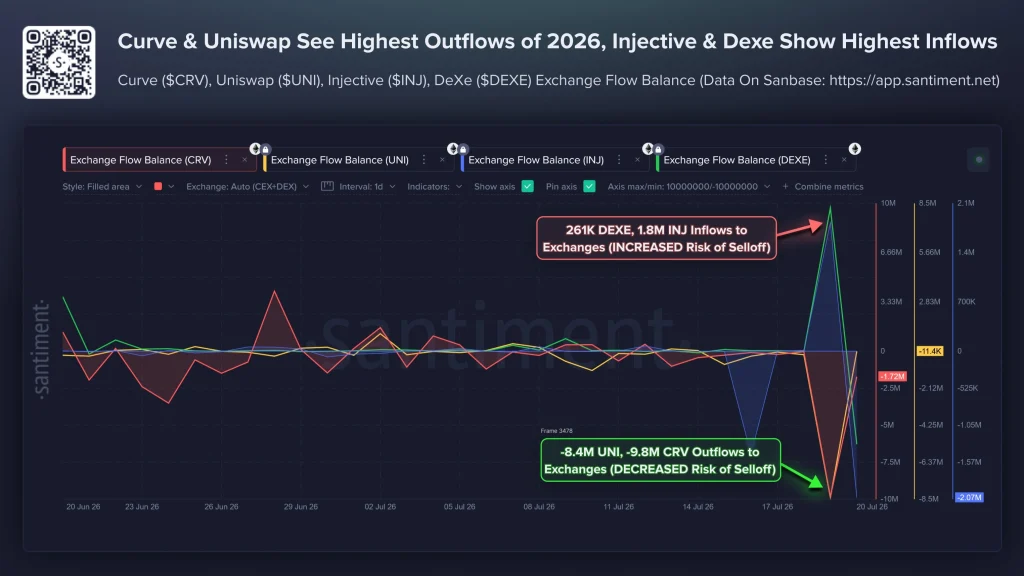
In contrast, Curve (CRV) and Uniswap (UNI) registered the largest exchange outflows, with nearly 9.8 million CRV and 8.4 million UNI withdrawn from trading platforms. Unlike inflows, exchange outflows are generally viewed as a sign that investors are transferring assets into self-custody or staking, reducing the immediate supply available for sale.
The divergence suggests traders are becoming increasingly selective rather than broadly bearish on the DeFi sector. While capital appears to be flowing away from recent outperformers like DeXe and potentially Injective, investors continue to accumulate or hold tokens such as Curve and Uniswap.
DEXE Price Analysis: Selling Pressure Intensifies as Open Interest Surges
DeXe’s price action confirms the bearish signals emerging from the exchange flow data. After rallying to a record high above $49, the token witnessed a sharp breakdown, plunging nearly 24% in a single daily session to around $4.64. The move was accompanied by one of the largest daily trading volumes in recent months, highlighting aggressive selling activity rather than a gradual decline.
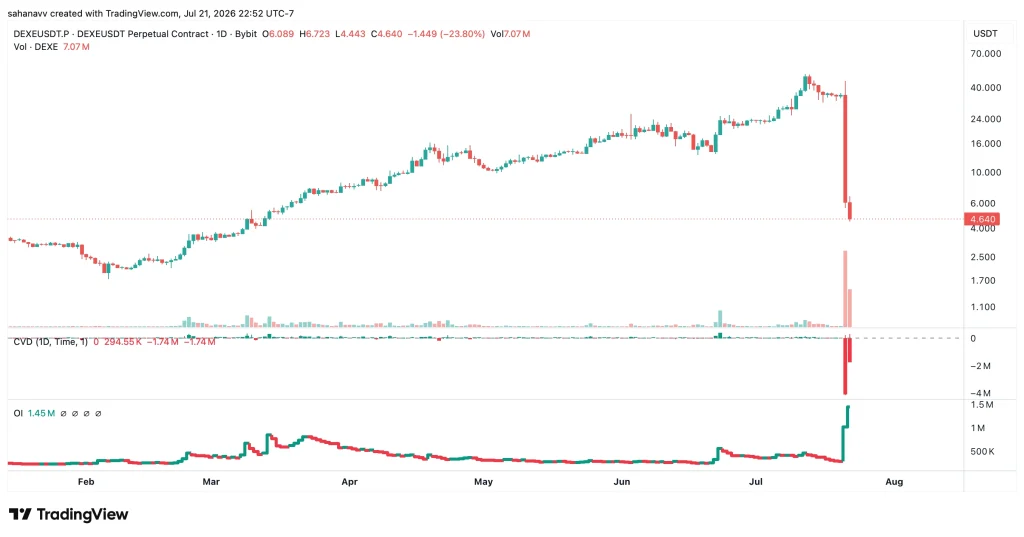
The CVD recorded a sharp negative spike, indicating that market sell orders significantly increased, signalling sellers remained firmly in control. Meanwhile, Open Interest (OI) surged to its highest level in months despite the collapse in price. Rising open interest during a sharp decline often indicates that new leveraged positions are entering the market rather than existing positions simply being closed.
The combination of heavy exchange inflows, rising trading volume, negative CVD, and a spike in open interest paints a consistent picture of increasing bearish participation.
The Bottom Line: Is Injective Next?
DeXe’s sharp correction highlights how quickly market sentiment can shift once exchange inflows begin accelerating after an extended rally. The combination of rising exchange deposits, weakening order flow, and aggressive selling suggests traders have already started locking in profits, turning one of July’s strongest performers into one of its biggest laggards.
Injective now finds itself under similar on-chain conditions. Santiment’s data shows 1.8 million INJ recently moved to exchanges, the second-largest exchange inflow among major DeFi tokens. This raises the possibility that traders are positioning for profit-taking if bullish momentum continues to fade. At the same time, the contrasting exchange outflows from Curve (CRV) and Uniswap (UNI) indicate that this is not a broad-based exit from DeFi. Instead, capital appears to be rotating within the sector.


