
Bonzo Lend loses $9M in oracle exploit on Hedera

Hedera-based lending protocol Bonzo Lend lost about $9 million after an attacker manipulated the price of SAUCE used as collateral, allowing the account to borrow assets far beyond the value deposited.
In a preliminary incident report published Saturday, Bonzo said the attacker deposited 250 SAUCE, worth only a few dollars, before submitting a price update that inflated the token’s value by roughly 12 orders of magnitude. The wallet then borrowed 6.63 million USDC and 34.5 million wrapped HBAR from the lending pool.
The case illustrates how oracle failures can turn low-value collateral into a tool for draining large amounts of liquidity from lending protocols, even when the application and underlying network continue operating as designed.
Bonzo attributed the incident to a flaw in Supra’s on-chain oracle verifier, which accepted a manipulated SAUCE price carrying a zeroed signature. The protocol said Supra acknowledged the issue and deployed a fix, while stressing that the incident was not a vulnerability in Bonzo Lend’s contracts or Hedera’s core network.
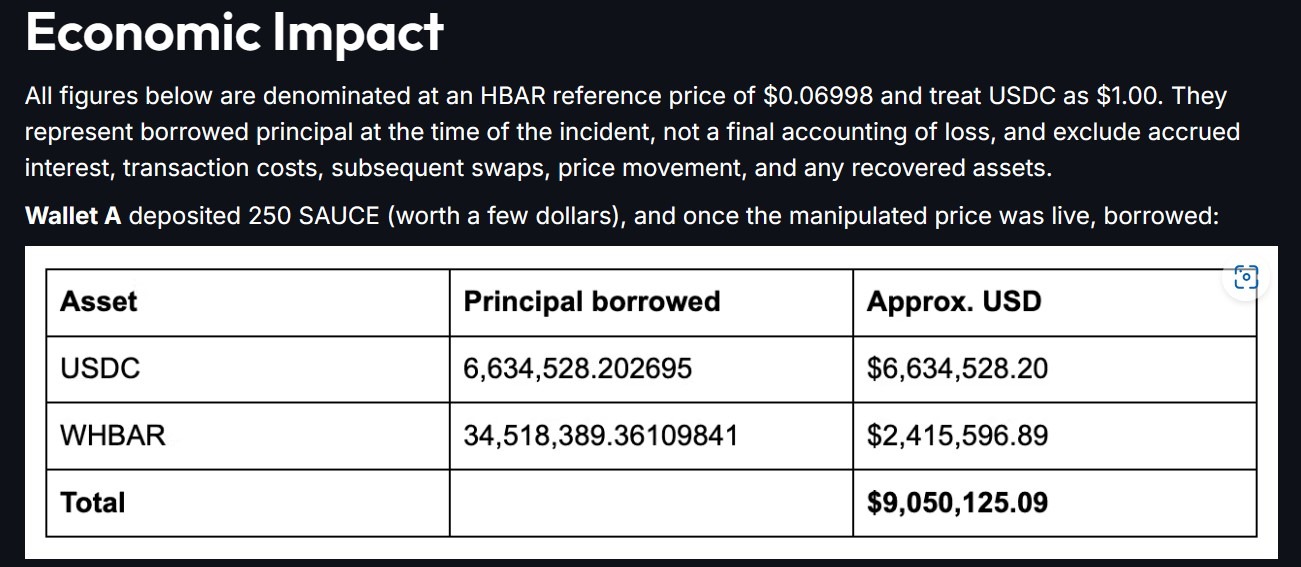
Estimated economic impact of the incident. Source: Bonzo Finance
DeFi hacks continue to pressure the sector
The incident adds to a growing number of exploits targeting decentralized finance (DeFi) protocols in 2026.
The second quarter had become the most-hacked quarter on record by incident count, with 83 exploits and about $755 million stolen. Cross-chain bridge exploits accounted for $351 million, while compromised administrator attacks and fake token price manipulation represented 37% of quarterly losses.
In 2026, DeFi’s total value locked (TVL) had fallen 39% to over $70 billion in June from about $115 billion in January. CryptoRank recorded 121 hacks and roughly $942 million in losses over the period, saying repeated security incidents likely weighed on user confidence and reinforced capital outflows.
The Bonzo incident also follows a similar collateral-pricing exploit on Stellar. In February, attackers drained roughly $10 million from a YieldBlox DAO-managed lending pool after manipulating the price path used to value USTRY collateral, allowing them to borrow assets beyond the token’s real worth.
Disclaimer: The content of this article solely reflects the author's opinion and does not represent the platform in any capacity. This article is not intended to serve as a reference for making investment decisions.
You may also like
XRP Outperforms Bitcoin and Major Stocks Over 10 Years but Numbers Are Easy to Misread
Federal Reserve Chair Waller: Number of Rate-Setting Meetings Will Be Reduced in Coming Years
Federal Reserve Chair Walsh pointed out that although eight meetings per year is "an appropriate number" for the FOMC, starting in 2027, one meeting will focus on macro monetary policy strategy without interest rate voting or policy statement issuance. In 2028, such strategic meetings will increase to two, and the number of policy-setting meetings will be reduced correspondingly to six. Walsh stated that this adjustment aims to provide the committee with space to consider more long-term "major issues."
The Federal Reserve holds rates steady as expected, with divisions resurfacing but fewer hawkish voices; Cook and two other voting members support a rate hike.
After three dissenting votes in July, there was once again division in this rate decision, with two of the 12 FOMC members opposed, indicating a decrease in hawkish dissent. Among the dissenters, Harker had already voted against holding rates steady in July due to his support for a rate hike, while Cook’s dissent is seen as a rebuke to Trump’s attempt to remove her. This statement changed the description of the economy from “steadily expanding” to “strong expansion,” continued to emphasize that inflation remains high, and newly added that accumulating information will help determine the policy stance needed to ensure inflation returns to target in a timely manner. According to the “New Fed News Agency,” the Fed’s decision to hold rates steady aims to gain time to assess whether further rate hikes are necessary.
Crypto prices
More


