
Spark: The delisting of rsETH assets in January once caused strong dissatisfaction among ETH looping leverage users, but it has now been proven that the strategy was prudent.

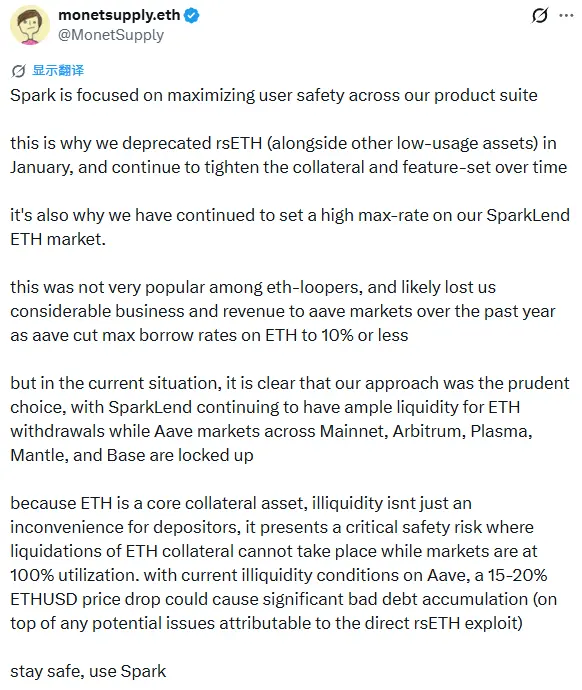
Spark Protocol’s Head of Strategy, monetsupply.eth, stated on X that in January of this year, assets with low usage such as rsETH were delisted and the range of collateral and functionalities continued to be tightened, which at the time triggered strong dissatisfaction among “ETH circular leverage” users.
Additionally, Spark has long set a relatively high maximum interest rate cap in the ETH lending market, and over the past year has ceded some business and revenue to a certain exchange (whose ETH borrowing rate once dropped to 10% or lower). However, under the current market crisis conditions, this strategy has proven to be more prudent. SparkLend still maintains ample ETH withdrawal liquidity, while that exchange has experienced liquidity shortages, and even “lock-in” situations, on Ethereum mainnet as well as multi-chain markets such as Arbitrum and Base.
monetsupply.eth further warned that since ETH is the core collateral asset, when market utilization reaches 100%, collateral liquidations cannot be properly executed. Liquidity depletion not only affects depositors’ experience, but could also pose systemic risk. Given the current liquidity shortage at that exchange, if the price of ETH falls by 15%-20%, significant bad debt could accumulate (in addition to the potential impact of the rsETH incident).
Disclaimer: The content of this article solely reflects the author's opinion and does not represent the platform in any capacity. This article is not intended to serve as a reference for making investment decisions.
You may also like
At a sensitive moment of the "bond market storm," the market focuses on today's 30-year Japanese government bond auction.
Japan’s 30-year government bond yield has risen to 4.155%, approaching a historic high. The 30-year bond auction scheduled for Thursday is drawing significant attention. Analysts generally expect a weak result and warn that if the auction goes poorly, it could put reverse pressure on US Treasuries, prompting a repricing of the global fixed income market and potentially becoming a new trigger for rising global borrowing costs.
US President Donald Trump: Renewed campaign against Iran will not continue for too long
Yen: Intervention is a cycle
DOJ Antitrust Unit Adds Eight Retailers to Beef Pricing Investigation
Crypto prices
More


