
Logan Paul sells Pokémon card for $16.5M, years after fractional NFT row

YouTube star Logan Paul has set a new Guinness World Record, selling his rare Pokémon card for nearly $16.5 million on Monday — the most expensive card sale in history — though the new record sale didn’t come without controversy.
The auction for the Pikachu Illustrator Pokémon card — one of 39 created in a competition in the 1990s — was won by AJ Scaramucci, the son of American financier Anthony Scaramucci, outbidding several others who made offers in the seven- and eight-figure range.
Paul is believed to have made an $8 million profit after auction fees on Monday. He bought the card for $5.3 million in July 2021.
However, the record sale reignited criticism over Paul’s move to fractionalize ownership of the card on Liquid Marketplace in 2022 before the platform went offline, leaving investors scrambling for returns and prompting a lawsuit in Canada.
In a post to X on Monday, Delphi Labs general counsel Gabriel Shapiro said Paul’s “Pikachu NFT fractionalization fiasco” is a “classic case of ‘slop tokenization.’”
“The token is basically just ‘juxtaposed’ with property but has no rights to it,” Shapiro said, urging investors to read the terms of service and to stop rushing into “legal scams.”
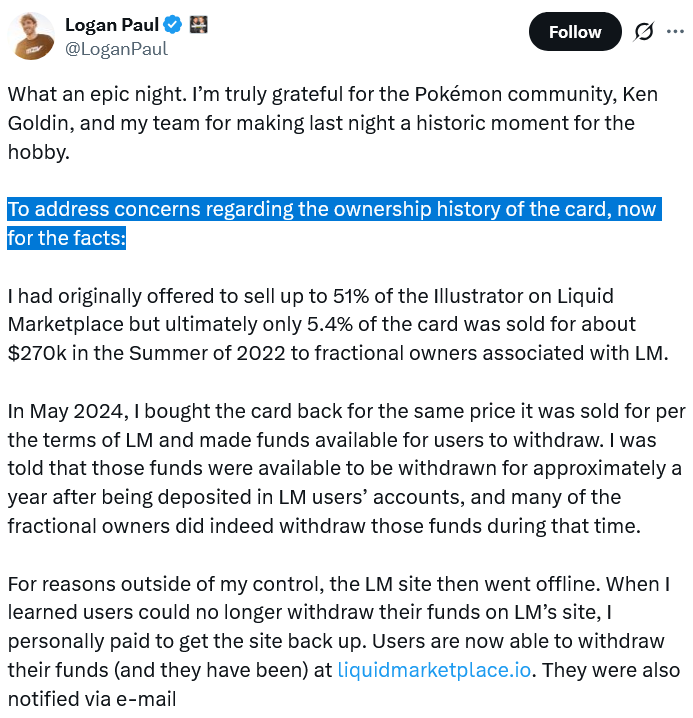
Paul addressed the criticism, stating that Liquid Marketplace went offline for reasons beyond his control and that, once aware of the issue, he paid to restore the site so users could withdraw their funds.
Only 5.4% of the card was fractionalized to owners who paid about $270,000, Paul noted.
 Source:
Logan Paul
Source:
Logan Paul
Paul isn’t named in the Liquid Marketplace lawsuit brought by the Ontario Securities Commission, Canada’s top securities regulator, in June 2024. A hearing is scheduled for June.
Logan Paul’s past NFT drama
It isn’t the first time Paul has had to defend himself over his involvement in NFTs. His CryptoZoo NFT project failed to deliver its promised play-to-earn game, drawing investor backlash and a class-action suit in 2023.
Related: US prosecutors drop OpenSea NFT fraud case after appeals court reversal
He set up a buyback program and eventually paid investors back after they agreed to waive legal claims, and the class-action fraud lawsuit was ultimately dismissed in 2025.
Other NFT investments by Paul have also flopped, including an anime-style digital avatar from the 0N1 Force collection he bought for around $635,000 in 2021 that is now valued at under $2,000.
NFT market continues to slide
The record Pokémon card sale also stands in contrast to the struggling NFT market, which deals in digital collectibles.
While the NFT market started strong in the first two weeks of 2026, the total NFT market cap has since fallen by more than 50%, from $3.2 billion to $1.55 billion amid a broader market pullback.
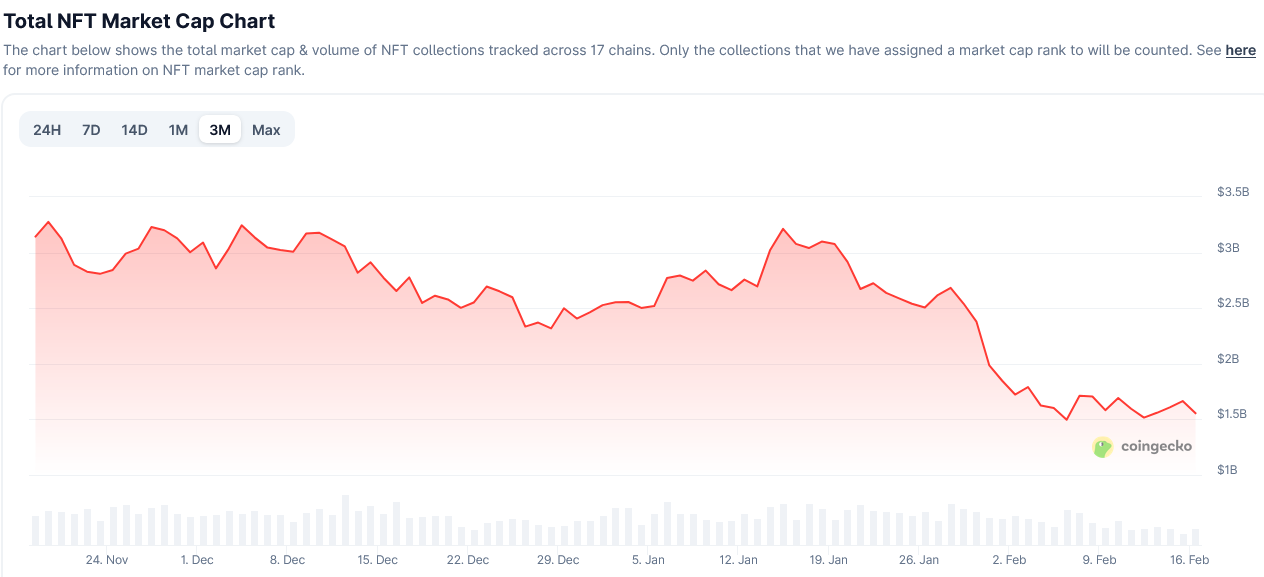 Change in NFT market cap over the last three months. Source:
CoinGecko
Change in NFT market cap over the last three months. Source:
CoinGecko
Last month, NFT marketplace Rodeo and Nifty Gateway announced in the last week of January that they would wind down operations, adding to the sector’s string of high-profile closures.
Magazine: Chinese New Year boosts interest, TradFi buying crypto exchanges: Asia Express
Disclaimer: The content of this article solely reflects the author's opinion and does not represent the platform in any capacity. This article is not intended to serve as a reference for making investment decisions.
You may also like
Credit panic hits AI trading: CoreWeave bond yields remain high, Nasdaq posts biggest weekly drop since late June
Concerns over the debt risk of AI infrastructure companies continue to rise. Yields on some CoreWeave bonds briefly exceeded 15% on Thursday and remained elevated on Friday. CoreWeave's stock price plunged another 12% on Friday, and the Nasdaq Composite Index fell about 4.5% for the week. Analysts point out that as capital costs rise to unbearable levels, companies will have no choice but to reduce their capital expenditures.
Philadelphia Semiconductor Index Experiences Longest Losing Streak Since 2008; Jensen Huang Responds Calmly: Short-term Fluctuations Won't Change AI's Long-term Growth Prospects
Despite recent sell-offs in AI-related stocks, Nvidia CEO Jensen Huang remains confident in the long-term prospects of the AI industry.
U.S. chip stocks drop for eight consecutive sessions! $2 trillion wiped out in market value, marking the longest losing streak since 2008
This week, the investment prospects of AI were questioned by the market. The Philadelphia Semiconductor Index fell by 11.4%, and the Nasdaq dropped more than 4% in a single week. CoreWeave's stock price fell over 25% during the week, and its bonds dropped to distressed levels, casting doubt on the high-yield debt financing model. Strategists warned that being overly bearish could lead to missing opportunities, while "Wood Sister" bucked the trend and increased her holdings of CoreWeave.
In August, overseas funds returned to the U.S. Treasury market; UK holdings surpassed $1 trillion for the first time; Japan and China continued to reduce holdings, with China’s U.S. Treasury holdings hitting the lowest level since 2008
According to a report by the U.S. Treasury Department, overseas investors made net purchases of $108.9 billion in U.S. Treasury bonds in August, reversing a two-month decline in holdings. Among the top ten countries and regions holding U.S. debt, only China and Japan reduced their holdings in August. Japan, the largest holder, saw its holdings drop for the fourth consecutive month, reaching a 22-month low in the same month it intervened in the foreign exchange market. China’s holdings declined for the third straight month, hitting new lows for two consecutive months not seen since 2008. The UK, the second-largest holder, posted historic highs for two consecutive months. Canada recorded the largest increase in August, up $38.3 billion, ranking fifth overall. Belgium had the second-largest increase, up $19.8 billion.

Crypto prices
More


