
Behind GIGGLE’s Surge: Can Meme and Philanthropy Coexist?

When an educational project meets a community-driven meme coin, miracles happen.
When an educational project meets a community-driven Meme coin, miracles happen.
Written by: Nicky, Foresight News
Do you remember last March, when CZ casually mentioned on Twitter that he wanted to start an educational project? Most people thought it was just a sentimental side project for the Binance founder. No one expected that this project, called Giggle Academy, would give rise to a Meme coin with over 1000x gains a year and a half later. Even more surprising, this Meme coin is truly changing the real world.
Origin: A Pure Educational Dream
In March 2024, CZ announced his new project, Giggle Academy—a free global basic education platform. In an interview with Foresight News this March, he candidly shared his thoughts: "When I had nothing to do in the US, I thought about what I could do to have the greatest positive impact."
The idea for Giggle Academy first came from CZ's observations of the current education system. "Today's classrooms are like assembly lines. Kids who are good at math might be forced to spend more time learning English, and in the end, everyone becomes 'average'," he said in the interview. He believes the future world needs people with "long enough planks" (strong strengths), not just "beautiful averages." There are still over a billion children worldwide who don't have access to schooling, especially in Africa, where building physical schools is highly inefficient. However, smartphones and tablets are already widespread—so why not use gamification to let kids learn while playing?
CZ's vision is clear: it's not about helping kids get into Harvard, but about helping them acquire skills to make a living. "A 10-year-old can earn money by doing AI data labeling, and my nephew managed a gaming community of 14,000 people at age 13." This pragmatic attitude set a unique tone for the project.

The project team carefully designed the logo—the smiley face made up of the "Gi" characters, and the tongue-sticking "G"—all reveal an intention to break the dull atmosphere of traditional education. More importantly, CZ stated: "All content is free. I think this kind of investment return is higher than any charity."
Turning Point: Spontaneous Community Action
The turning point came on September 21, 2025, when Giggle Academy announced it would accept cryptocurrency donations. The rules were simple: all donations are traceable on-chain, and the funds are used to incentivize community contributors.
After that, the community spontaneously created the GIGGLE token, which began to operate quietly. The design of this token is simple yet clever: a 5% transaction tax is levied on every transaction, and 100% of it goes into the GiggleFund smart contract.
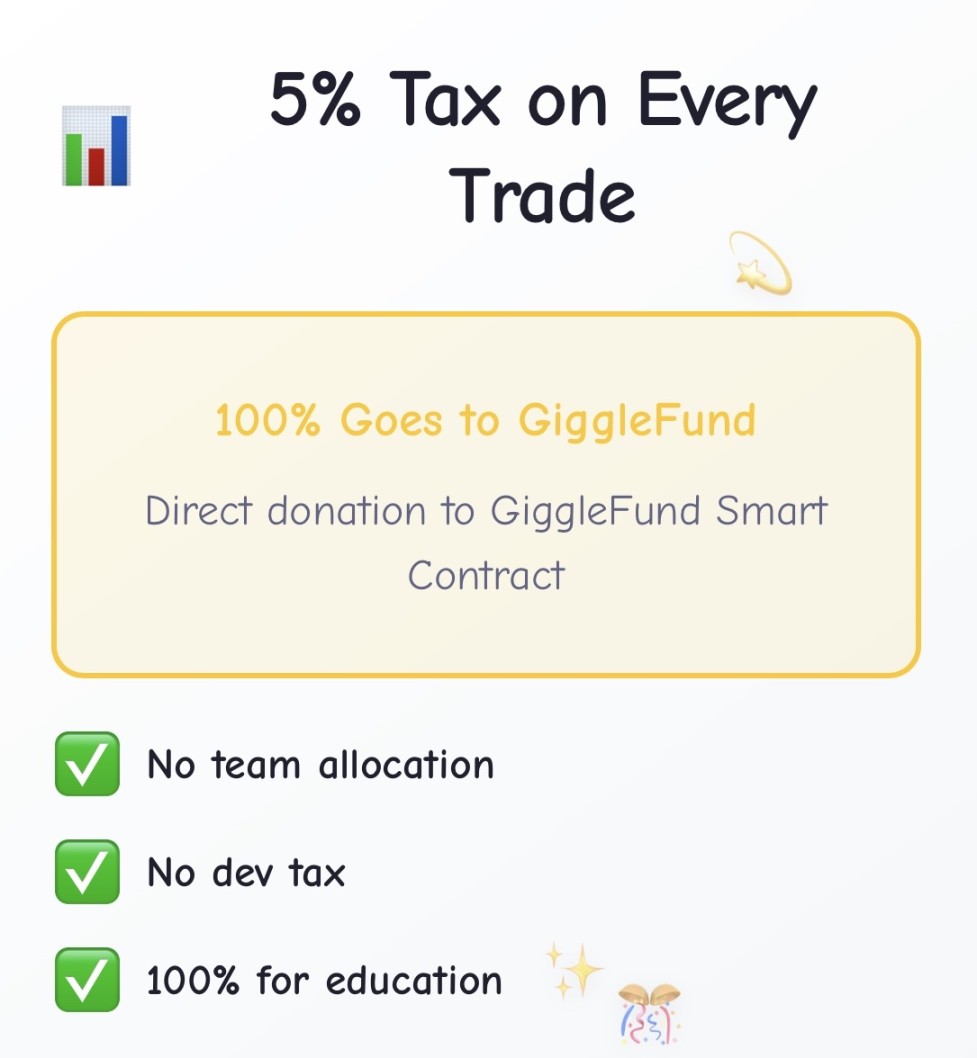
The effect was immediate. Within 12 hours of opening donations, Giggle Academy received over $1 million in donations, 90% of which came from the GIGGLE token transaction tax. Even CZ himself was surprised: "I still don't understand how a coin with a $5 million market cap can generate $900,000 in donation fees within 12 hours."
Even more surprising was CZ's change in attitude: "This completely changed my view of Meme coins. Meme coins are actually useful." These words sparked a huge reaction in the community, and GIGGLE's market cap broke $50 million that day.
The subsequent development was not all smooth sailing. On September 25, the official GIGGLE account was suspected to have been hacked, and the token's market cap plummeted by more than 60% in a short period, once falling below $10 million. Some worried that GIGGLE would repeat the fate of Meme coins going to zero.
Unexpectedly, on October 3, GIGGLE was listed on Binance Alpha, and on the 9th, it was listed on Binance perpetual contracts. By the 10th, CZ announced on X: "In less than 20 days, $11 million worth of BNB has been donated to Giggle Academy."
On the 25th, GIGGLE was listed on Binance spot, and the token price once soared above $300, with a market cap exceeding $300 million. But the next day, the token price began to fall, and on November 4, it once dropped below $50.
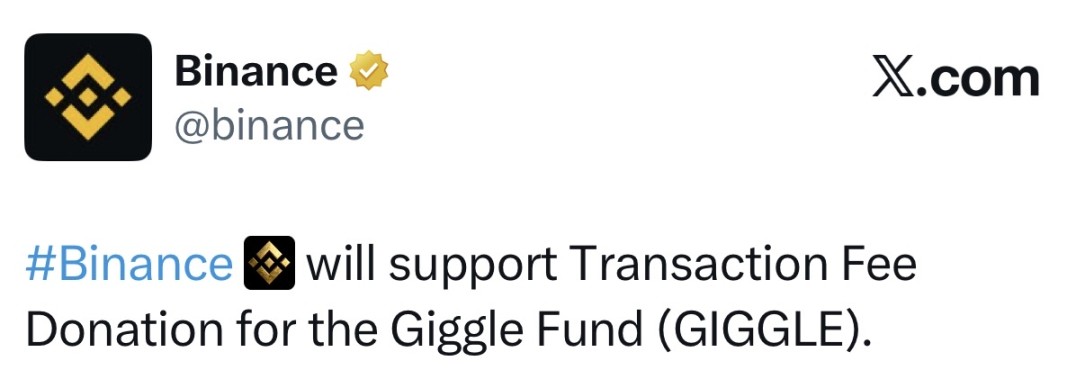
The real milestone also appeared on November 4. Binance announced it would donate 50% of the spot and margin trading fees from GIGGLE to support the charitable projects advocated by Giggle Fund. Giggle Academy then stated it would use 50% of these funds for token burning.
However, GIGGLE's burning mechanism created an interesting paradox: when Binance announced that 50% of trading fees would be donated to Giggle Fund, and the project team chose to use these funds for token burning, the originally pure charity narrative began to take on a financial operation color.
He Yi's description of "mutual pursuit" indeed paints a beautiful picture, but reality may be more complex. When the charitable effect becomes the support for the token's value, and when children's educational opportunities and token holders' investment returns are placed on the same scale, Giggle Academy has to face a dilemma: how to find a balance between goodwill and profit.
As with most Meme coins, we don't know whether GIGGLE will eventually go to zero, or whether those who profited or lost truly have goodwill. But this craze driven by Binance will leave a mark for future participants and the Meme ecosystem.
Disclaimer: The content of this article solely reflects the author's opinion and does not represent the platform in any capacity. This article is not intended to serve as a reference for making investment decisions.
You may also like
XRP News Today : Ripple Expands Prime Brokerage Services for Brevan Howard
ROI - For the Trump-led Treasury, the "tail" of the auction is the most difficult part: McKeever
The views expressed in this article are solely those of the author, Reuters columnist Jamie McGeever. Reuters, Orlando, Florida, October 6 – U.S. Treasury auctions are typically dull, predictable, and not newsworthy. But these are not ordinary times, and the Trump administration now faces the risk of sluggish U.S. debt sales making headlines. The U.S. Treasury plans to issue nearly $120 billion in Treasuries this week, the first non-bill bond sales in two weeks: $58 billion in three-year notes on Tuesday, $39 billion in ten-year notes on Wednesday, and $22 billion in thirty-year bonds on Thursday. These auctions would usually be insignificant events, but due to the exceptionally weak performance of auctions from September 22 to 24—especially the five-year note auction on September 23, which triggered the largest spike in bond yields since April last year—they are attracting growing attention. Since then, yields have not only failed to retreat but have surged across most tenors to multi-decade highs. It's worth noting that the possibility of a U.S. Treasury auction "failing" is almost zero. Primary dealers—currently 26 Wall Street banks and institutions authorized by the New York Fed as market makers for Treasuries—are always involved. They effectively underwrite the sales, ensuring the smooth operation of the $30 trillion U.S. Treasury market, the most liquid market in the world. This, in turn, allows the entire global financial system to function, given that trillions of dollars in global debt, assets, and market derivatives are benchmarked against U.S. Treasuries. Treasuries are also the primary collateral for lubricating the financial “pipes” of the U.S. and global markets, including repo agreements, interbank loans, and financing. In short, as long as U.S. Treasuries remain the pillar of the global financial system, there will always be buyers at Treasury auctions. The question, as always, is at what price these bonds will be sold. Currently, borrowing costs in the secondary market are at their highest levels since the mid-2000s, so it's reasonable to expect that the Treasury will pay relatively high rates in the primary market as well. But as recent auctions have shown, negative surprises remain possible. "Too big to be absorbed by the market"? The $70 billion five-year auction on September 23 was among the most worrisome in years. Demand, as measured by the bid-to-cover ratio, was at a nine-year low. The Treasury ended up selling the notes at a yield of 5.033%, more than 3 basis points above the market yield at the close of bidding. Three basis points might not sound like much, but it's exceptional for a five-year note auction. This is the largest so-called "tail" since June 2022. According to JPMorgan analysts, the last time a five-year auction had a three-basis-point tail was back in 2011—amid the brewing debt ceiling crisis that eventually led to a U.S. credit rating downgrade in August that year. Currently, concerns over the U.S.'s daunting fiscal outlook are driving up long-term borrowing costs. As a result, markets generally expect the Trump administration to gradually shift the Treasury’s massive funding needs toward the lower-yield (and therefore lower-cost) short- and medium-term segments of the curve. That's why the five-year note auction two weeks ago sparked such concern. A three-basis-point tail is common in long bond auctions, but not in the "belly" of the yield curve. If the Treasury is forced to pay a higher premium to issue these bonds, then Houston, we have a problem. A large auction tail can be caused by many factors, including market volatility on the day of the auction or more concerning, fundamental issues that may erode demand over time. The two are often hard to distinguish because they are not mutually exclusive. On a brighter note, this unease has not yet spread to the short end of the yield curve. At least, not yet. Three-year and ten-year Treasury yields are up about 50 basis points from the last auction a month ago, hovering around 4.96% and 5.32%, respectively. The thirty-year yield is up roughly 35 basis points to 5.65%. These levels should be high enough to attract strong demand and ensure smooth sales, right? Maybe. But if surprises do occur, volatility and uncertainty could spill over across the market. Investors will be watching developments as closely as hawks. (The views in this article are solely those of the author, a Reuters columnist.) Like this column? Check out Reuters' "Unhedged" (ROI), your essential new source for global finance commentary. Follow ROI on LinkedIn and X. You can also listen to the daily "Morning Bid" podcast on Apple, Spotify, or the Reuters app—subscribe for in-depth market and finance news, seven days a week. US 5-year auction has biggest 'tail' since 2022 https://fingfx.thomsonreuters.com/gfx/mkt/dwpkmkzogpm/TAIL.png (For the convenience of non-English speakers, Reuters provides automated translations of its reports
Crypto prices
More


