
The mysterious team that dominated Solana for three months is about to launch a token on Jupiter?

No marketing, no reliance on VCs—how did HumidiFi win Solana's on-chain proprietary market maker war in just 90 days?
Author: SpecialistXBT
A team with no official website, no community, and anonymous members managed to capture nearly half of the trading volume on Jupiter within just 90 days.
To gain a deeper understanding of this mysterious project, we first need to delve into a silent on-chain trading revolution currently unfolding on Solana.
HumidiFi accounts for 42% of the total trading volume processed on Jupiter
Source: Dune, @ilemi
How Prop AMMs Are Reshaping On-Chain Trading
In the context of AMMs, toxic order flow refers to high-frequency arbitrageurs leveraging low-latency connections and advanced algorithms to quickly capture price discrepancies and rapidly flatten the spread between on-chain prices and those at price discovery venues (typically centralized exchanges like Binance). The profits taken by these toxic flows ultimately come at the expense of traders, liquidity providers, and on-chain market makers.
In traditional financial markets that use centralized limit order books (CLOBs) for trade matching, professional market makers can respond to toxic order flow in various ways (such as adjusting spreads or pausing quotes). By analyzing order flow patterns, they can identify traders with informational advantages and adjust their quotes accordingly, thus reducing losses from "adverse selection." As a result, market makers operating on Solana naturally chose DEXs like Phoenix, which use CLOBs. However, during the Solana "meme frenzy" from 2024 to early 2025, the network was overwhelmed by unprecedented demand, causing market makers' orders to frequently fail to reach the chain, while updating quotes consumed a large amount of expensive compute units, sharply increasing market makers' costs.
A series of thorny practical issues is forcing some of the most experienced AMM market makers to fundamentally rethink how on-chain markets operate, giving rise to a revolutionary new market structure.
This new paradigm is called "Prop AMM" (Proprietary AMM), aiming to provide tighter spreads and more efficient liquidity on-chain while minimizing the risk of being exploited by high-frequency arbitrageurs.
SolFi, ZeroFi, and Obric were the original "big three" of Prop AMMs. They do not publicly expose contract interfaces but instead provide them directly to major trade routers like Jupiter, requiring Jupiter to route orders into their AMMs. This design makes it extremely difficult for external professional arbitrageurs like Wintermute to interact natively with the contracts, as they cannot understand or predict the trading logic, thus preventing market makers' quotes from being replaced and mitigating the "adverse selection" problem posed by informed traders.
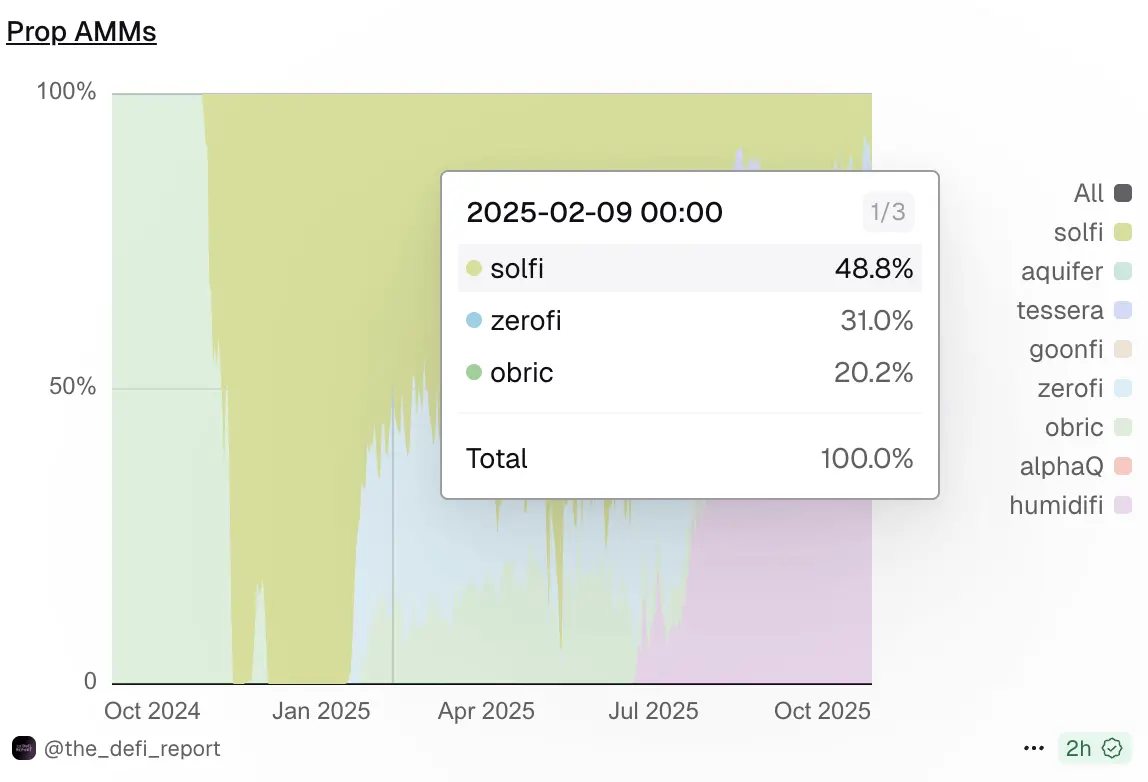
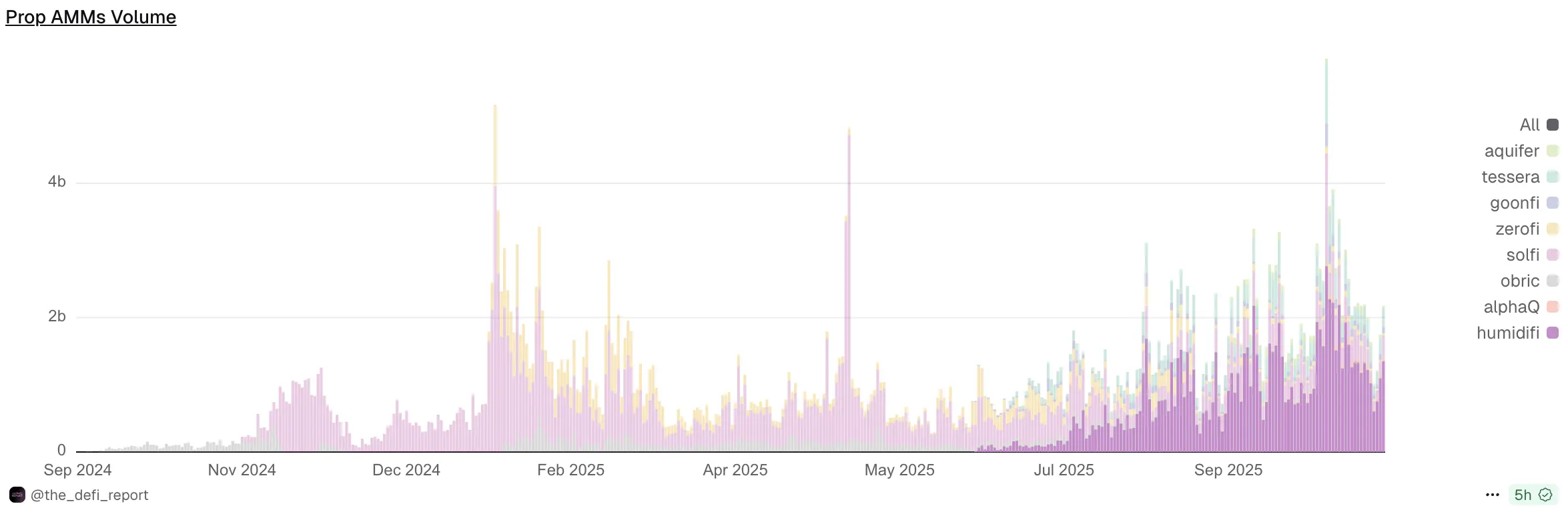
In February 2025, SolFi, ZeroFi, and Obric were the main three Prop AMMs
Source: Dune @the_defi_report
HumidiFi's Blitzkrieg
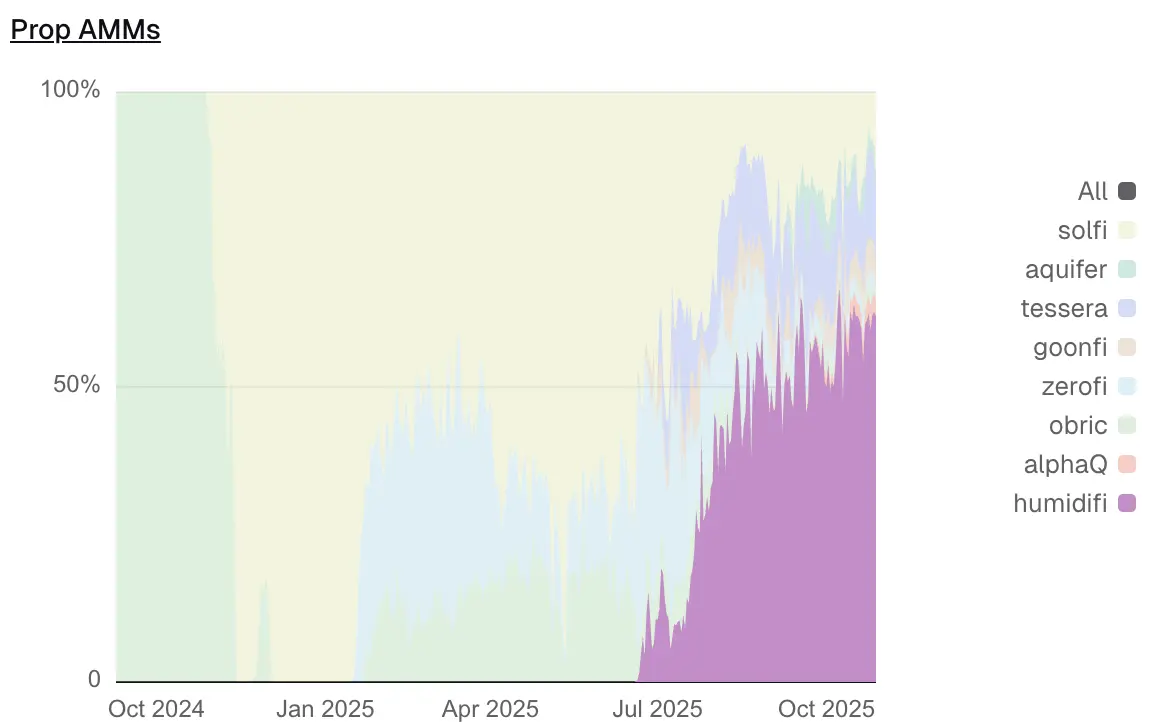
The competition among Prop AMMs reached a fever pitch by July 2025, and a project named HumidiFi rewrote the entire market landscape at a staggering pace.
HumidiFi officially launched in mid-June 2025, and just two months later, it had captured 47.1% of all Prop AMM trading volume, becoming the undisputed market leader. In contrast, former leader SolFi saw its market share plummet from 61.8% two months prior to just 9.2%.
Source: Dune @the_defi_report
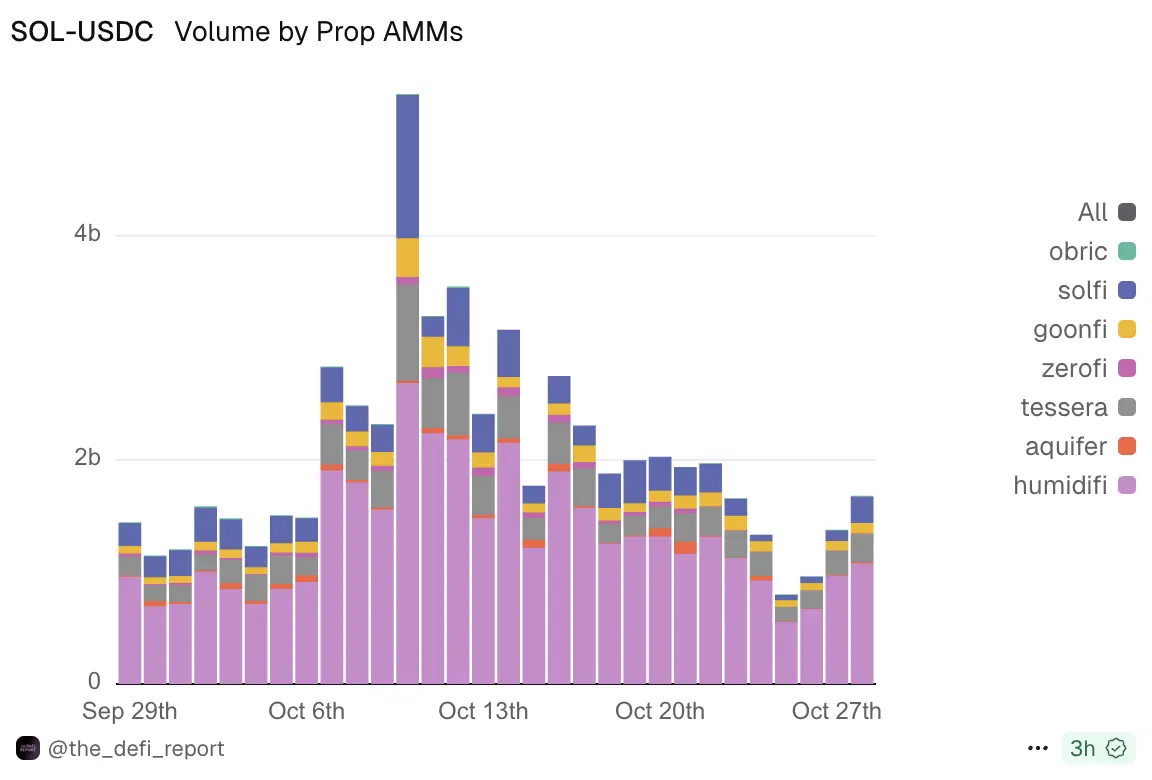
HumidiFi's dominance is especially evident in the SOL/USDC trading pair. On October 28 (UTC+8), HumidiFi processed $1.08 billions in SOL/USDC trades in a single day, accounting for 64.3% of the total volume for that pair on that day.
Source: Dune @the_defi_report
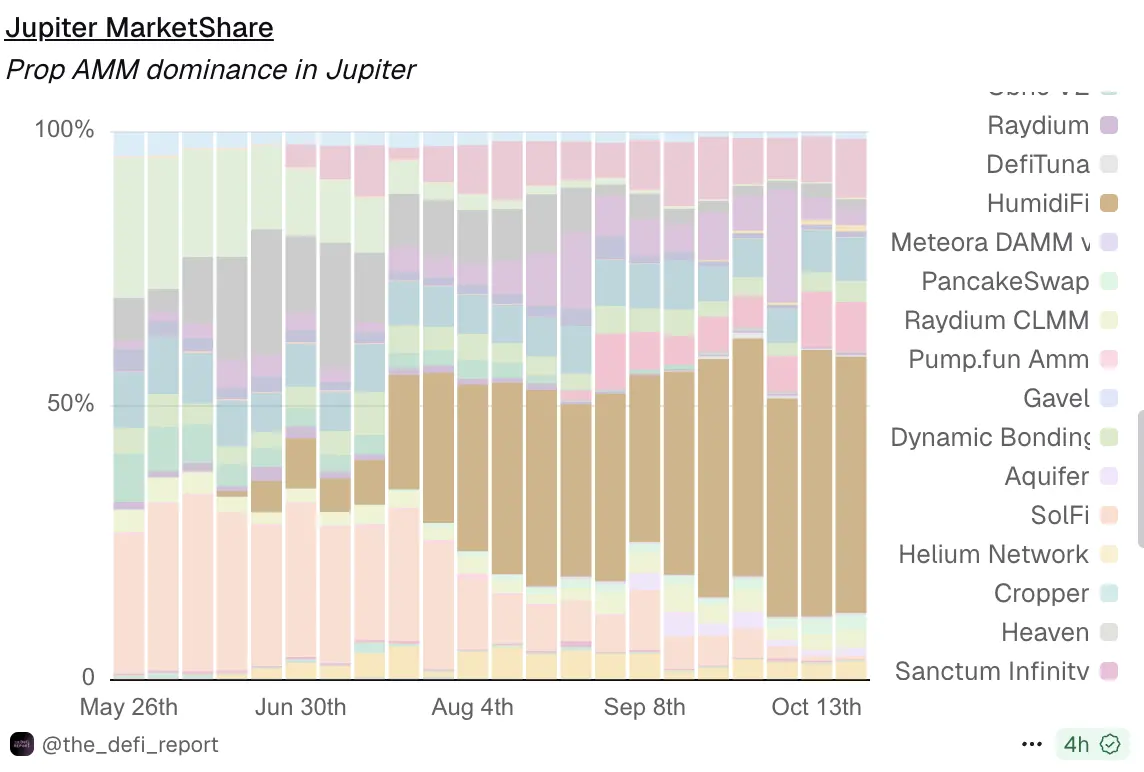
HumidiFi also has a very high penetration rate in Jupiter routing. As an aggregator holding 86.4% market share on Solana, Jupiter's routing choices largely determine the actual trading experience for users. Data from October 20 (UTC+8) shows that HumidiFi's market share within Jupiter reached as high as 46.8%, more than four times that of the second place, TesseraV (10.7%).
Source: Dune @the_defi_report
Expanding the view to the entire Prop AMM ecosystem, HumidiFi's dominance remains solid. On October 28 (UTC+8), the total trading volume for all Prop AMMs reached $2.18 billions, with HumidiFi alone accounting for $1.35 billions, or 61.9%. This figure not only far surpasses the second place SolFi's $309 millions, but even exceeds the combined trading volume of all competitors ranked 2nd to 8th.
Source: Dune @the_defi_report
HumidiFi's victory was achieved almost entirely in "stealth mode." It had no official website, no early Twitter account, and no public information about its team members.
HumidiFi doesn't need marketing, airdrops, or storytelling. All it needs is to offer better spreads and better execution prices on every trade compared to its competitors. As Jupiter's routing algorithm repeatedly chose HumidiFi, the market cast its vote in its own way.
The Ultimate Race of Speed and Cost
The key to HumidiFi's success lies in its extreme compression of oracle update compute costs, and its clever use of the Jito auction mechanism to turn this technical edge into absolute market dominance.
First, HumidiFi consumes very little compute resources. According to data from @bqbrady, each oracle update by HumidiFi uses only 799 CUs (compute units). In comparison, its main competitor SolFi requires 4,339 CUs. TesseraV, operated by top market maker Wintermute, also needs 1,595 CUs—twice that of HumidiFi.
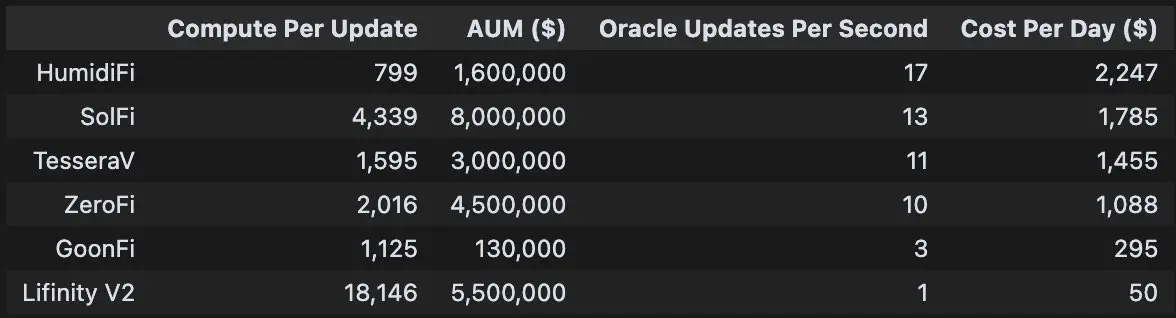
Source: X, @bqbrady
HumidiFi also fully leverages its low CU consumption to gain absolute transaction priority in Solana's MEV infrastructure, the Jito auction. In Jito auctions, transaction priority is determined not by absolute tip, but by tip per compute unit (Tip per CU). HumidiFi pays about 4,998 lamports in tips for each oracle update. Due to its extremely low CU usage (799 CUs), its Tip per CU ratio reaches an astonishing 6.25 lamports/CU.

According to data from Brennan Watt, an engineer at Solana core developer Anza, HumidiFi uses six times fewer CUs than former Prop AMM leader SolFi, while paying over eight times more in tips.
Another key advantage for HumidiFi is the frequency of oracle updates. HumidiFi updates its oracle 17 times per second, far surpassing its main competitors (SolFi at 13 times, TesseraV at 11 times, and ZeroFi at 10 times).
In the highly volatile cryptocurrency market, this near real-time price tracking ability allows HumidiFi to always stay close to fair value, leaving no room for arbitrageurs, and providing tighter liquidity without needing to widen spreads for self-protection.
In addition, HumidiFi excels at cost control. Its daily operating cost is only $2,247. In comparison, SolFi, despite managing five times the assets under management (AUM) as HumidiFi ($8 billions vs $1.6 billions), has a daily cost only 20% lower ($1,785).
WET Token Lands on Jupiter DTF
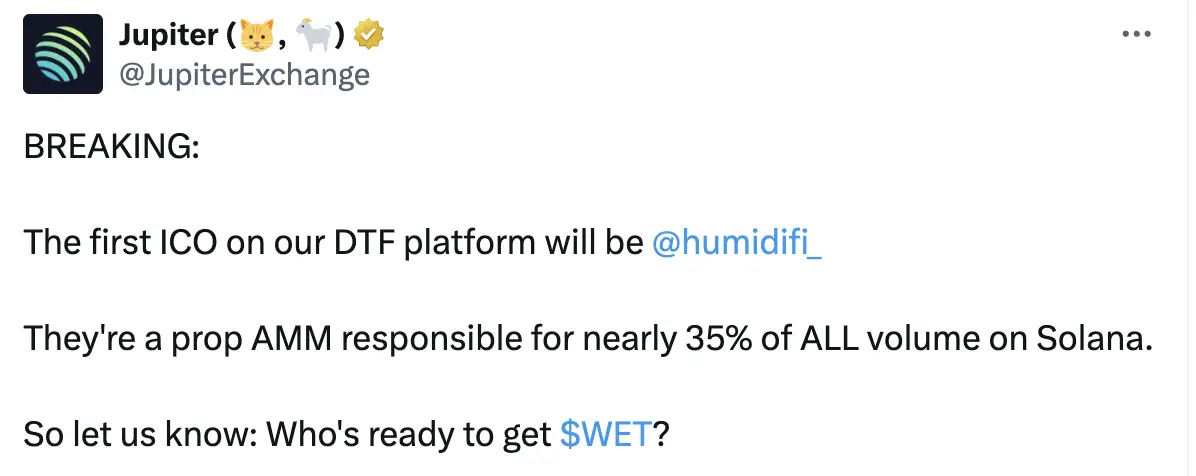
Prop AMMs are a "winner-takes-all" track. HumidiFi has achieved its current dominance through technical prowess, but this also means that if a new competitor makes a breakthrough in CU efficiency or oracle speed, it could quickly erode HumidiFi's market share. Clearly, this Prop AMM war has only just begun.
Disclaimer: The content of this article solely reflects the author's opinion and does not represent the platform in any capacity. This article is not intended to serve as a reference for making investment decisions.
You may also like
Chipmaker earnings growth cools to 136% as AI boom lifts S&P 500
Updated: Delta Air Lines warns that as fuel prices hit profits, airline capacity will tighten further
Delta Airlines lowers its annual profit forecast due to an expected increase in fuel costs to $6 billion. The CEO stated that ticket prices have risen by about 20% this year, with limited passenger resistance. Analysts warn that maintaining high ticket prices in 2027 is critical for improving profitability. The article includes comments from the earnings call and analyst remarks. Rajesh Kumar Singh/Shivansh Tiwary, Reuters Chicago, October 9 - Delta Airlines (DAL.N) said on Friday that, despite strong travel demand and rising ticket prices, soaring fuel costs have forced it to cut its 2026 profit expectations by nearly a quarter. So, the airline industry may need to further limit flight growth next year to protect profitability. This warning highlights the increasingly tough challenges faced by U.S. airlines. While strong demand and restricted seat growth have allowed airlines to significantly raise ticket prices and offset higher fuel costs, aggressively increasing flights to capture more demand may intensify competition, making it harder to maintain high fares and protect profits. Based in Atlanta, Delta now expects its annual fuel expenditure to increase by about $6 billion compared to last year—about $2 billion higher than its July forecast—due to the Iran war (link) causing global jet fuel prices to spike. Airlines worldwide are preparing for a prolonged fuel shock. Michael O’Leary, CEO of Ryanair Group RYA.I, said Thursday that high jet fuel prices could persist for another 12-18 months (link), adding more pressure on airlines to raise fares and control costs. https://www.reuters.com/graphics/AUTOMATED-20261008/A4A-JET-FUEL-DAILY-1Y/xmpjwjnmbvr/chart.png “In a high-cost environment, you can’t simply grow your way out,” Delta CEO Ed Bastian said on the earnings call. He noted that the industry has already taken steps to restrict capacity, but more measures will be needed next year to improve profitability. Bastian said Delta raised ticket prices about 20% this year, and passenger resistance has been limited. He is confident that even if fuel costs eventually drop, the high fares can still be maintained. Delta lowered its adjusted annual earnings per share forecast from the July prediction of $6.50-$7.50 to $5.10-$5.60. According to LSEG data, the midpoint of the new range is below analysts’ average expectation of $5.46. Third-quarter adjusted earnings per share were $1.72, four cents below analysts’ average forecast. In midday trading, shares of Delta dropped 1.7%, United Airlines UAL.O fell 1.4%, and both American Airlines AAL.O and Southwest Airlines LUV.N were down about 1%. Delta partly shields itself from rising fuel costs by owning a refinery outside Philadelphia (link), which is expected to generate over $700 million in profits this year. Even with this buffer, the airline expects its fourth-quarter fuel price to rise from $3.61 per gallon in Q3 to $4.25 per gallon. Delta forecasts adjusted fourth-quarter earnings per share to be between $1.15-$1.65, with the $1.40 midpoint roughly matching analysts’ average expectation of $1.39. Fare increases Government data shows that in the first eight months of 2026, U.S. airlines spent $42.9 billion on fuel, an increase of $13.2 billion compared to the same period last year despite slightly reduced consumption. According to the U.S. Bureau of Labor Statistics, strong demand and limited seat growth pushed average U.S. airline ticket prices up by about 25% year-on-year between April and August. https://www.reuters.com/graphics/USA-AIRLINES/FUEL/lbpgdnbzwvq/chart.png Analysts at Melius Research said that despite surging fuel costs, Delta’s ability to raise fares helps keep second-half profits roughly stable. Still, they warn that the company’s profit margin has struggled to improve over the years. “It is critical for margin improvement to maintain or raise fares in 2027,” they wrote in their research report. With industry capacity growth expected to accelerate in Q4, this challenge will likely become even tougher. Deutsche Bank analysts expect the proportion of fuel costs recouped through revenue measures to fall in Q4 and predict full recovery won’t happen until early 2027. Bastian noted that low industry returns are another reason for limiting capacity growth. He said Delta will be cautious with its 2027 capacity plan until the fuel price outlook becomes clearer. He added that international routes may account for a larger share of Delta’s capacity expansion compared to domestic routes. Currently, Delta says its premium cabins and corporate travel business remain strong, and its economy cabin business is gradually improving. With Q4 ticket bookings already exceeding 60%, Delta expects revenue to increase about 20% year-on-year, despite limited capacity growth. Executives said early booking trends for Q1 2027 are also encouraging. (For the convenience of non-native English speakers, Reuters automatically translates its reports into several
AI and Quantum: Trump's $6 Billion Plan Could Also Impact Bitcoin
Wall Street giants to release financial reports next week: stock trading revenue expected to approach $19 billion, "everyone is a winner" may be a thing of the past
According to analyst expectations compiled by Bloomberg, the combined equity trading revenue of the five major U.S. banks in the third quarter will approach $19 billion, but fixed income trading revenue is expected to drop to its lowest point of the year, and M&A activity has also cooled. Meanwhile, AI-driven cash optimization tools may lead to deposit outflows, sparking concerns about bank stocks in the market. Analysts believe that while the profit performance of each bank may further diverge, market concerns about the impact of AI may be overblown.
Crypto prices
More


