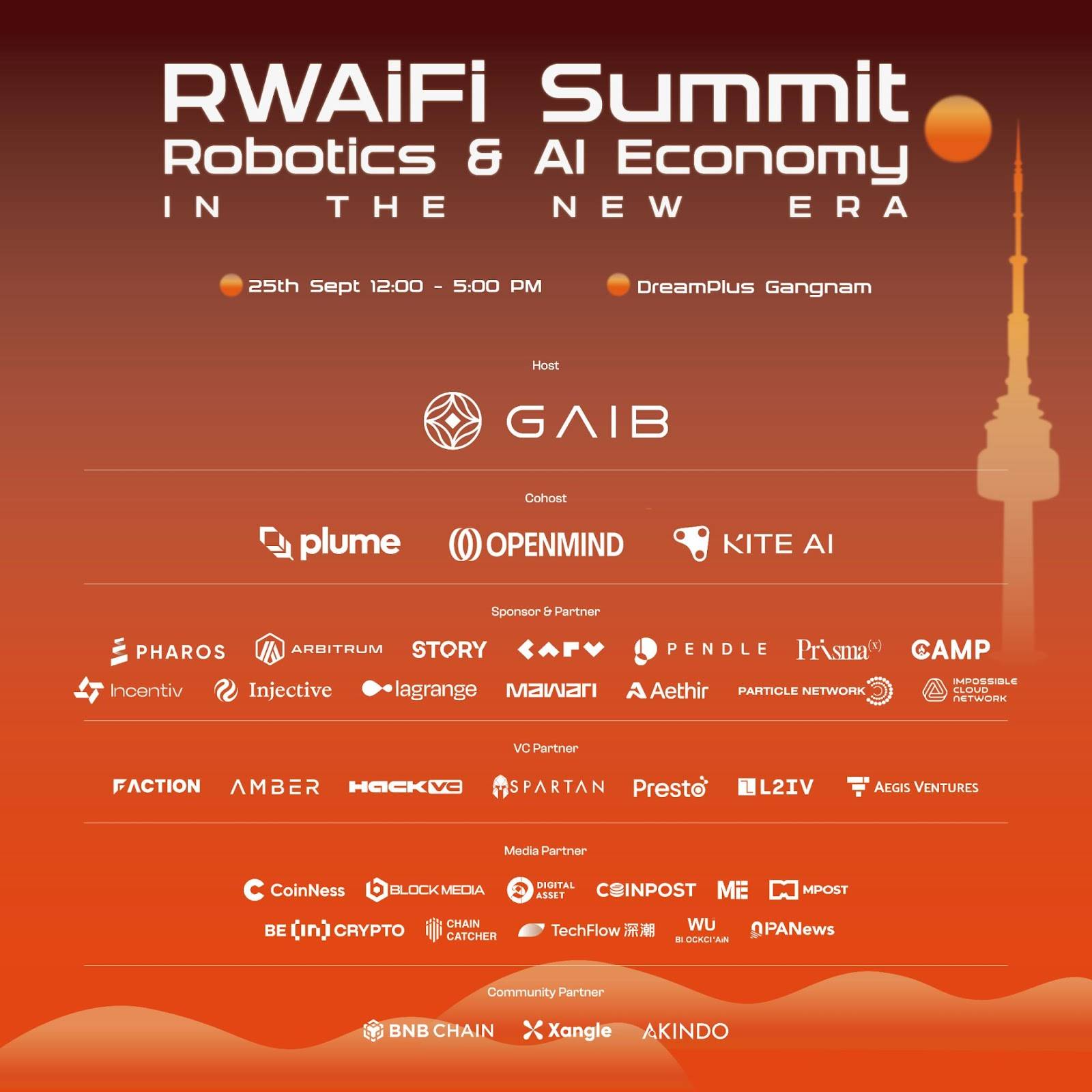
The RWAiFi Summit, hosted by GAIB, concluded successfully in Seoul on September 25, attracting over 400 participants and bringing together 20 top ecosystems and projects, including Plume, OpenMind, Kite AI, Pharos Network, Arbitrum, BNB Chain, Story Protocol, CARV, Pendle, PrismaX, Camp Network, Incentiv, Injective, Lagrange, Mawari, Aethir, Particle Network, ICN Protocol, as well as renowned investment institutions such as Faction VC, Amber Group, Hack VC, Spartan Group, and L2 Iterative Ventures. Together, they witnessed the convergence of AI, Robotics, and DeFi, and discussed new opportunities brought by computing power, large-scale robotics, and the financialization of real-world assets.
Robotics: From R&D to Scale
The summit focused on the implementation and expansion of the AI robotics economy. AI-driven robots are moving from the R&D stage to large-scale deployment. By integrating with on-chain financial tools, robotics infrastructure and hardware procurement can access more efficient financing channels, allowing capital to be converted into real productivity more rapidly.
This not only unleashes new industry dividends but also provides investors with the first opportunity to directly share in the economic returns of robotics via on-chain mechanisms.
RWAiFi: The Financial Foundation of the AI Economy
With the rapid rise of the AI economy, the demand for computing power and hardware is growing at an unprecedented rate. Finding efficient, transparent, and scalable financing methods for these key assets has become a pressing issue for the entire industry. GPU computing power, robotics hardware, and their derivative cash flows are gradually emerging as a new blue ocean for on-chain financialization. By transforming infrastructure investments, previously exclusive to institutions, into on-chain assets accessible to everyone, not only does it provide more flexible financing channels for infrastructure, but it also allows ordinary investors to share in the growth dividends of this industry for the first time.
As a representative project in the RWAiFi sector, GAIB demonstrates how to tokenize GPU and Robotics yields and enables capital to enter the AI industry faster and more efficiently through AID. This model significantly reduces financing costs, while investors can directly share in stable returns backed by real assets on-chain, making it one of the best practices for the RWAiFi model.
GAIB's Vision
Bringing AI yields on-chain, GAIB is financializing GPU and Robotics through AID, enabling investors, enterprises, and developers to seamlessly participate in the AI economy.
With the joint efforts of partners and the community, this summit was not only an industry exchange event but also marked a new stage in the RWAiFi narrative. Against the backdrop of rapidly growing global demand for the AI economy and the accelerated implementation of AI robotics, RWAiFi is gradually becoming a key bridge connecting real cash flows with the on-chain financial system.
Organizer:
GAIB is the first economic layer for AI computing power, transforming GPU assets into a new type of yield-bearing asset. GAIB has launched the AI synthetic asset AID, enabling investors to seamlessly participate in the AI economy and receive real returns from AI computing power yields. Investors can stake AID (sAID) to earn rewards while maintaining liquidity, further participating in the AI-driven financial market. GAIB also provides capital solutions for cloud service providers and data centers, optimizing their computing power resources and promoting the development of AI infrastructure. With extensive DeFi protocol integration, including lending, derivatives, and structured products, GAIB has built a bridge between AI and blockchain finance, unlocking new opportunities for technology and investment.
Co-organizers:
Plume is the first complete RWA chain and ecosystem designed specifically for RWAfi, accelerating the on-chain integration of real-world assets. The Plume network already hosts over 200 projects, providing an EVM-compatible composable environment that supports the management and onboarding of diverse assets. Plume’s end-to-end tokenization engine and financial partner network simplify the asset on-chain process, promoting deep integration between RWA and DeFi, enabling assets to be tokenized and globally distributed.
OpenMind is building a universal operating system for intelligent machines. Its OM1 platform enables various forms of robots to perceive, adapt, and act in human environments; the decentralized coordination layer FABRIC creates secure machine identities and powers a global network for intelligent system collaboration. Together, they lay the foundation for machines that can operate in any environment while maintaining security and coordination at scale.
Kite AI is building the next-generation AI foundational trading layer, aiming to create network effects by providing real utility in a decentralized AI economy. At its core is a trust layer—an open, decentralized network where autonomous modules can operate with full interoperability and verifiability. Kite AI’s token economic model is designed to incentivize both the supply and demand of agent services. Kite AI’s modular and composable design provides unified infrastructure for identity, payments, and governance, enabling agents to authenticate, transact, and collaborate securely without any intermediaries.