
Morgan Stanley raises gold target price to $3,800, silver may see better-than-expected performance

According to Jinse Finance APP, the latest research report from Morgan Stanley points out that the precious metals market is entering an upward cycle driven by multiple favorable factors, with gold and silver prices expected to diverge amid the Federal Reserve's rate-cutting cycle and changes in the macro environment. According to the report, historical data shows that precious metals usually experience significant gains after the Federal Reserve cuts rates—gold rises by an average of 6% (up to 14%) within 60 days after a rate cut, while silver rises by an average of 4% during the same period. This pattern provides important reference for the current market.
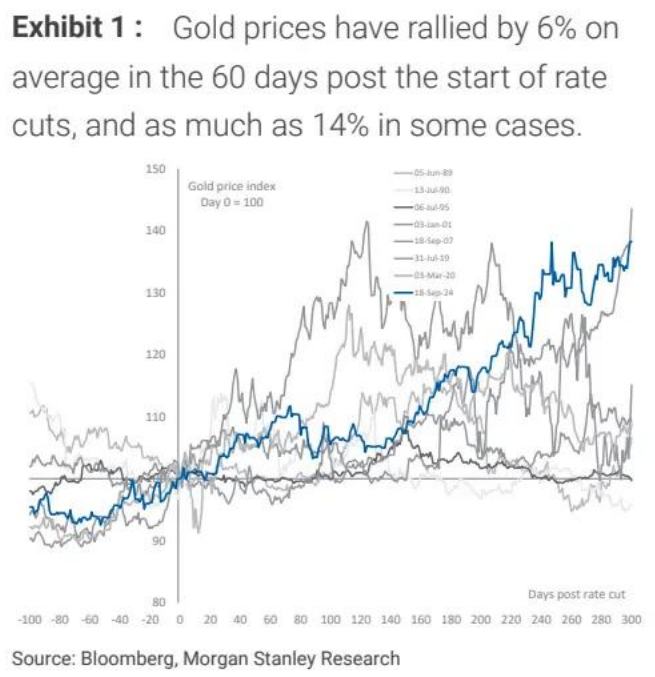
Figure 1
On the demand side, global gold ETFs have increased their holdings by about 440 tons this year, reversing the net outflow trend of the previous four years, indicating a rebound in institutional demand for gold allocation. Silver ETF holdings have increased by 127 million ounces during the same period, but the report warns that speculative trading may lead to excessive price surges.
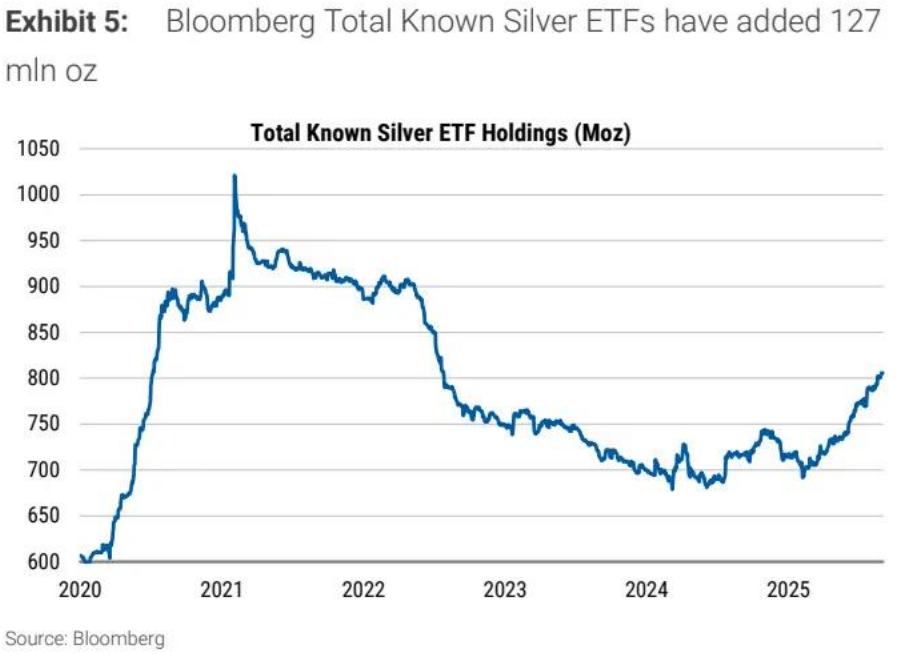
Figure 2
It is worth noting that India's gold import data for July has shown signs of improvement. Although jewelry demand in the second quarter hit its lowest level since Q3 2020, expectations of increased consumer purchasing power brought by local Goods and Services Tax (GST) reforms may lay the groundwork for a subsequent demand recovery.
In terms of price forecasts, Morgan Stanley has set its year-end target price for gold at $3,800 per ounce, with three core driving factors: the continued progress of the Federal Reserve's rate-cutting cycle, the potential further weakening of the US Dollar Index (DXY), and the potential recovery of jewelry consumption in emerging markets.
For silver, although analysts remain cautious (target price $40.9 per ounce), the contradiction between stable solar panel production and a 7% year-on-year contraction in Mexican mine supply suggests that silver prices may have upside potential beyond expectations.
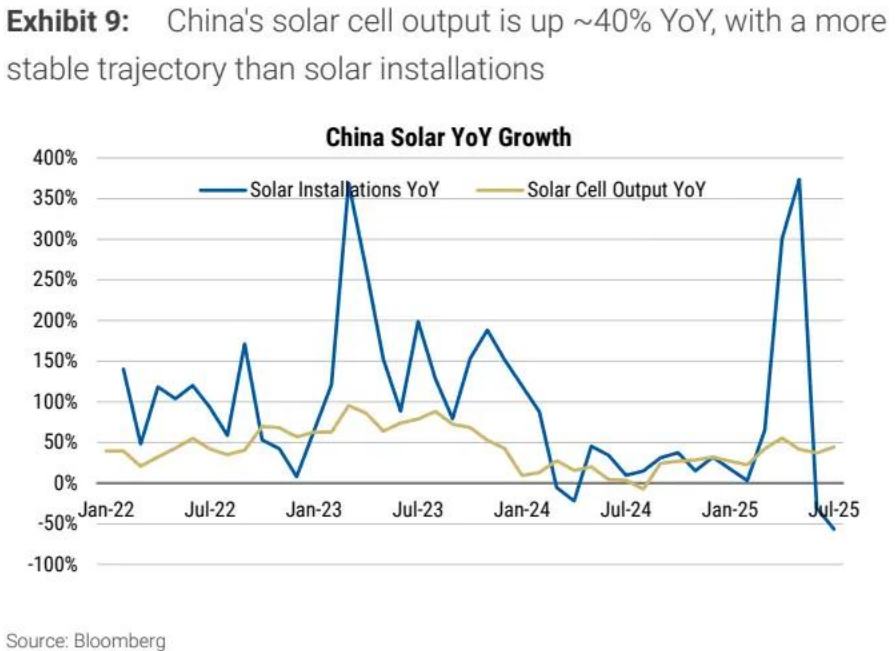
Figure 3
The report particularly emphasizes that the strong negative correlation between gold and the US dollar remains a key pricing logic. If the current depreciation trend of the US Dollar Index continues, it will directly benefit precious metals priced in US dollars.
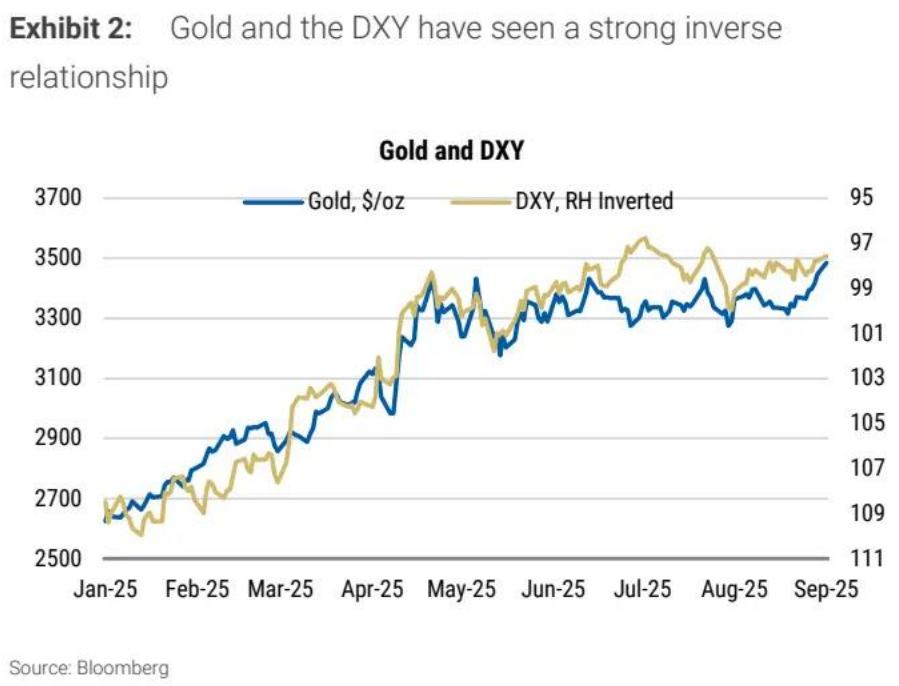
Figure 4
However, the report also highlights risks: although India's GST reform does not directly benefit gold and silver, tax reductions in other areas may indirectly boost consumer purchasing power. In addition, Morgan Stanley's business dealings with related companies should also be considered by investors when making decisions.
Overall, the report believes that gold's safe-haven and anti-inflation attributes during the rate-cutting cycle will support its price increase, while silver needs to find a balance between industrial demand and speculative sentiment. Investors should closely monitor Federal Reserve policy moves, the US dollar trend, and signals of consumption recovery in the Indian market to seize structural opportunities in the precious metals market.
Disclaimer: The content of this article solely reflects the author's opinion and does not represent the platform in any capacity. This article is not intended to serve as a reference for making investment decisions.
You may also like
The calm period in the US stock market is over! The S&P 500 ends its record of 53 consecutive trading days without a drop of over 1%. AI stock sell-off intensifies market concerns.
The S&P 500 Index fell by 1.1%, ending a streak of 53 consecutive trading days without a drop of 1% or more. This was the longest period of calm since January 2020.
Federal Reserve Beige Book: U.S. economy expands moderately but inflationary pressures intensify; AI boosts productivity curbing some corporate hiring demand
The latest Beige Book released by the Federal Reserve on Wednesday shows that overall economic activity in the United States continues to grow, but performance varies across regions. Consumer spending remains generally weak, and there has been little change in the labor market.
Overnight US Stocks | September Inflation Remains High, Major Indexes Decline, Coreweave (CRWV.US) Drops Over 15%
At the close, the Dow Jones Industrial Average fell by 47.96 points, or 0.09%, to 51,622.14 points; the S&P 500 Index dropped by 85.95 points, or 1.10%, to 7,719.50 points; and the Nasdaq Composite Index declined by 511.51 points, or 1.88%, to 26,692.87 points.
The S&P 500 ends its longest calm period in over six years, falling more than 1% for the first time in 53 trading days as AI trading loses momentum
The main reason for the decline in US stocks on Wednesday was the combination of higher-than-expected US September CPI and AI credit risk shocks. This downturn was particularly unfavorable for quantitative funds, as these funds have continued to increase their positions during a period of extremely low volatility, and the breaking of the calm period triggered adjustment pressure on their holdings. Currently, the decline remains moderate, with the VIX hovering around 17, below the typical 20 threshold indicating market stress.
Crypto prices
More


