
Current status of BTC holdings in the United States: Young men are the main force, and most holders are moderate
Original author: Troy Cross
Original translation: TechFlow
I’m very proud of this report on Bitcoin ownership. Our survey of 3,538 adults in the U.S. found that:
Covering the entire political identity spectrum
Prefers young and male
Weakly associated with a unique configuration of moral values
Strong correlation with Bitcoin knowledge

We wanted to understand who holds Bitcoin, who doesn’t, and why. This required a deeper dive. Not just surface-level statistics, but digging into the roots of our psychosocial identities. Many frameworks claim to do this, but my research partner @andrewwperkins chose “moral foundations” and designed a comprehensive set of questions. We then hired a professional firm to help us achieve a representative sample.

As every Bitcoiner knows, true randomness is hard to get, but we think even visually you can see we did a pretty good job of getting a fairly representative sample across several dimensions. And the sample size is large, 3,538 people.

Demographics
We found no strong correlations across many dimensions—race, ethnicity, religion, relationship status, income, education, or financial literacy—with holding Bitcoin. Age and gender were the exceptions. Bitcoin holders in the United States tend to be young and male.

politics
A surprising part of what shapes American identity and behavior is politics. It seems that our political divisions are not only deepening, but are becoming the most important fact about identity, surpassing all other factors. So we investigated in five different ways:

What we found was absolutely the most shocking. Like most people on this app, our media critics, academics who write about Bitcoin, and nearly all politicians, we assumed that Bitcoin holdings would skew the political right and libertarian. Wrong!

The Bitcoin holders in our sample look almost identical to non-Bitcoin holders: mostly moderates! They still tend to be more politically extreme, both liberal and conservative, than non-holders. (Statistically significant but small.)
Even stranger, those who self-identify as “very liberal,” or position themselves far to the left on a 10-point scale, are the most likely to own Bitcoin relative to other political identities.

Note that the chart above is not saying that there are more very liberal Bitcoin holders than people of other political identities. That is not the case. Most Bitcoin holders are moderates. What it means is that if you randomly picked a very liberal person and a moderate person, the liberal is more likely to hold Bitcoin.
In terms of “moral foundations,” we know that liberals and conservatives have different values. For example, liberals place more emphasis on “caring,” while conservatives place more emphasis on “loyalty.” We wanted to see which side Bitcoin holders lean toward. It turns out that they have a bit of both.

Finally, we explored whether people understand Bitcoin, trust Bitcoin, find Bitcoin useful, and think Bitcoin is good. We asked four questions for each dimension. The results showed that Bitcoin holders differed significantly from non-holders of all political persuasions in these dimensions.

Looking specifically at trust and perceived morality, you can clearly see a stark contrast between those who hold Bitcoin and those who do not.
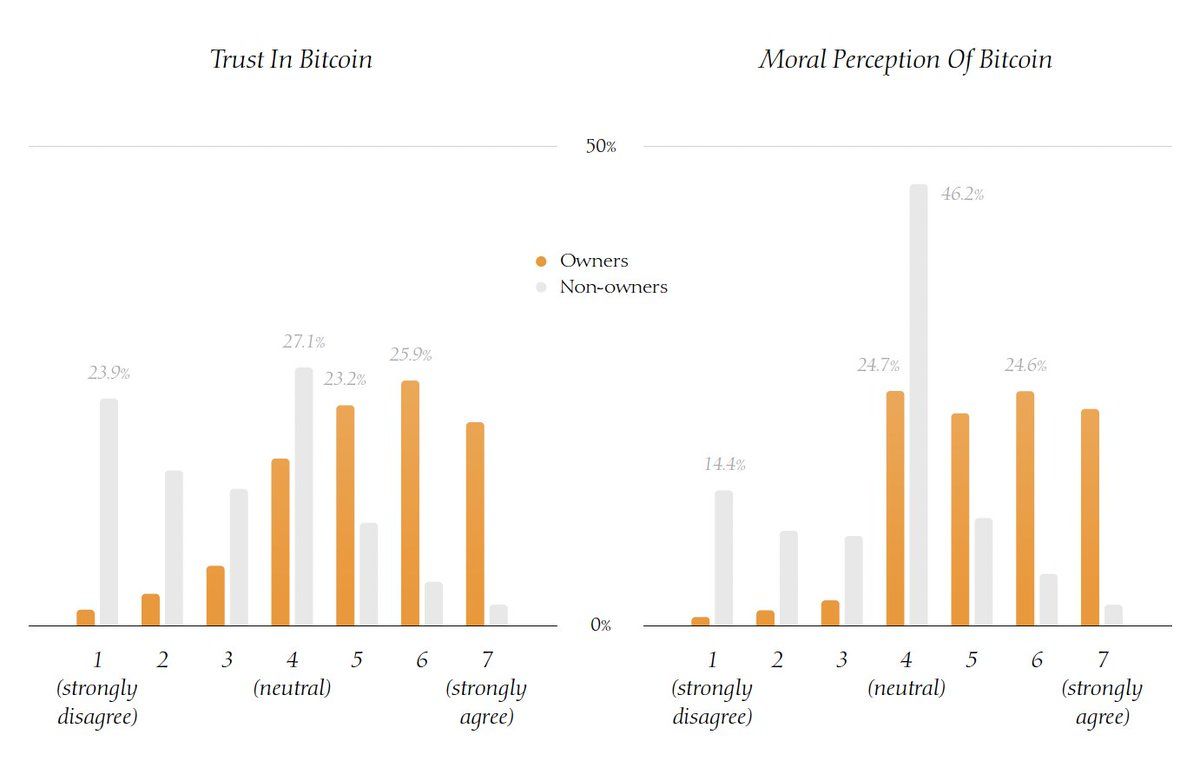
These four factors: Trust, Knowledge, Utility, and Perceived Morality , are the strongest correlates with Bitcoin holdings in our data. They also have strong correlations with each other. Here you can see how these factors compare to the Moral Foundation.

To summarize our findings, I quote the conclusion of our report:
“Given our polarized political discussions, one might argue that Bitcoin ownership is an identity, especially one that reflects political leanings.”
But we found that this is not the case. Bitcoin holders are politically similar to other Americans: most are moderate, with only a small number of conservatives and liberals.
Bitcoin holders are similar to other Americans in most demographics, with one notable exception: They tend to be younger and male.
What is most strongly correlated with Bitcoin holding is not who you are, but how much you know about Bitcoin and whether you think it is useful, trustworthy, and good.
It turns out that the 14% of Americans who own Bitcoin are not members of a particular political faction. Rather, they are regular Americans who have taken the time to research the technology and have formed a positive attitude toward it.
(For complete application, please refer to: https://thenakamotoproject.org )
Original link
Disclaimer: The content of this article solely reflects the author's opinion and does not represent the platform in any capacity. This article is not intended to serve as a reference for making investment decisions.
You may also like
Federal Reserve Holds Rates Steady, Oracle (ORCL.US) Surges 11% to Ignite Tech Stock Rally
The Federal Reserve maintained its interest rates at 3.75%~4.00%. Combined with Oracle’s strong growth guidance and SK Hynix’s record profits, the S&P 500 index rose for the third consecutive day, and the Nasdaq closed up 0.27%. Market focus is shifting to earnings reports from major tech companies.
99.3% shareholder vote: MicroStrategy (MSTR.US) preferred stock to start daily dividends
MicroStrategy has passed the bylaws amendment with a 99.3% approval rate, establishing a daily cumulative dividend mechanism for four preferred stocks including STRF. This move, together with a $204.9 million buyback plan, aims to address the risk of removal from the MSCI index and stabilize stock price volatility.

Global fund managers collectively shift! High yields and improved supply-demand resonate, making Japanese government bonds popular again
As signs of recovering domestic demand and a more favorable policy environment enhance the appeal of high yields, global fund managers are once again showing interest in the Japanese bond market.
AI Capital Rush! Global Bond Issuance Hits Historic Record
This year, global bond financing has reached $6.61 trillion, a 15% year-on-year increase, breaking the 2025 historical record two months early. The main driving force is the AI arms race—cloud computing providers and data centers have issued nearly $368 billion in bonds this year, six times more than last year, accounting for one third of the overall increase. Amazon has become the fourth largest bond issuer in the world, surpassing France and the UK. Citibank has warned that the capital demand from AI is pushing up the global neutral interest rate, which may structurally raise the long-term interest rate benchmark.
Crypto prices
More


