
Satoshi Era Bitcoin Wallet Awakens, Moves 50 BTC to Binance
 A Satoshi bitcoin wallet from the early days of Bitcoin has made an unexpected transfer of BTC.
A Satoshi era bitcoin wallet address, dormant for 14 years, reportedly transferred 50 BTC (approximately $3.05 million) to the Binance exchange on June 27.
The wallet is believed to belong to a Bitcoin miner who likely earned the 50 BTC as mining rewards in 2010.
Mystery Surrounds Satoshi Era Bitcoin Wallet Transfer
On-chain analytics firm Lookonchain revealed the Bitcoin wallet’s origins . It’s linked to a miner who received 50 BTC as a mining reward on July 14, 2010, just months after the Bitcoin network launched.
Back in 2010, one BTC was valued at a mere $0.003. This price wasn’t surpassed until February 2011, reaching $30 by June of that year.
Today, Bitcoin stands at $61,110 , reflecting a 16.99% decrease from its mid-March 2024 all-time high of over $73,750.
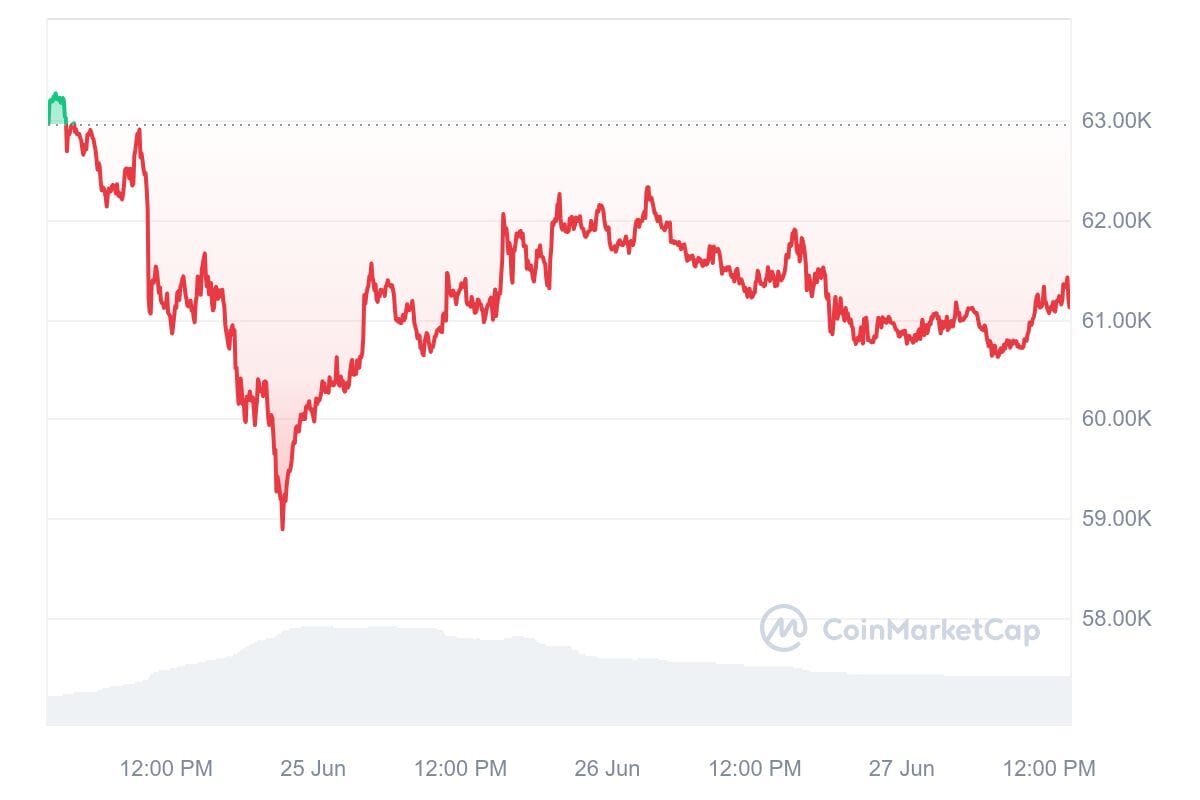 Source: CoinmarketCap / Bitcoin
Created during Bitcoin’s infancy (2009-2011), Satoshi bitcoin wallets hold historical significance.
This period marked the time when Bitcoin’s enigmatic creator, Satoshi Nakamoto, was still an active presence in the cryptocurrency community.
The wallets’ historical value, coupled with the limited transactions during that era, makes any movement of funds from them a notable event.
Satoshi Bitcoin wallets were created during Bitcoin’s early years, specifically between 2009 and 2011, when its pseudonymous creator, Satoshi Nakamoto, was still active in the cryptocurrency community.
These wallets are considered important due to their historical value and the relatively small number of transactions during that period, making any movement of funds from them noteworthy.
In 2010, Bitcoin mining was accessible to anyone with a personal computer, yielding a reward of 50 BTC. This accessibility stands in stark contrast to the current Bitcoin mining environment.
Four halving events have since reduced the block reward to a mere 3.125 BTC. These halvings, occurring roughly every four years, are integral to Bitcoin’s deflationary model.
This recent transfer from a Satoshi bitcoin wallet is not an isolated incident. It joins a growing list of dormant wallets springing back to life.
In March, a similar event occurred. A miner transferred 50 BTC, earned from mining on April 25, 2010, to Coinbase after 14 years of wallet inactivity.
The reactivation of these wallets often stirs interest and speculation within the cryptocurrency community.
Many are curious about the intentions behind these moves, whether they signal a change in market dynamics or simply represent a long-time holder finally deciding to liquidate their assets.
Bitcoin Whale Wake Alongside Satoshi Era Wallet Addresses
Bitcoin Whales, individuals or entities holding vast amounts of Bitcoin, possess the capacity to influence the cryptocurrency market through their sheer trading volume and holdings.
Two such Whale wallets, dormant for a decade, sprang to life on May 12, 2024 , transferring a combined 1,000 BTC.
Each wallet initially received 500 BTC (valued at $62K then) on September 12 and 13, 2013, when Bitcoin traded at $124.
In another noteworthy event on May 6, a Bitcoin Whale moved $43.893 million worth of BTC to two wallet addresses.
This Whale had remained inactive for over 10 years, having initially received the Bitcoin on January 12, 2014, when it traded at $917.
Disclaimer: The content of this article solely reflects the author's opinion and does not represent the platform in any capacity. This article is not intended to serve as a reference for making investment decisions.
You may also like
Morgan Stanley Quantitative Team: AI Chip Stocks Haven’t Bottomed Yet, Recommend “Reducing Positions on Rebounds”
Morgan Stanley’s quant team has warned that the sell-off in semiconductor and data center stocks is not over yet, as the current trend of the chip index resembles that of the internet bubble in 2000, indicating continued medium-term downside risk. They recommend taking advantage of rebounds to reduce positions, increase allocation to low-volatility and value stocks, and position in AI application companies. The report points out that the AI theme is shifting from upstream infrastructure to downstream applications, with AI adoption companies demonstrating relative resilience.
JPMorgan: If AI-driven profits persist, US stocks can withstand a 10-year Treasury yield rising to 5.5%-6.0%
JPMorgan pointed out that based on approximately 80 years of historical data, if the current forecast for forward EPS growth exceeding 20% is achieved, the S&P 500 has the capacity to absorb a rise in the 10-year U.S. Treasury yield to the 5.5%-6.0% range—especially under the premise that AI-driven productivity growth supports a high valuation environment.
Crypto prices
More


