Anthropic releases 2030 economic forecast: rapid economic growth, declining workers’ wages
Source: Innovation Observer
Regarding the impact of AI on work, the most frequently discussed question has always been: Will it cause mass unemployment?
But Anthropic's latest economic research raises a potentially more challenging question: What happens if AI not only fails to collapse the economy, but instead creates a wave of growth at a pace almost unprecedented in human history?
The answer is not necessarily that everyone gets richer together.
In the most radical scenario constructed by Anthropic, by 2030, US GDP may be 32.4% higher than the "no AI" baseline, with annual growth rates reaching as high as 15.4%, and the overall economic scale doubling roughly every 4.5 years. Meanwhile, the wages of knowledge workers may fall by more than 10%, the number of knowledge jobs shrinks sharply, and for the first time, capital's share of income exceeds that of labor.
In other words, a seemingly counterintuitive future may emerge: The economy expands at unprecedented speed, but many people's jobs and incomes become even less stable.
Recently, Anthropic Institute released a working paper titled “Economic Scenarios for Transformative AI”, attempting to systematically model the effects of AI from 2026 to 2030 on US GDP, wages, employment, unemployment rate, and the distribution of income between labor and capital.
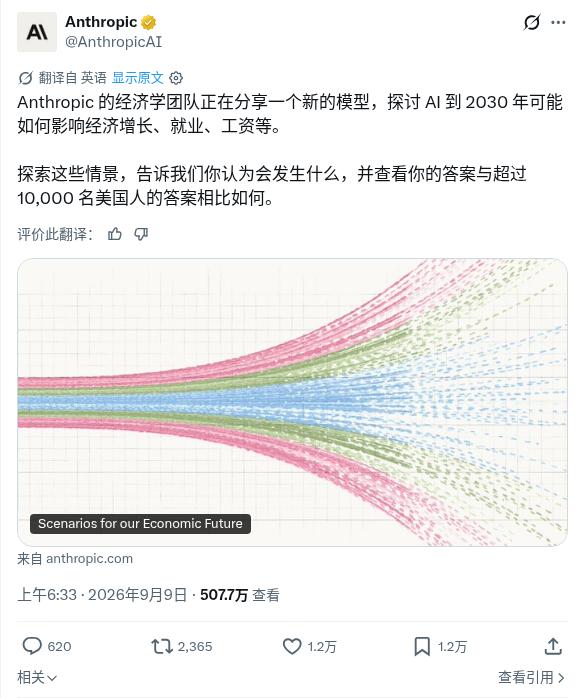
It is important to emphasize that Anthropic does not call these figures “predictions.” The research team clearly states this is a set of scenario models: researchers change parameters such as AI capability, adoption rate, degree of automation, productivity improvement, and the speed at which workers find new employment, then observe how the economy evolves under different conditions.
Precisely because of this, what truly matters in this research is not “what exactly will happen by 2030.” Rather, as AI capabilities continue to grow, there may—perhaps for the first time—be a dramatic decoupling between economic growth, employment, and wealth distribution.
Anthropic modeled three possible 2030s
Anthropic divides the future into three scenarios.
The first is relatively moderate change. Like the internet, AI becomes an important general-purpose technology, but its penetration is not that rapid, and the macroeconomic impact remains within historically understandable bounds.
By 2030, US GDP is 1.6% higher than the no-AI baseline, at about $34.1 trillion. Economic growth goes from about 2% without AI up to 2.4%.
In this scenario, AI does improve productivity, but there is no major shock to the overall labor market. The model’s overall unemployment rate is about 3.9%, and the wages of knowledge workers are even 0.4% higher than the no-AI baseline. This is actually the version of tech revolutions we are most familiar with.
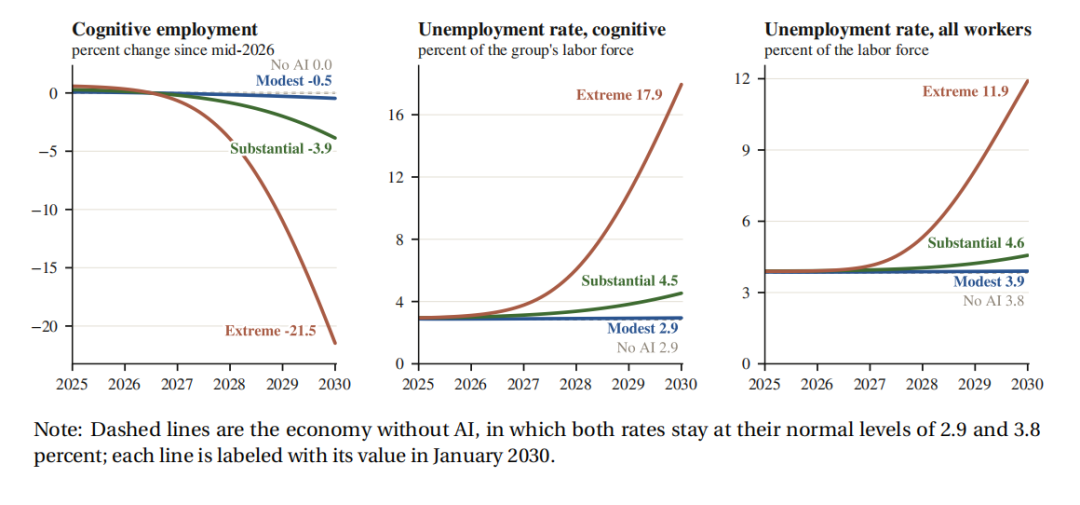
Labor market under three scenarios, 2025–2030
Corporate efficiency improves, some jobs disappear, some new ones are created, and ultimately the economy absorbs the technological shock.
The real changes start with the second scenario. Anthropic calls this “Substantial Change.”
In this world, by 2030, AI is already able to complete about half of all knowledge work, and a significant portion of that autonomously.
But “able to do” is not the same as “already adopted by all firms.” The actual rate of AI adoption lags behind the rate of capability growth, so plenty of work is still done by humans. Even so, the macroeconomy has already begun to shift.
By 2030, US GDP is 8.3% higher than the no-AI path, reaching $36.3 trillion; that year’s GDP growth rate is 5.4%, more than twice the 2% rate in the no-AI scenario.
But a major divergence emerges. Average overall wages are 2.1% higher than in the no-AI case, but the wages of knowledge workers are actually 0.3% lower.
Meanwhile, jobs not directly affected by AI see wages 5.9% higher. The number of knowledge jobs shrinks by 3.9% compared to mid-2026, and knowledge worker unemployment rises from 2.9% to 4.5%.
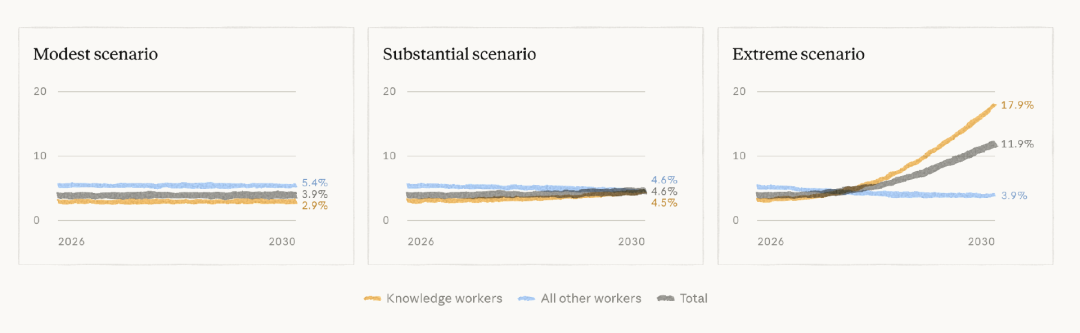
Rising unemployment in knowledge work
Here, a once-overlooked issue begins to surface: The productivity dividend from AI does not flow evenly to all workers.
The third scenario is by far the most extreme, pushing this divergence to another level.
GDP soars by 32%
Knowledge workers’ wages actually decrease
Anthropic calls the third scenario “Extreme Change.” Here, AI is truly beginning to restructure knowledge work.
By 2030, about 30% of all economic tasks are affected by AI, about half of all the tasks knowledge workers did in 2025. Of these, 90% of tasks are fully automated, with only about 10% done by humans aided by AI.
Crucially, the model assumes AI creates almost no new tasks for knowledge workers. This is where it departs most from previous technological waves, where automation often wiped out old tasks but also created new roles.
ATMs cut back on bank tellers’ cash-handling, but led bank branches to move staff into sales and customer service; the internet wiped out some offline jobs but created e-commerce, digital marketing, software and a host of new professions.
But if AI can continuously take over new knowledge tasks as humans create them, this cycle of “old jobs disappear—new ones appear” may be disrupted.
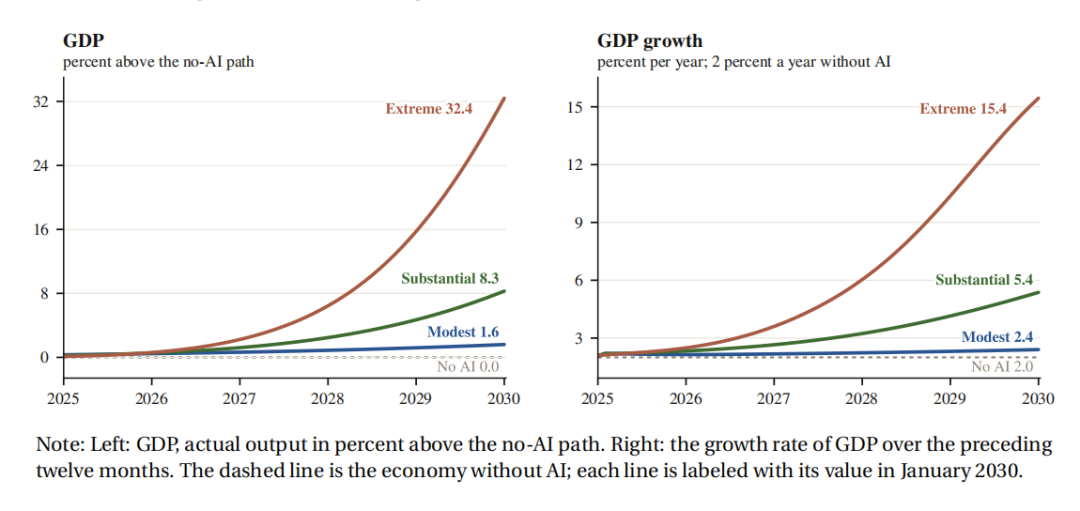
GDP and growth rate for three scenarios, 2025–2030
In Anthropic’s extreme model, the resulting productivity boost is astonishing. By 2030, US GDP is 32.4% above the no-AI path, at about $44.4 trillion. Annual growth rate is 15.4%.
If this rate is sustained, the economy doubles in size every 4.5 years; or as the technical report notes, per capita income doubles every five years, whereas historically it took roughly 35 years for US per capita income to double. This is a growth rate almost never seen for extended periods in modern economic history.
But the labor market does not enter a golden age in sync. Quite the opposite. In this scenario, although average societal wages are 9.7% higher than the “no AI” path, knowledge worker wages fall by 11.5%. Jobs not replaced by AI see wages 33.6% higher.
The worlds of software engineers, office clerks, customer service, sales, and professional services may look totally different from those of electricians, nurses, or construction workers.
The reason is not complicated: As knowledge work productivity rises sharply, fewer people are needed for each design, project approval, order, or software assignment. The supply of knowledge labor becomes “excess.”
At the same time, higher productivity creates more demand in the real world. Faster design and approval of a building may spur more construction projects; faster corporate expansion needs more construction, installation, care, and other real-world services.
Thus, a counterintuitive model result appears: the better AI is at knowledge work, the less “relatively scarce” human knowledge labor becomes; whereas many real-world jobs AI cannot easily do become more scarce. The issue is not just wages.
By 2030, knowledge job numbers in the extreme scenario are down 21.5% versus mid-2026. Knowledge worker unemployment reaches 17.9%. Total US unemployment is 11.9%.
This means AI can easily produce two seemingly contradictory figures at the same time: 15% economic growth, and nearly 12% unemployment.
In the past it was easy to associate “economic boom” with “employment boom.” Anthropic’s model suggests these two indicators may, for the first time, move in completely different directions at high speed.
The real change
may be “who gets the growth?”
If you only read to here, the study may still sound like just another “AI takes jobs” report.
But Anthropic’s key insight is found in another figure: labor’s share of income. Today, for every $1 an economy creates, about 60 cents goes to workers, 40 cents to capital.
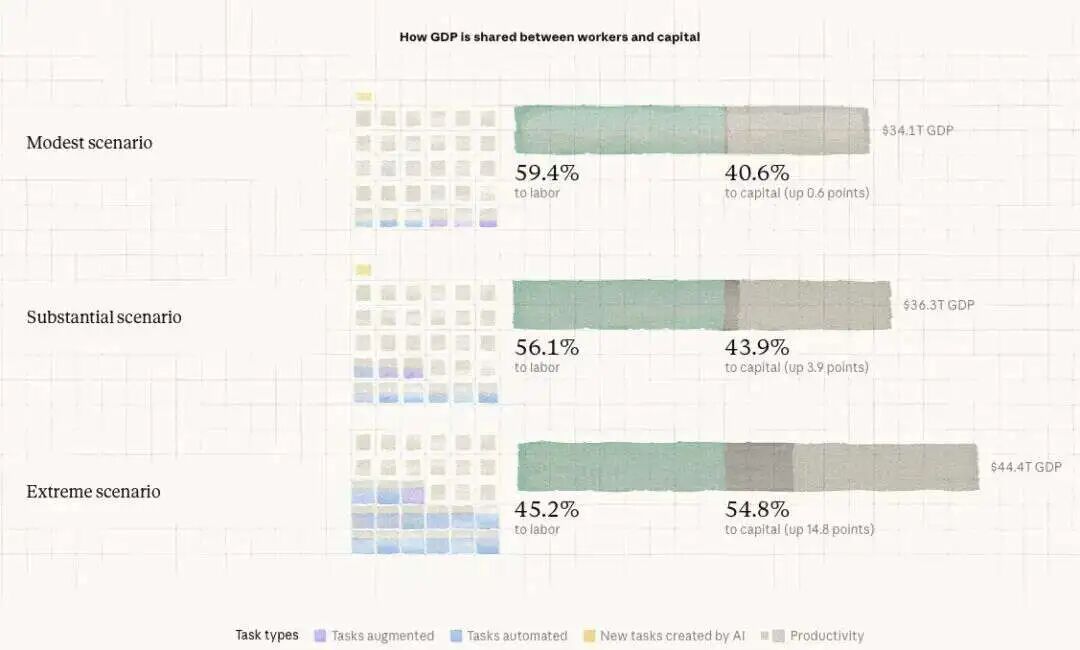
How GDP divides between US workers and capital
Of course, this is a macro-level simplification. But it provides a crucial perspective: After growth, where does the new wealth ultimately flow?
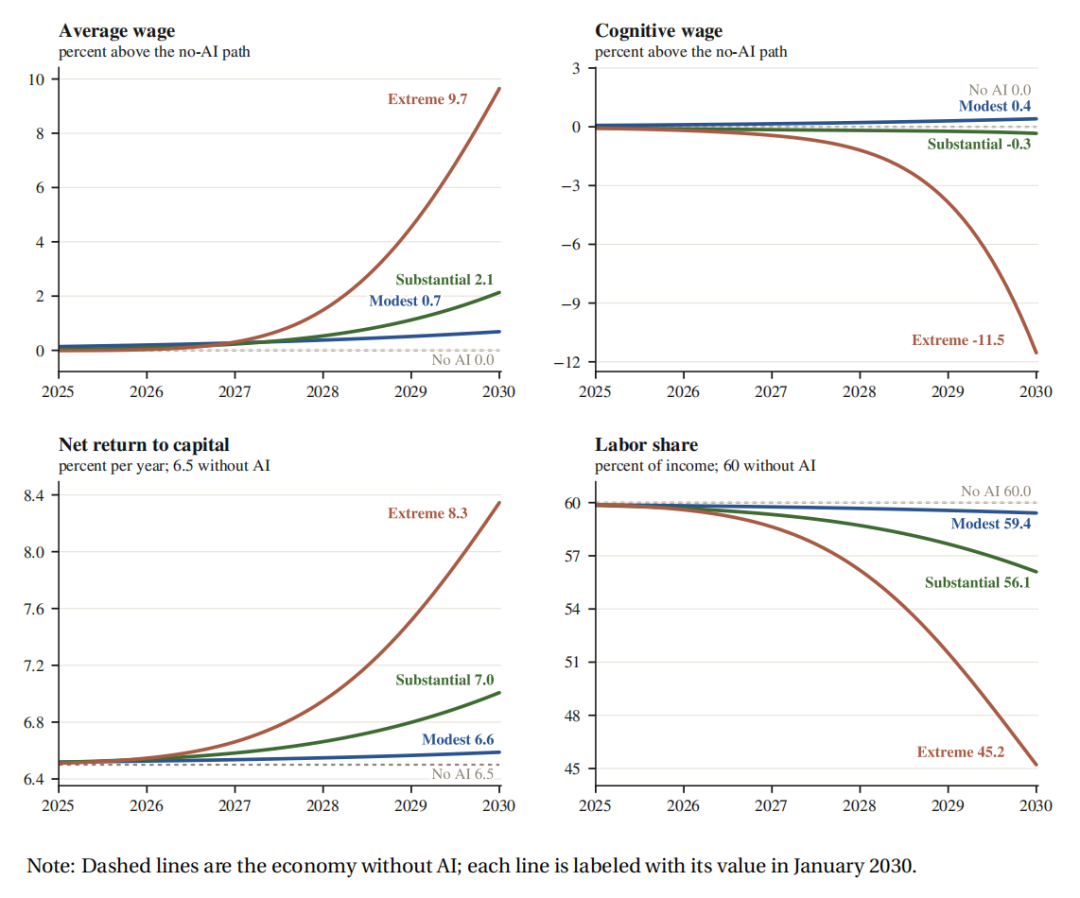
Factor prices and labor share across three scenarios, 2025–2030
Anthropic’s three scenarios give radically different answers. In the moderate scenario, by 2030 labor still receives 59.4% of GDP, capital 40.6%. In the substantial change scenario, labor’s share falls to 56.1%, capital rises to 43.9%.
In the extreme scenario, for the first time, the two swap places: labor gets just 45.2%, capital rises to 54.8%. The economic pie becomes unprecedentedly large.
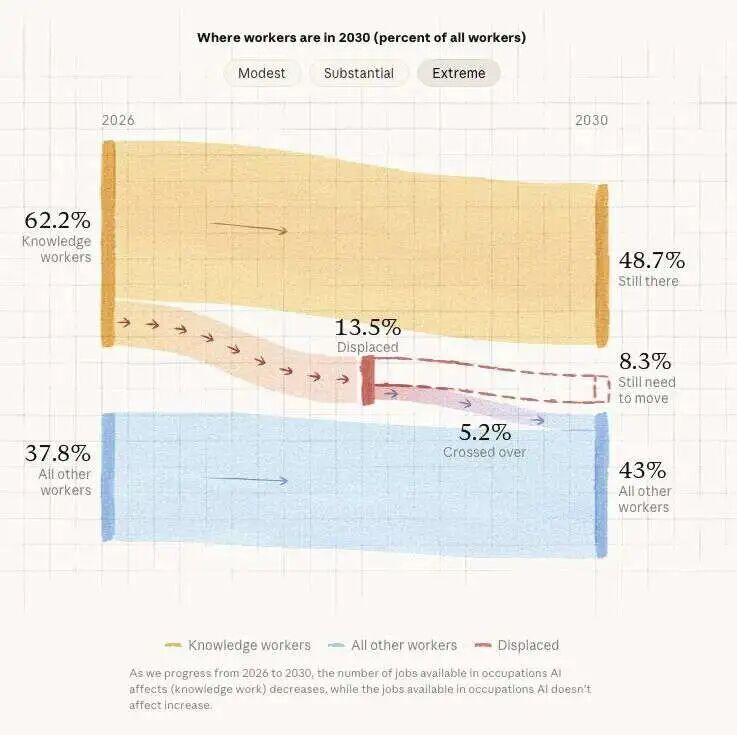
Labor force distribution in the extreme scenario, 2030
The way the pie is sliced changes, too. The logic: As AI can use computing, data centers, chips, software, and other capital to do more work formerly done by humans, capital itself gains importance.
Firms need more computing power, bigger data centers, more advanced chips, and more AI-enabled infrastructure. Thus, the dividends of higher productivity no longer flow mainly to workers via wages—an ever-larger portion goes to capital owners as returns.
In the extreme, the shift is staggering. Anthropic’s technical report estimates that though 2030 GDP is about a third higher, the total income received by workers is barely increased compared to the no-AI scenario.
The reason can be captured by a simple formula: GDP rises by about 32%, but labor’s share falls from 60% to 45%. The economic surplus generated is almost entirely absorbed by increased capital income; capital's income is 81% higher than the no-AI path.
This may be the most important phrase in the whole report: The biggest economic question with AI may not be whether it can create enough wealth, but how that wealth is divided once it’s created.
Past debates on AI have often focused on productivity: Can one worker do the work of three? Can a company cut costs by 30%? Can a team do in a day what used to take a month?
But if we shift focus from firms to the whole economy, the problem changes. A person’s efficiency increasing tenfold does not mean their income goes up tenfold. It doesn’t even mean the company still needs that person.
The most critical period
may be after 2027
One further detail is worth noting. Anthropic points out that the three scenarios only truly start to diverge significantly after 2027. The reason: all three models are rooted in currently observable data.
In the short term, differences are minor. What causes the real gap is the speed at which AI capability and adoption advance in coming years, and the balance between “human augmentation” and “direct automation.”
In other words, seeing only a limited AI impact on the overall job market by 2026 does not mean we know which scenario will play out. It may mean AI is ultimately just a generic tech like the internet. It may also simply mean the more dramatic change has not yet started.
Anthropic also surveyed 10,980 US adults about their expectations for AI’s capabilities, adoption, autonomy, productivity, and reemployment time after unemployment. Feeding these responses into the model produced an interesting result:
The typical American respondent’s expectation is not the most moderate scenario, but in fact aligns closely with Anthropic’s “Substantial Change” scenario.
Among those whose responses were used for the full simulation, the median scenario for 2030 is: GDP 8.6% higher than no-AI, annual growth rate of 5.3%, knowledge jobs down 4.2%, and overall unemployment at about 4.6%.
In other words, even without Anthropic’s most extreme assumptions, ordinary people’s expectations already point to an AI-reshaped economic structure.
The real question
is no longer just “Will AI replace me?”
Of course, the study is still subject to much uncertainty. Anthropic repeatedly warns not to treat this as a road map for 2030. The model does not fully account for government policy, business cycles, financial market volatility, or aggregate demand shifts. Nor does it consider catastrophic risks.
It crudely splits workers into knowledge and other categories, without refining for age, location, skills, or company differences. It even deliberately leaves out the rapid advancement of humanoid robotics.
Once robots enter the real world en masse, “safe” occupations in construction, manufacturing, or care—as shown in today’s model—could be impacted as well. Thus, the $44.4 trillion GDP and 17.9% knowledge worker unemployment figures should not be interpreted as Anthropic’s precise forecast for 2030.
They are more a stress test. Anthropic’s real question is: If AI does get strong enough, can our current economic system withstand this leap in productivity?
For the past 200 years, humanity has followed a fairly stable logic when facing new technology: Machines boost productivity, which drives growth; companies expand investment; new industries create jobs; and wages eventually rise. The Industrial Revolution, electrification, autos, computers, and the internet have all fit this cycle.
The great unknown about AI is that it may plug directly into the heart of that cycle: human labor itself.
If machines replace a type of equipment, workers can learn to use that equipment. If machines replace a task, they can switch tasks. But if AI becomes ever more general, always learning new knowledge tasks, then “where should people transition” becomes a much harder question than before.
Yet Anthropic’s model suggests another answer: Workers are not necessarily without options. Huge demand may shift to healthcare, care, construction, electrical work, manufacturing, and other real-world services. What’s difficult is that becoming an electrician from a software engineer, or a nurse from a financial analyst, or going from office work to construction, is not something that can be “solved by retraining.”
Behind occupations are education, skills, experience, geography, income expectations, and personal choices. Technology may adjust in months, but people may need years. This “lag” is where unemployment happens. So, after reading Anthropic's report, what may be most important to remember is not “How many jobs will AI destroy?”
But rather these three more fundamental questions: How much value does AI create? Who does that value ultimately belong to? How long will it take for workers displaced by technology to find their new place?
If AI’s capabilities only rise slowly, the answers may not differ much from the internet era.
But if it really develops along a more radical path, by 2030 we may face a new kind of economic problem: It’s not that there isn’t enough wealth. It’s not that productivity is too low. It’s not even that growth is too slow.
It’s quite the opposite—as machines grow the economic pie ever larger, humanity will have to answer, once again, how we divide that pie.
Source: Anthropic





