After including the $628 billion off-balance-sheet commitments in valuation, is Meta stock "35% more expensive"?
Meta’s off-balance-sheet liabilities of approximately $628 billion have long been hidden in financial statement footnotes. Once this number is added into enterprise value calculations, the valuation framework for mega-cap tech stocks is facing an overhaul.
On October 2, Needham analyst Laura Martin published a research report pointing out that if Meta’s off-balance-sheet commitments are included in enterprise value (EV), its valuation multiple would rise by 35%, making the stock far more expensive to shareholders than traditional metrics suggest.
Martin subsequently stated on CNBC: "Meta’s on-balance-sheet debt and leases total about $100 billion, with off-balance-sheet liabilities reaching $600 billion. If you don’t include that $600 billion in EV, your valuation is 35% too low." This assessment directly challenges the market’s pricing logic for Meta.
More importantly, when Needham’s methodology is consistently applied to Alphabet, the conclusion dramatically reverses: Google’s adjusted EV/FY27E revenue multiple reaches 9.0x, above Meta’s 8.3x—meaning that after fully disclosing off-balance-sheet liabilities, Google actually becomes the more expensive company by valuation. Meanwhile, Meta added approximately $68 billion in new data center leases in July alone, indicating that expansion of off-balance-sheet obligations is accelerating. Whether the market has fully priced in this hidden leverage has become a core issue mega-cap tech investors can no longer ignore.
A 5.6x Gap Between Meta’s On- and Off-Balance-Sheet Liabilities
Needham’s analytical framework is rooted in basic accounting principles. They argue, "Equity value is what remains for shareholders after debts and other contractual obligations are repaid," so regardless of accounting treatment, ever-increasing obligations and commitments act as a drag on share price appreciation and should be included in EV calculations.
Specifically for Meta, as of the end of June 2026, its on-balance-sheet debt and leases total about $112 billion, while its two main off-balance-sheet liabilities add up to about $628 billion—a ratio of 5.6x. That is, for every $1 of leverage disclosed on Meta’s books, there’s another $5.60 hidden in the footnotes.
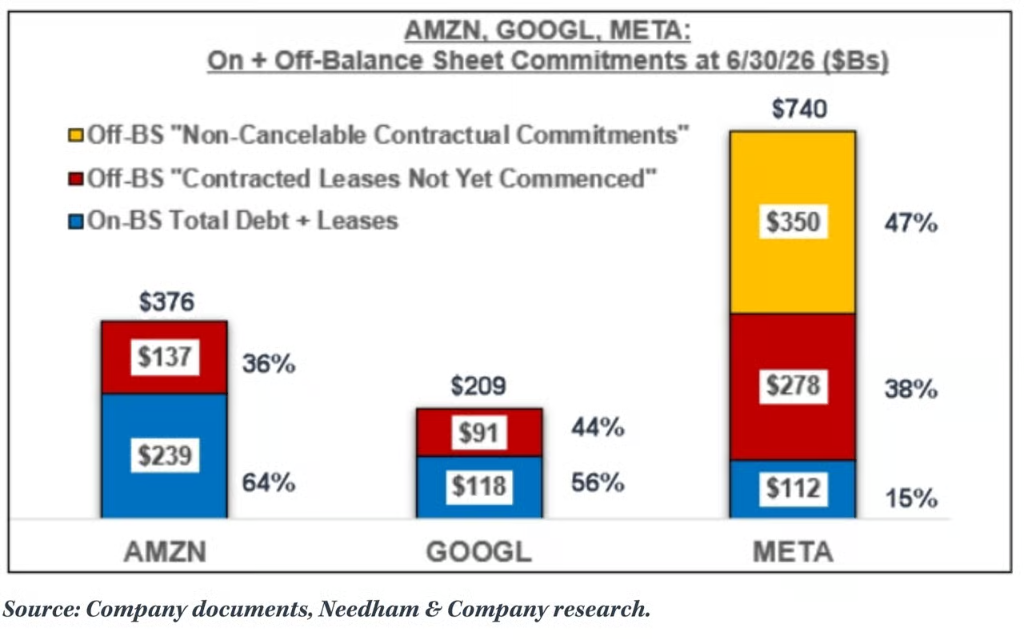
The composition of these two off-balance-sheet liabilities is clearly disclosed in Meta’s Q2 10-Q, footnote 9: First, about $279 billion in operating and finance lease obligations not yet commenced, related to data centers, hosting facilities, and certain network infrastructure, with terms extending from 2026 to 2036 and up to 30 years; second, about $349.3 billion in non-cancellable contractual commitments, primarily third-party cloud capacity arrangements, servers and network infrastructure investments, data center construction, and Reality Labs consumer hardware products, with about $53.5 billion and $81.7 billion maturing in 2026 and 2027, respectively. Additionally, Meta has as much as $14.7 billion in contingent cloud capacity purchase obligations.
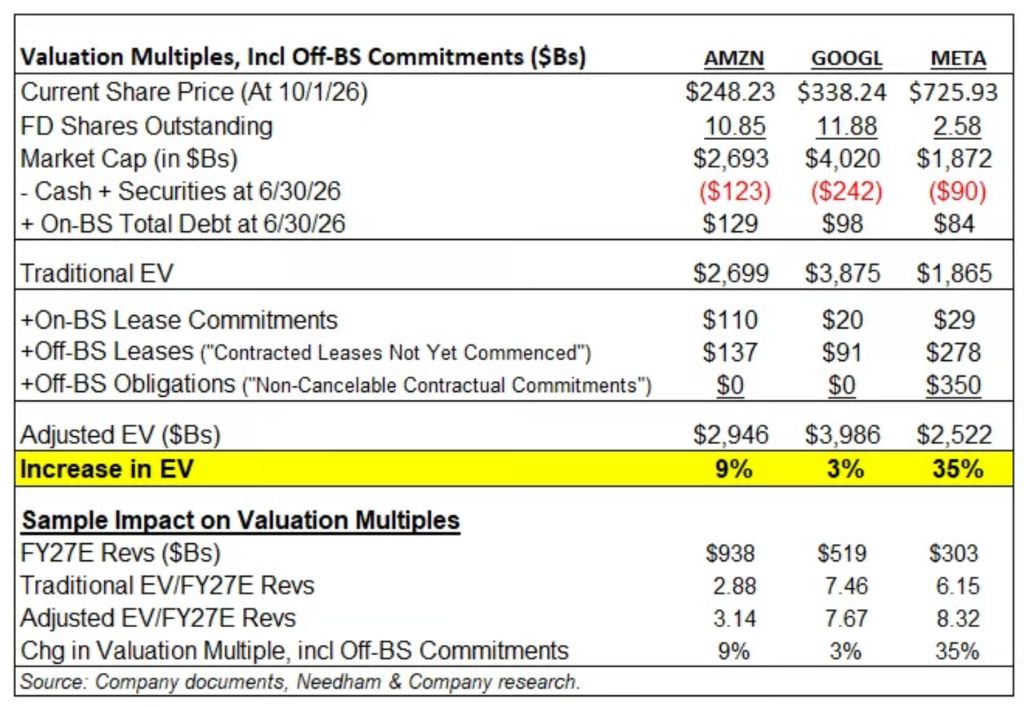
After adding these off-balance-sheet liabilities to EV, Meta’s EV/FY27E revenue multiple rises from 6.15x to 8.32x, a 35% increase.
An Accelerating Pace of AI Infrastructure Commitments
The figures above do not yet reflect the latest developments. Meta disclosed in its Q2 10-Q that as of July 2026—i.e., after the quarter ended—the company signed an additional $68 billion in new data center lease obligations.
This means that in just one month, the newly added lease commitments are equivalent to approximately 80% of Meta’s total on-balance-sheet debt as of the end of June (about $84 billion), increasing the “not yet commenced” lease obligation bucket by more than 10% even before Q3 ends. Needham therefore concludes that Meta’s off-balance-sheet obligations are showing “rapid growth” in Q3.
According to research from Goldman Sachs credit strategist Amanda Lynam in August, as of the Q2 earnings season, mega-cap technology companies collectively tracked $1.5 trillion in lease commitments, with $1.0 trillion in leases not yet commenced. Due to special US GAAP lease accounting treatment, these “not yet commenced” lease commitments are not presented on financial statements, but will become actual payment obligations in the coming years. Lynam points out that this may “understate leverage and future liquidity needs” and expects that “AI-related issuers will continue to endure additional spread risk premia.”
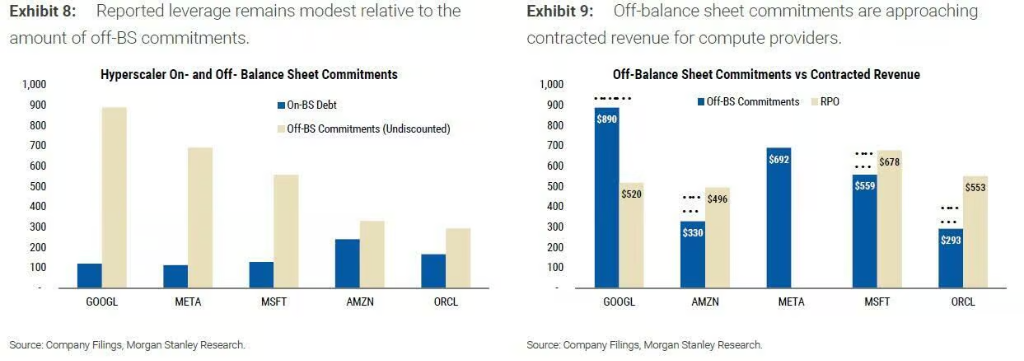
Morgan Stanley’s accounting team (including Todd Castagno) extended the statistical scope at the end of August to include Nvidia, Broadcom, and various guarantees or backstops, calculating total off-balance-sheet commitments topping $3.1 trillion. According to ZeroHedge tracking, by September 30, mega-cap tech firms’ off-balance-sheet liabilities reached $3.8 trillion—up about $700 billion from the end of June.
Google Is the More “Expensive” One: Consistent Application of Needham Methodology
Needham’s original research report had a notable methodological flaw: It listed “non-cancellable contractual commitments” for Amazon and Alphabet (Google’s parent) as zero, but their financial disclosures do not support this.
Alphabet’s Q2 10-Q disclosed $707 billion in long-term purchase commitments—consistent with Morgan Stanley’s approach; Amazon disclosed $130 billion in unconditional purchase obligations. These commitments are of the same nature as those counted for Meta by Needham.
When Needham’s methodology is applied consistently across all three companies, conclusions change significantly:
-
Alphabet: The EV increase goes from 3% in Needham’s original report to 21%, and the adjusted EV/FY27E revenue multiple rises to 9.0x, above Meta’s 8.3x;
-
Amazon: The EV increase goes from 9% to 14%;
-
Meta: If we also include the new $68 billion July lease addition, guarantee exposures on the Hyperion and El Paso data center projects (about $46 billion and $13 billion in maximum loss exposure, respectively), and the $14.7 billion contingent cloud purchase obligations, the real adjustment approaches 42%.
In other words, Meta still has relatively the largest off-balance-sheet leverage among the three, and Needham’s core argument holds; but the original “35% versus 3%” comparison vastly understated Google’s off-balance-sheet liability scale. After full adjustment, Google actually becomes the more expensive stock on an EV/revenue multiple basis.
Has the Market Priced in This Hidden Leverage?
Supporters argue that purchase commitments are not traditional debt—they are contracts for servers, cloud capacity, and chips that Meta expects to monetize. Credit rating agencies typically treat lease liabilities as equivalent to debt, but do not treat purchase obligations the same way. In addition, Meta’s disclosed $628 billion in off-balance-sheet liabilities is an undiscounted figure; calculated at present value, the EV impact will be narrower.
However, the rebuttal is also strong. Morgan Stanley cautions: “These contracts are strategically valuable in periods of tight supply, but should supply and demand normalize sooner, companies may have to pay for excess capacity or renegotiate terms.” In other words, the premise that purchase commitments are “not debt” is valid only as long as the company always needs what it has agreed to buy.
Free cash flow is already showing signs of pressure. According to Morgan Stanley, Amazon and Google’s free cash flows turned negative in Q2, and Meta is expected to post negative free cash flow in the next quarter as well.
In the bond market, Goldman Sachs data indicate that bond issuance by mega-cap tech companies has already reached $250 billion this year, a sharp jump from under $20 billion in 2024. The forecast for 2027 is $420 billion, and that figure does not include data center financings made through special purpose vehicles (SPVs)—a core component of the current off-balance-sheet structure identified by Morgan Stanley.
Needham maintains its “Hold” rating on Meta; its concerns are not just accounting-related. Laura Martin points out that Meta is simultaneously pushing ahead on custom chips, data centers, enterprise AI, business agents, model APIs, compute sales, smart glasses, and other fronts: "Management attention, engineering talent, and shareholder capital are spread across too many directions." With $628 billion in commitments, there’s much less room for error.
Meta’s Q3 10-Q is expected at the end of October. With the $68 billion in new leases already a done deal in July, the direction of those footnotes is all but certain to the market.





