Institution: Gold price may dip to $4,000 in the short term, but could still challenge $5,000 within six months
FXheadlines September 29, News—— Akash Doshi, Head of Gold Strategy at State Street Global Advisors, stated that rate hike expectations have pushed up US Treasury yields, and gold prices may test the $4,000 support level in the short term. However, this support is relatively strong, and there is still hope for gold to challenge $5,000 within six months. The US Treasury term premium is rising on fiscal imbalance, Asian countries’ gold imports have hit record highs, Western gold ETF inflows continue, gold options are turning bullish, and structural buying is supporting gold prices. As a result, interest rates are no longer the sole driver of gold’s price.
As market rate hike expectations intensify, US Treasury yields continue to soar, and gold prices may fall back to $4,000 per ounce next week. However, Aakash Doshi, Head of Gold Strategy at State Street Global Advisors, believes
Short-Term Tactical Headwinds – Gold May Test $4,000 Support
Akash Doshi said that the market is repricing a more aggressive path for the Federal Reserve, the dollar is strengthening at the same time, and gold is facing obvious short-term pressure. Since mid-August, the market has priced in two additional Fed rate hikes, and long-term yield expectations have seen a major shift. Gold is enduring the most hawkish Fed expectations in this cycle, with both nominal and real yields rising, combined with dollar strength, suppressing precious metal prices.
Given drastic changes in rate expectations, it is not surprising to see a pullback in gold prices. He said: “A few more rate hikes from the Fed are indeed a short-term headwind for gold, and high real yields will make the road to $5,000 more difficult for gold.” However, he emphasized that this round of price corrections has not fundamentally altered gold’s long-term structural outlook.
Doshi gave an example: Before the COVID-19 pandemic, the US 10-year Treasury yield was around 1.5%. Few investors could have predicted that six and a half years later, the 10-year Treasury yield would approach 5.3%, yet gold prices would still hold near $4,000. This divergence sufficiently proves that, aside from the traditional interest rate logic, strong structural factors also dominate gold price trends.

US Treasury Term Premium Surges; Fiscal Imbalance Becomes the Core Variable
In its September Gold Monthly Report, State Street highlighted that identifying the causes of rising yields is essential. Due to fiscal imbalances, persistent inflation risks, and geopolitical uncertainty, the long-term term premiums of the US, UK, France, and Germany have climbed to their highest levels since 2011. In August, the size of US public debt exceeded $40 trillion, and the latest $1 trillion increase took only about five months.
Doshi explained that the main drivers of higher term premiums are threefold: market concerns about the credibility of policy institutions, ongoing inflationary pressure, and fiscal imbalances combined with an expansion in US Treasury supply. The rise in interest rates essentially represents a market repricing of the sustainability of US fiscal policy, and such risks cannot be resolved merely by raising rates. As a hedge against fiat monetary systems, gold's long-term value will continue to stand out.
Dual Support from Physical and Investment Demand, with Bullish Signals in the Derivatives Market
Gold's underlying demand remains robust, with physical and investment buying from Asian countries providing continuous support. According to State Street data, in the first seven months of 2026, non-monetary gold imports from Asian countries reached a record 1,000 tons, up 78% compared to the same period last year.
Western investors are also actively increasing gold allocation during price pullbacks. September gold ETF inflows show that institutions are strategically increasing exposure to gold as a hedge against macro policy uncertainty and fiat currency risk. In August, Western investment demand had already rebounded significantly, with global gold ETFs absorbing $17.1 billion that month. US-listed gold funds attracted $7.9 billion, marking the strongest monthly inflow since September 2025.
The open interest structure in the options market also favors higher gold prices. Doshi introduced that the long-term volatility skew remains positive, and investors are more willing to position themselves with calls betting on the upside. State Street’s September report noted that the flow of funds in gold derivatives has shifted from being dominated by puts to calls, with call option premiums continuing to rise relative to puts, reflecting institutional capital being bullish on gold prices over the long term.
Conclusion
Overall, short-term expectations for Fed rate hikes and rising US Treasury yields will put pressure on gold and may push prices down to around $4,000 per ounce. However, support at $4,000 is solid—US fiscal deficits, high debt interest burdens raising Treasury term premiums, strong physical gold imports from Asian countries, and ongoing inflows into global gold ETFs are structural forces that will not disappear with a few rate hikes. Although the road to $5,000 has become more winding, the case for gains over a six-month horizon remains intact.
Investors should closely monitor changes in long-term US Treasury yields, comments from Federal Reserve officials, as well as flows into global gold ETFs, in order to judge the depth of any gold price pullbacks and timing of rebounds.
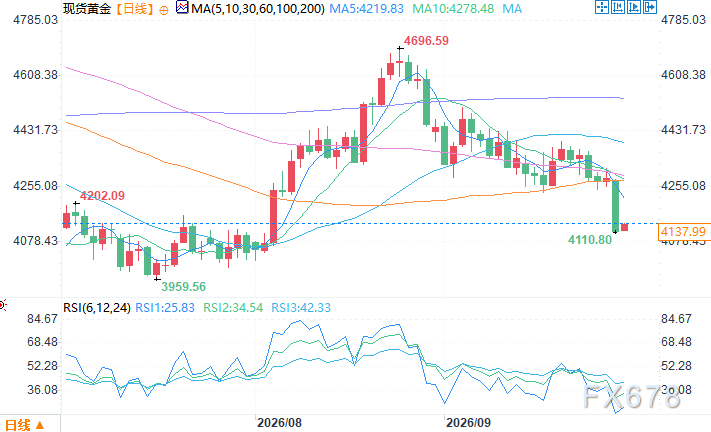
Gold Spot Daily Chart Source: eFXheadlines
East 8 Time Zone September 29, 11:17 Gold Spot Price $4,135.49/oz





