PI trades near $0.09771, up 0.44% today, pushing against the upper boundary of a rising wedge that’s held since the sharp July drop from the $0.13 to $0.14 zone down to a low near $0.07. That wedge has been narrowing for two months, with today’s candle testing its top edge directly.
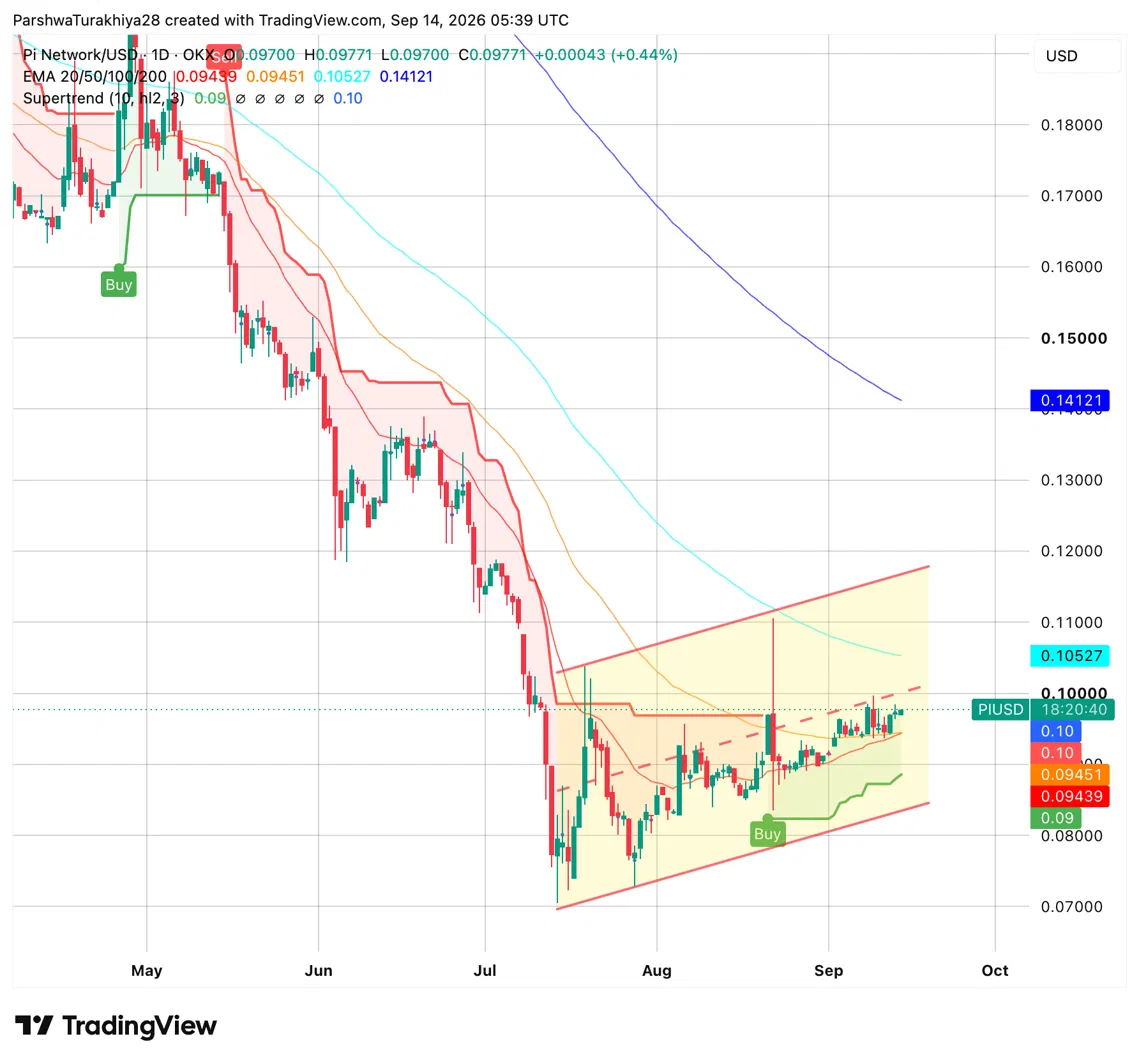
The Supertrend indicator currently reads $0.09 in buy mode, sitting just below current price and confirming the short-term trend remains bullish. Price stays above the 20-day EMA at $0.09439 and the 50-day at $0.09451, both essentially flat and converging with price, while the 100-day at $0.10527 and 200-day at $0.14121 remain well overhead, both still trending down from earlier in the year.
| Type | Price |
| Resistance | $0.0977 |
| Resistance | $0.10 |
| Resistance | $0.1053 |
| Support | $0.09 |
| Support | $0.0944 |
| Support | $0.08 |
Pi Network is targeting September 15 for Protocol 27’s mainnet completion, following its successful move to Testnet after Protocol 26 finished on Mainnet, according to the Pi Core Team. The upgrade introduces more flexible and secure smart contract authentication for accounts and applications, laying groundwork for more advanced transaction approvals and services, though the date remains tentative.
The practical impact for most users is limited at launch. Node operators need to upgrade to version 27.1 to stay connected, but regular users and mobile miners don’t need to change anything. Claims that all pending features, including a decentralized exchange, will be available immediately on September 15 remain unverified.
GCV ambassador Dimas Nawawi told the Pi community to ignore short-term noise around PiDEX, Protocol 27, and Protocol 28, and judge the network by its GitHub activity instead, pointing specifically to a project called PiCoinStellar. He also repeated his usual advice: don’t sell or transfer mined Pi to exchanges.
The code he cited sets a stablecoin peg at $314,159 per Pi. That number comes from GCV, a long-running community valuation theory with no backing from the Pi Core Team, any exchange, or any independent market data provider.
Separately, Nawawi has floated that PiPay, a payment system built by community developer Kosasih, could eventually support a Pi-based stablecoin. Official Pi Network development stays focused elsewhere, on Open Network utility, merchant payments, and the Protocol 27 rollout, and the Pi Core Team has never recognized any Pi stablecoin, community-built or otherwise.
PI holds above $0.09 and breaks decisively above the wedge resistance near $0.0977 to $0.10. A clean Protocol 27 mainnet completion without delays could act as the catalyst, opening room toward the 100-day EMA at $0.1053.
PI loses the Supertrend support at $0.09 and slips back toward the wedge’s lower boundary near $0.08. A delayed or messy Protocol 27 rollout, combined with unmet expectations around features like PiDEX, could trigger that pullback.
PI could extend toward $0.1053 if it clears the wedge resistance near $0.0977 to $0.10 and holds above $0.09. Losing $0.09 risks a slide toward the wedge’s lower boundary near $0.08.
It introduces more flexible and secure smart contract authentication for accounts and applications, a technical foundation for developers rather than an immediate feature launch for regular users, who don’t need to change anything with their accounts.
No official body recognizes it. The figure comes from a community valuation theory called GCV and has never been acknowledged by the Pi Core Team, any exchange, or any independent market data provider.
Not officially. Community projects like PiPay have floated the idea, but the Pi Core Team has never recognized any Pi-based stablecoin, and official development remains focused on Open Network utility and the Protocol 27 rollout.





