Bitget App
Trade smarter
MarketsTradeFuturesStocksEarnInstitutionAI & More
Raydium crypto surges 14% as negative funding raises short squeeze prospects

Raydium crypto surges 14% as negative funding raises short squeeze prospects

AMBCryptoAMBCrypto2026/10/08 21:33

Raydium [RAY] spent most of the summer going nowhere. Then in early September, it finally woke up.

Why does that matter today? Here’s the rundown.

Raydium crypto jumps 14% in a day!

Most of the market had a bad week, but Raydium clearly did not get the memo.

@media only screen and (min-width: 0px) and (min-height: 0px) { div[id^="bsa-zone_1774359638628-7_123456"] { min-height: 50px; transition: min-height 0.3s ease; } } @media only screen and (min-width: 640px) and (min-height: 0px) { div[id^="bsa-zone_1774359638628-7_123456"] { min-height: 90px; } }
AD

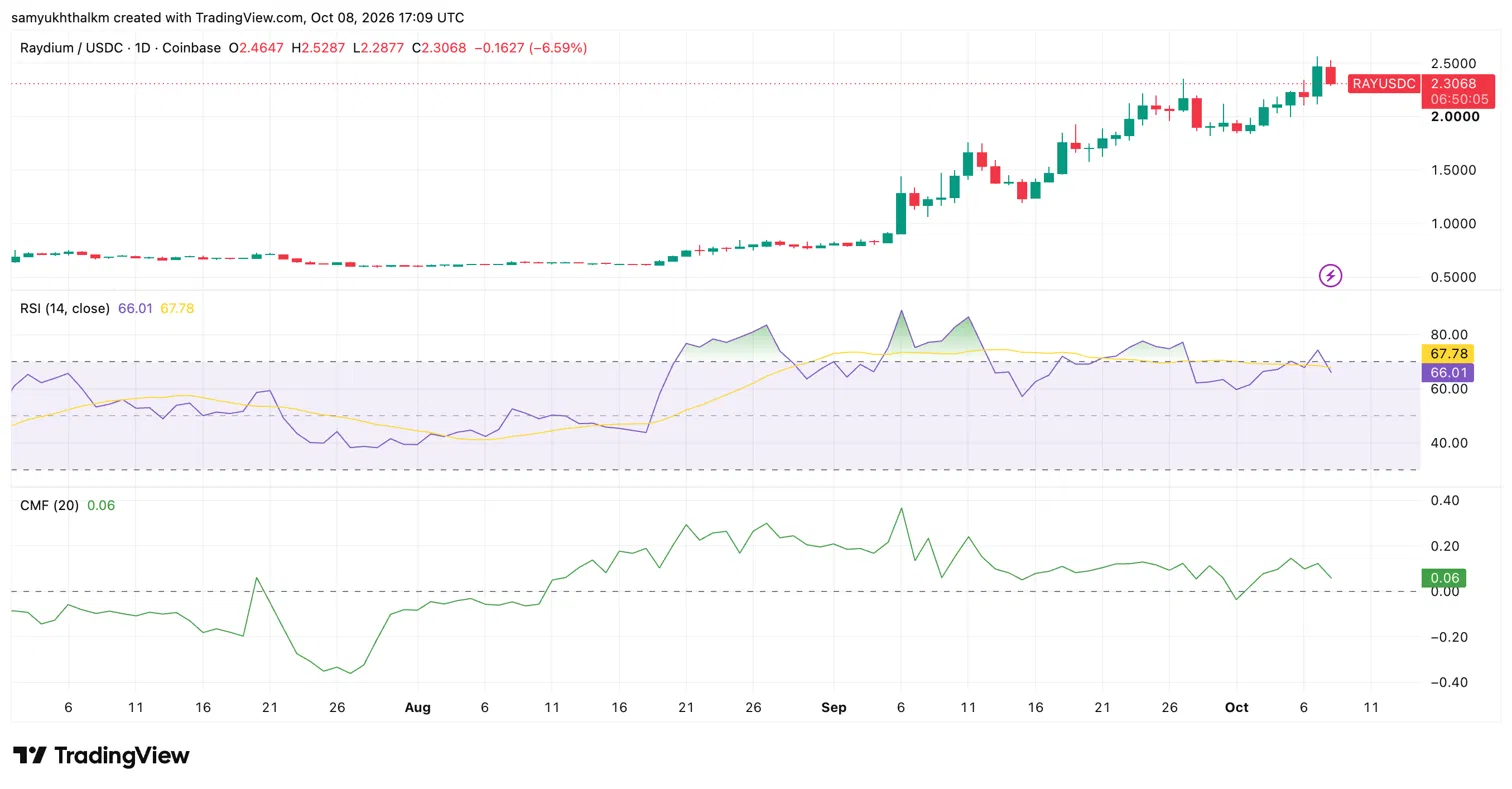
RAY traded around $0.90 before its September breakout and climbed as high as $2.56 on 7 October, an increase of roughly 184%. Even after retreating to $2.31, the token remained more than 150% above its early-September level.

That hardly makes a difference if you think of the bigger picture. Before its breakout on September 5, RAY was around $0.90.

It has more than doubled in the past month alone.

The pace is still there, but the tiredness is obvious. RSI was at 66; back in September, it was running above 80.

Chaikin Money Flow is positive at 0.06, but well off its September highs.

But here’s where it gets interesting.

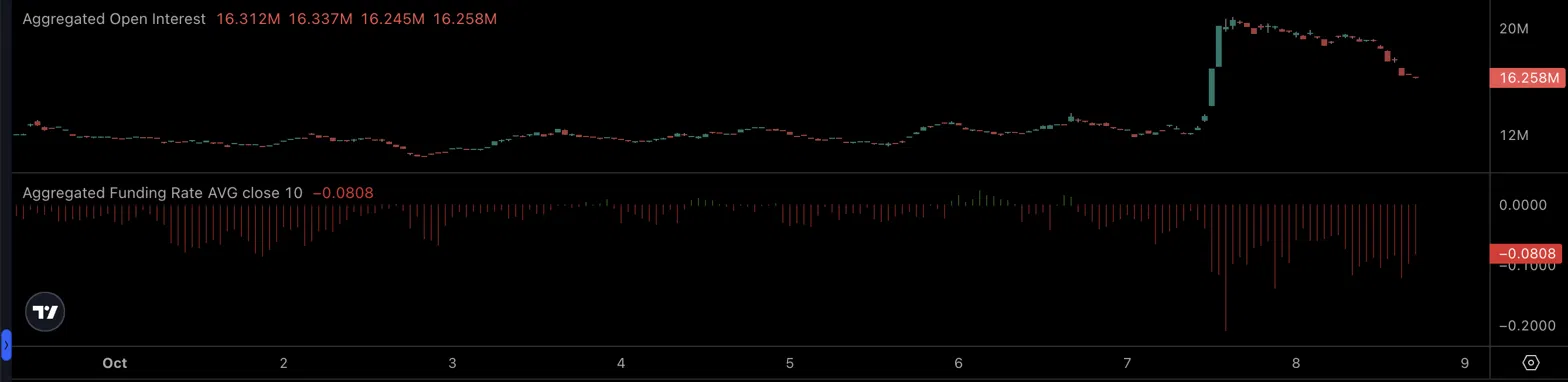
OI went from about $13 million to over $20 million during today’s rally. At the same time, funding went deep into the red, close to -0.20%.

A lot of traders opened short positions, betting the pump wouldn’t last. OI has since dropped to about $16.3 million, and funding is still negative at -0.08%.

The bears are still here, but in fewer numbers.

Why is RAY running when everything else isn’t?

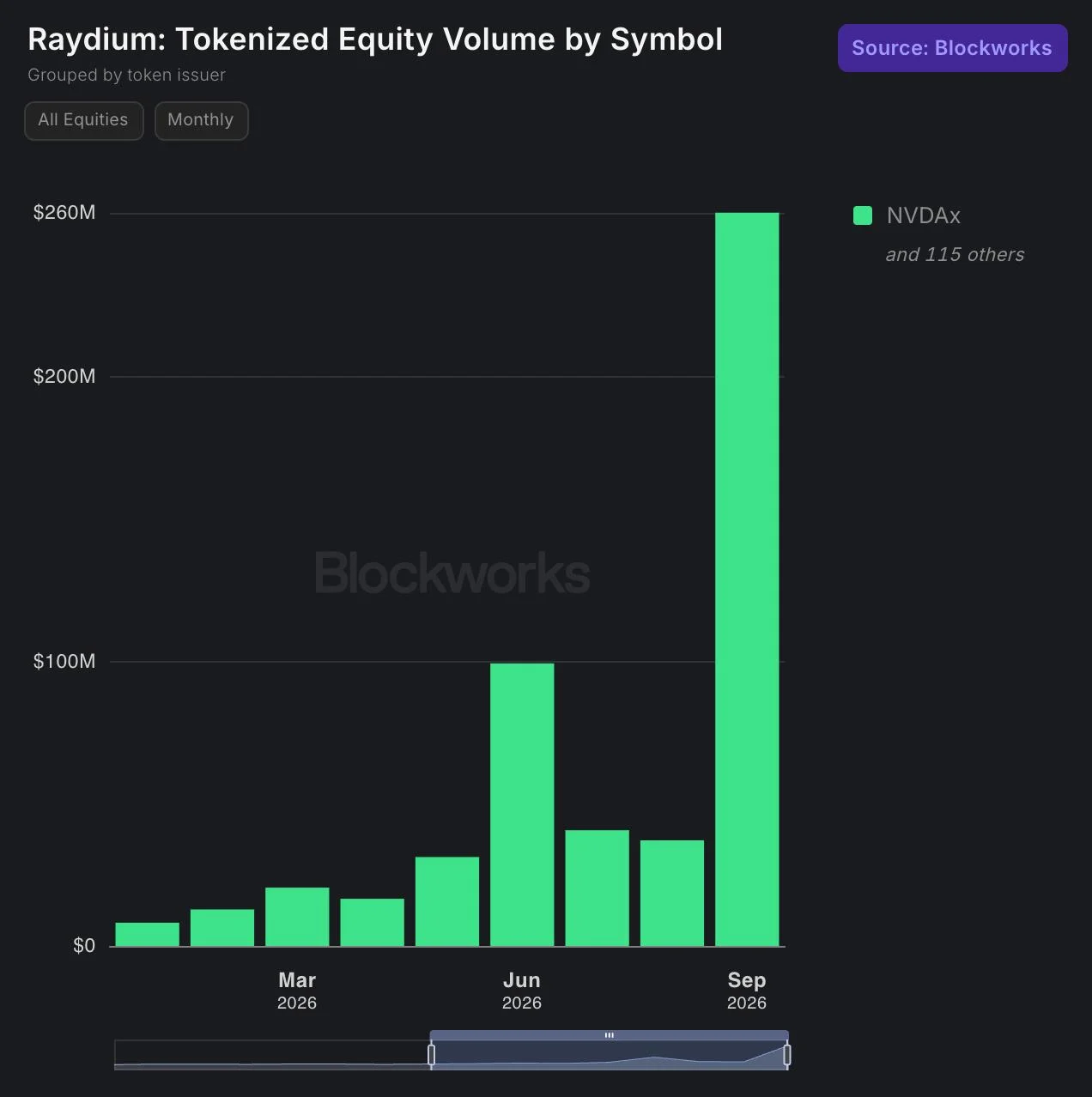
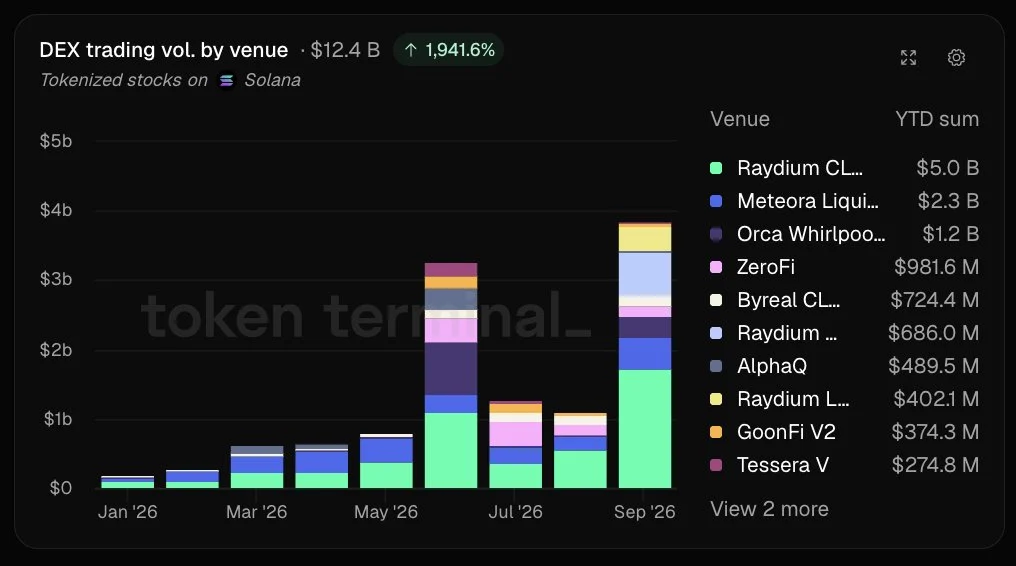
Meteora handled $2.3 billion, and Orca $1.2 billion. Those two together still don’t match Raydium.

The most traded ticker? NVDAx, the tokenized version of NVIDIA. There were 115 others, but AI names were clearly what people came for.

So while most of the market sat this week out, RAY had actual trading volume behind it.

Final Summary

  • Raydium (RAY) jumped 14% in a day; more than doubled in the past month.
  • Raydium handled about $6.1 billion of Solana’s $12.4 billion tokenized stock DEX volume this year.
 

News Image 0News Image 1News Image 2News Image 3
0
0

Disclaimer: The content of this article solely reflects the author's opinion and does not represent the platform in any capacity. This article is not intended to serve as a reference for making investment decisions.

You may also like

Updated Version 4 - SpaceX Targets U.S. Wireless Operators Through Spectrum Acquisition

The U.S. Federal Communications Commission (FCC) has approved Starlink Mobile Gen2's application to launch 15,000 satellites. Low-frequency radio waves can expand coverage and enhance signal penetration through walls and tree canopies, improving indoor reception. The share prices of T-Mobile, Verizon, and AT&T each fell by nearly 7% in after-hours trading. On October 8, Reuters reported that SpaceX reached an agreement on Thursday to acquire a nationwide portfolio of low-frequency spectrum, enabling Elon Musk's satellite company to directly challenge giant traditional wireless carriers across the United States from orbit. While Starlink Mobile’s existing global 2 GHz mid-band spectrum offers high bandwidth capacity, the new spectrum will allow signal penetration through obstacles. Financial terms of the deal were not disclosed. Low-frequency bands are favored for their longer transmission ranges and ability to penetrate dense structures like walls and tree cover—addressing a major technical challenge previously faced by satellite-based mobile networks. By combining nationwide low-frequency radio coverage with high-frequency space transmission, SpaceX is positioning Starlink Mobile to entirely bypass traditional cell towers, challenging the wireless oligopoly both in wide-area coverage and indoor signal reliability. This deal also increases competitive pressure on traditional operators, shifting direct-to-device satellite technology from a supplementary feature for remote dead spots to a comprehensive commercial rival to terrestrial cellular networks. The share prices of T-Mobile US, Verizon, and AT&T each dropped nearly 7% in after-hours trading. “Incumbent wireless carriers have been publicly skeptical, arguing that SpaceX’s network quality could not match theirs,” said analysts at William Blair. “We expect SpaceX to launch very attractive bundled packages of Starlink broadband with Starlink Mobile, and the company may include Grok in these bundles.” The deal involves acquiring 100% of a nationwide 800 MHz spectrum portfolio from private equity firm Grain Management, pending regulatory approval from the FCC. Earlier this year, Grain had acquired this spectrum from T-Mobile. Crucially, most existing, unmodified mobile phones already support the 800 MHz band, so consumers will not need to purchase special satellite phones. This week, the FCC also approved Starlink Mobile’s application for its second-generation satellite constellation, authorizing SpaceX to launch 15,000 satellites worldwide optimized for the 2 GHz band. This new satellite array will operate in very low Earth orbit, providing regular smartphones with higher bandwidth and low-latency connections.

路透社•2026/10/08 22:36

BRIEF-Veea Regains Full Compliance With Nasdaq Continued Listing Requirements

Oct 8 (Reuters) - Veea Inc VEEA.O: VEEA REGAINS FULL COMPLIANCE WITH NASDAQ CONTINUED LISTING REQUIREMENTS Source text: ID:nGNX9LhSKf Further company coverage: VEEA.O ((Reuters.Briefs@thomsonreuters.com;))

Reuters•2026/10/08 21:54
BRIEF-Veea Regains Full Compliance With Nasdaq Continued Listing Requirements

Exclusive Report – Sources say Refresco is planning an initial public offering (IPO) with a valuation of over 10 billions dollars.

According to sources, several banks have been competing for IPO underwriting business in recent weeks. The sources said the potential listing could take place in either the United States or Europe. KKR acquired Refresco for approximately $8 billion in 2022. Reuters New York, October 8 – According to informed sources, Netherlands-based Refresco and its parent company KKR have recently heard pitches from several investment banks regarding their potential roles in the IPO of Refresco, one of the world's largest independent beverage manufacturers. Sources, speaking anonymously, revealed that Refresco is exploring listing plans, possibly in either the US or Europe, and that regardless of the market, the company’s valuation could surpass $10 billion. They cautioned that the plans are at a preliminary stage and may change. KKR, an investment firm, acquired the company in 2022 for about $8 billion through its global infrastructure strategy, which focuses on investing in critical infrastructure assets. Other investments under this strategy include utilities, energy, and telecommunications service companies. Both Refresco and KKR declined to comment. Founded in 1999 and headquartered in Rotterdam, Netherlands, Refresco partners with retailers such as Walmart and Aldi to produce private label beverage products, and also collaborates with branded beverage companies like Coca-Cola, PepsiCo, and Monster Beverage. Refresco claims to be the world’s largest independent beverage manufacturer, providing production, bottling, warehousing, logistics, and distribution services to partners. The company operates 85 production sites across North America, Europe, and Australia. According to its annual report, the company achieved nearly $7 billion in revenue and about $930 million in adjusted EBITDA in 2025. Sources noted that although Coca-Cola Consolidated mainly collaborates with Coca-Cola, this North Carolina-based beverage manufacturer could still be a relevant comparable for Refresco. According to data provider LSEG, that company's market capitalization is around $12.5 billion, and its EBITDA multiple is close to 12 times. Dealogic data show that the US IPO market had a strong start this year, with traditional IPO funding approaching $140 billion so far, making 2026 likely to approach the record levels seen in 2021. However, market volatility, rising bond yields, rate hike concerns, and increasing questions over AI spending and valuations are threatening the once-expected bumper autumn IPO season. Several companies, including smart ring maker Oura, have postponed planned listings in recent weeks. Nevertheless, IPO advisors and investors say companies continue to hold pitches with investment banks to vie for underwriting spots—known as “beauty contests.” They are also continuing informal meetings with investors and other preparations to allow them to move quickly when market conditions improve. (For the convenience of non-English speakers, Reuters automatically translates its reports into various languages. Reuters does not guarantee the accuracy of automated translations, and such translations are provided solely for reader convenience. Reuters accepts no liability for any damage or loss caused by use of the automated translation function.)

路透社•2026/10/08 21:36