
BCA: Liberation Day 2.0 - Tariff Policy and Outlook for the 2026 Midterm Elections

Every time tariff news returns to the headlines, investors’ most direct question is: Is the US stock market going to fall again?
BCA Research, in its report “Liberation Day 2.0” released on September 9, 2026, offers a judgment with a longer time span.

According to BCA, a new round of tariff conflicts could last until 2027, and the market still has a chance to absorb the shock, so the bull market may not necessarily end because of this. However, today’s tough policies may, through impacts on prices, public opinion, and election results, prompt a shift in policy directions in the years that follow.
This report was written by Matt Gertken, Yushu Ma, and Jesse Kuri. It links the 2026 midterm elections, the 2028 presidential election, and possible tax changes in 2029 into a continuous analytical chain.
Tariff conflicts may recur, and in BCA’s view, financial markets remain a key constraint on policy.
The report reviews that in the first wave of “Liberation Day” tariff shocks in 2025, US stocks once approached bear market territory and US Treasury yields rose significantly. Subsequently, Trump rolled back some tariff arrangements.
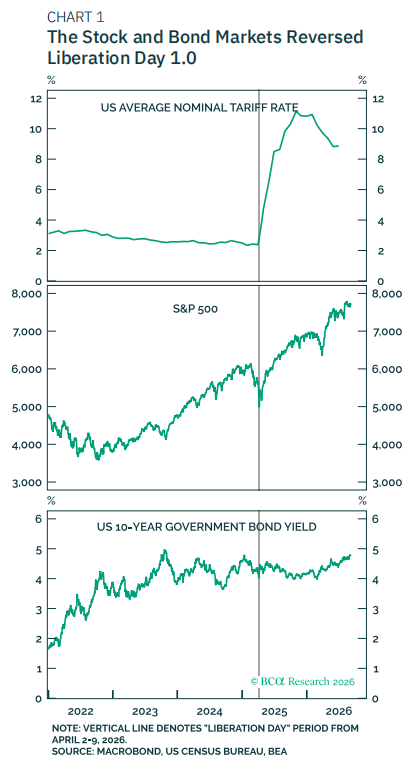
BCA believes that even if Trump cannot run for president again in 2028, he still cares about the Republican Party’s election results and his political legacy. This means that he has an incentive to use tariffs as bargaining chips in negotiations, but also a reason to avoid driving the economy and stock market out of control.
Thus, BCA expects we may continue to see processes such as: raising tariffs first, then negotiating; after market pressures build, some policies are adjusted.
However, this logic does not mean that each downturn will quickly be cushioned by policy changes. Before adjustments happen, businesses and investors may already have borne considerable costs.
Judicial review and checks and balances in Congress cannot immediately remove tariff risks, either. According to the analysis, even if some tariffs are constrained by the courts, the government may still use alternative legal grounds; even if the Democrats win both chambers, they may not have enough votes to override a presidential veto.
Therefore, BCA does not use “automatic removal of tariffs after the midterm elections” as its base case scenario.
A more difficult aspect of the new round of trade wars lies in the changing reactions of other countries.
BCA expects Canada, China, and Europe may take more countermeasures in the next stage. Governments in these countries also face domestic political pressures, and sometimes the cost of accepting US demands is no less than that of striking back.
It is also difficult for the US to entirely shift tariff costs abroad.
Using Canada as an example, the report notes that about 40% to 60% of US-Canada trade involves intermediate goods. These components and materials may cross borders multiple times, so tariffs propagate along the supply chain and can impact US domestic companies.
Michigan stands as a prime example. The report cites data showing about 39% of the state’s exports go to Canada. With such tight ties in the automotive supply chain, trade pressure on Canada may also hurt order volumes and costs in US manufacturing states.
According to BCA’s scenario simulation, the effective US tariff rate may reach 15% to 17% by 2027. The actual outcome depends on subsequent tariff hikes, negotiations, and judicial reviews, but the cost pressures faced by businesses are likely to persist for longer.
These economic costs are being factored into BCA’s outlook for the midterm elections.
Voters experience policy most directly through activities like filling up the tank, grocery shopping, and paying bills.
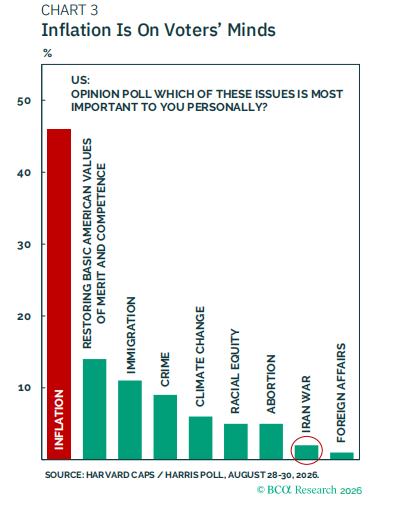
The report believes that price pressures on goods from tariffs, combined with energy costs from geopolitical crises, could erode the Republican Party’s electoral advantage. Even if the overall US economy remains resilient, residents and businesses in some swing states may feel more acute pressure.
As a result, BCA continues to lean toward Democrats taking both the House and Senate in the 2026 midterms.
But here’s an important detail: the analysts’ outlook does not fully agree with the results from the quantitative model.
BCA’s Senate model, which previously forecast a 51-49 Republican advantage, now sees each party holding 50 seats. In this situation, Republicans could still rely on the Vice President’s tie-breaking vote to retain control.
In other words, the model sees the Republican edge narrowing; analysts believe Democrats could achieve enough breakthroughs.
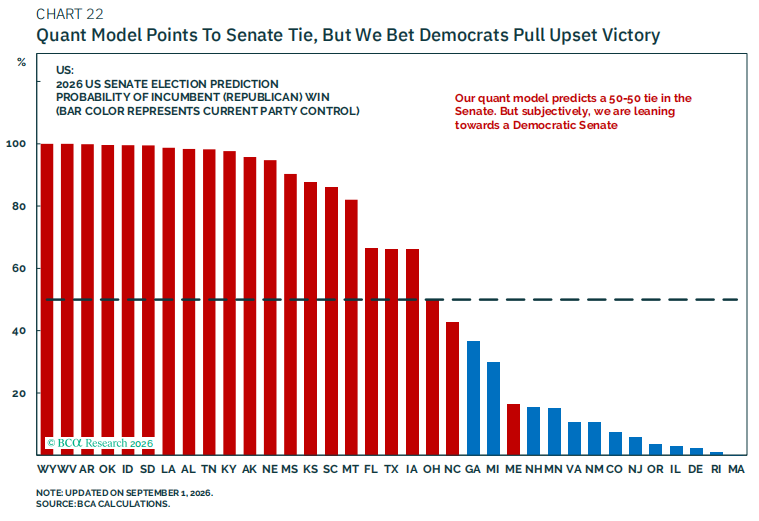
The report also admits that leading margins in key state polls are around the 2-3 point margin of error, and that candidate performance, unexpected events, and turnout rates could all influence the final outcome.
This divergence is worth noting. It shows that an analytical report can take a clear stance, while still acknowledging its conclusions have not been fully confirmed by data.
BCA is looking toward 2029 because one election can alter expectations for the next.
If Democrats perform strongly in 2026, the market might raise its expectations that they will capture both the White House and Congress in 2028. Under BCA’s scenario, this would further raise the likelihood of a higher tax rate in 2029.
For businesses, taxes affect after-tax profits, subsidies affect project returns, and regulatory changes can alter competitive conditions. Even if policy changes have not taken effect, changes in the probability of their enactment can prompt markets to adjust valuations in advance.
Of course, moving from polling in 2026 to tax policies in 2029 involves many hurdles. Election results, the balance of Congressional seats, and specific bills all introduce uncertainty.
Understanding this report means always keeping these conditions in mind. It maps out a possible path for policy developments.
This also explains BCA’s seemingly contradictory attitude: the firm remains alert to longer-term policy shifts, while also believing pre- and post-election volatility in 2026 may not necessarily disrupt the year-end bull market.
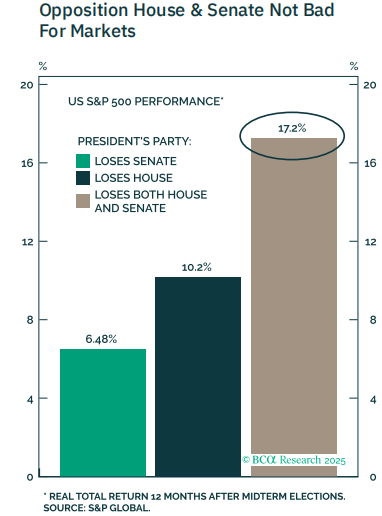
The report notes that, historically, the president’s party losing both chambers does not necessarily lead to poor market performance. Still, past average performance is only a reference background, not a direct answer for any specific election’s market outcome.
One key risk to BCA’s relatively moderate forecast is an unexpected downturn in the US economy. The report warns that if both the economy and approval ratings deteriorate simultaneously, Trump might adopt more aggressive trade policies, escalating what was expected to be a controllable conflict.
Thus, when reading this report, economic resilience is a prerequisite that needs continued monitoring.
If policy shifts occur, the impact varies greatly between sectors.
BCA raises four observation directions in its report.
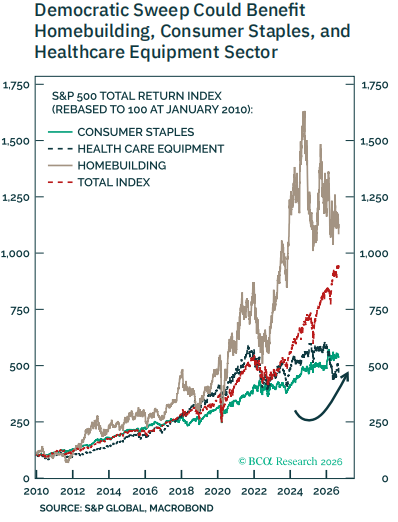
Homebuilders are at the top of the list. BCA believes improving housing affordability could become a Democratic policy focus. If tariffs on lumber, steel, and aluminum fall in the future, labor supply in construction improves, and is paired with housing support measures, homebuilding companies may benefit from both reduced costs and stronger demand.
Green energy relates to the change in the scope of policy support. The report believes that if Democrats regain more policy initiative, support may expand from batteries and strategic materials to more clean energy fields. This logic still depends on specific subsidies, tax incentives, and corporate profitability for realization.
Medical devices reflect internal industry differences. BCA judges that if discussion of universal healthcare heats up again, health insurance companies could face greater business model pressure, whereas specialized device manufacturers, due to product thresholds and regulatory barriers, may experience relatively limited impact. This view emphasizes relative positioning.
The logic for consumer staples is closer to residents’ daily lives. The report notes that social welfare support may help demand, and should tariffs and energy costs decline, margins could also benefit. However, political pressure around corporate pricing behavior could likewise increase.
What these four directions have in common is that they all connect corporate revenues or costs directly to specific policies. Actual stock price performance will also depend on valuations, interest rates, competition, and management performance.
After reading this report, I am more focused on how it handles problems across different time frames.
Near-term tariff escalation disturbs market sentiment and affects business costs. Persistent living cost pressures could shift votes. Election results might then influence tax and industry policies several years later.
These links are interconnected, and each requires new evidence for confirmation.
Next, besides observing tariff declarations themselves, we can continue tracking how businesses absorb costs, whether key state polls are beyond the margin of error, and whether concrete, executable policy proposals begin to take shape. As these details evolve, BCA’s scenarios must also be tested against reality.
Disclaimer: The content of this article solely reflects the author's opinion and does not represent the platform in any capacity. This article is not intended to serve as a reference for making investment decisions.
You may also like
Ondo Finance trades below key EMAs as analyst eyes $0.50 target
Bitcoin’s 200-week moving average rises above $65,000 for the first time
Watch Out: A Large Number of Token Unlocks Are Scheduled for 20 Altcoins This Week—Here’s the Day-by-Day, Hour-by-Hour List
Analyst maps 306% potential XRP/ETH upside, ETF access expands in US


