Crypto liquidity is becoming increasingly divided across networks and market sectors. Ethereum and Tron still hold the largest stablecoin reserves, while Solana is leading spot DEX activity and Hyperliquid dominates on-chain perpetual trading.
The latest on-chain data shows that the largest stablecoin base does not necessarily translate into the highest trading activity. Solana is generating more DEX volume than Ethereum despite holding a much smaller stablecoin supply, while Hyperliquid has emerged as the leading venue for perpetual trading.
The data points to a more specialized crypto liquidity market, where stablecoin reserves, spot trading and derivatives activity are increasingly concentrated in different ecosystems.
Ethereum Still Controls the Deepest Dollar Liquidity
Ethereum remains the largest stablecoin Liquidity hub, holding $147.5 billion of tracked supply. Tron follows with $94.2 billion, while Solana holds $16.0 billion, leaving a wide gap between the market’s deepest liquidity pools and its faster-growing trading hubs.

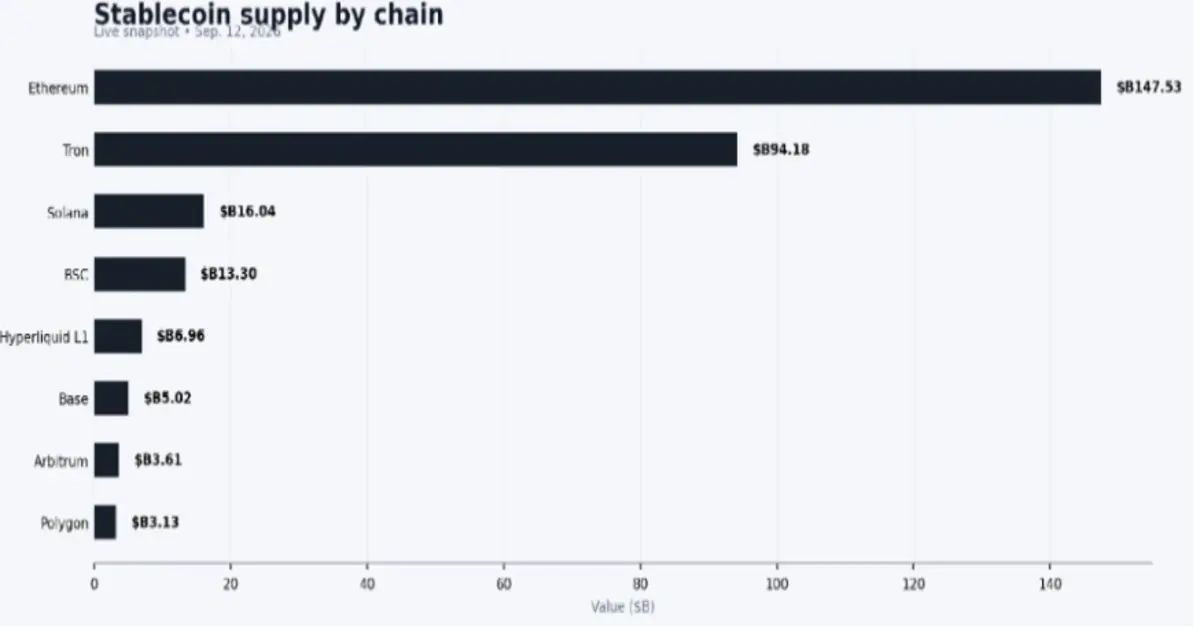
Ethereum and Tron together account for roughly 79% of tracked stablecoin liquidity, keeping the market’s deepest dollar reserves concentrated across two networks. Smaller chains are growing from significantly lower bases, so percentage gains alone do not yet establish a meaningful liquidity rotation.
Ethereum remains the dominant liquidity reservoir, while a stronger rotation signal would emerge if stablecoin balances rise materially on high-activity chains alongside sustained trading volumes.
USDT Remains the Market’s Core Liquidity Asset
USDT remains the dominant stablecoin, with roughly $183.5 billion in tracked supply, or about 60% of the market. USDC follows at $74.2 billion, leaving the two assets responsible for the bulk of dollar liquidity circulating across crypto markets.
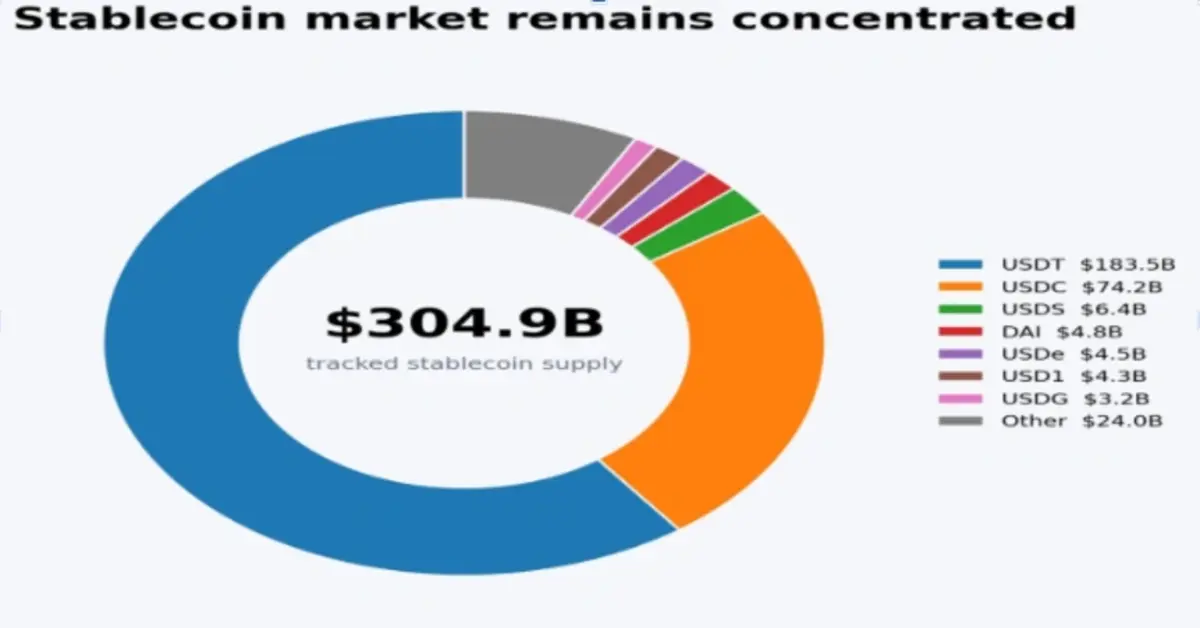
Stablecoin Market By Asset
| Stablecoin | Market Cap | Share |
| USDT | $183.5B | 60.2% |
| USDC | $74.22B | 24.3% |
| USDS | $6.38B | 2.1% |
| DAI | $4.78B | 1.6% |
| USDe | $4.53B | 1.5% |
| USD1 | $4.29B | 1.4% |
| USDG | $3.24B | 1.1% |
USDT and USDC account for more than 84% of the tracked stablecoin market, keeping liquidity heavily concentrated in the two largest dollar assets. Changes in their supply and destination chains therefore offer a cleaner signal of capital movement than percentage gains among smaller stablecoins. The next liquidity shift should be easier to identify through USDT and USDC flows at the chain level.
Where Stablecoins Are Deployed Matters More Than Supply Alone
Stablecoin supply shows how much dollar liquidity is available on-chain, but deployment determines how much of that capital is actually being used. Comparing stablecoin balances with DeFi TVL and trading activity therefore gives a better read on liquidity utilization, and helps separate passive reserves from capital actively moving through crypto markets.
On-Chain Liquidity and Market Activity
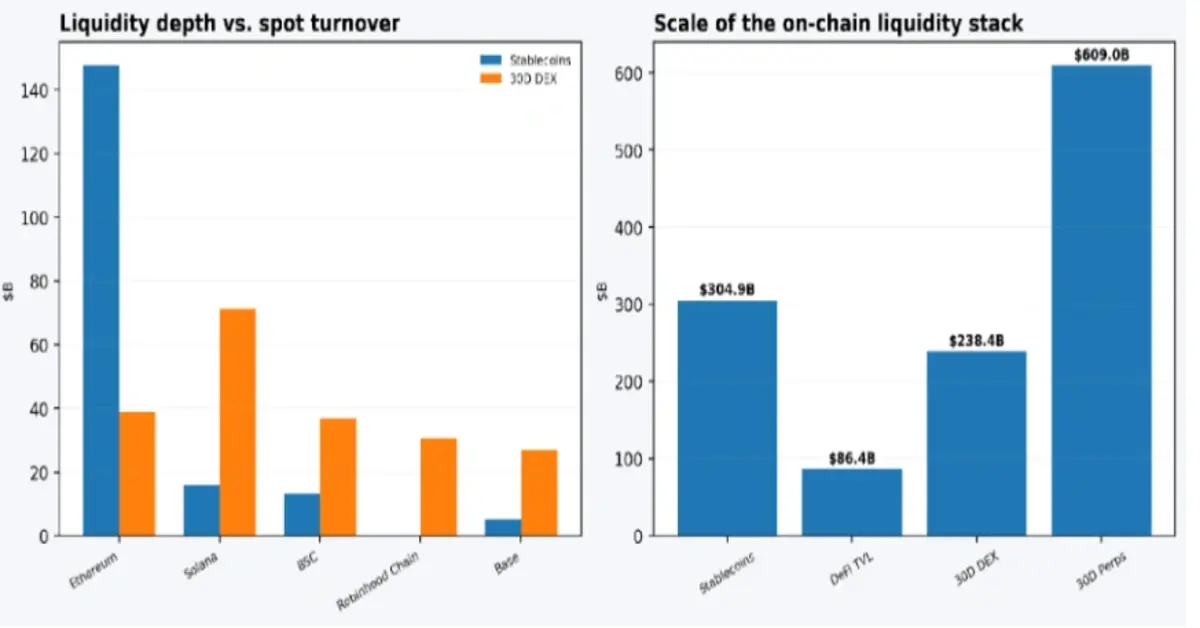
DeFi TVL remains substantially below total stablecoin supply, while the scale of DEX and perpetual volumes shows that on-chain liquidity is supporting significant trading activity beyond capital held directly in DeFi protocols.
Solana Is Capturing the Strongest Spot-Market Activity
Solana leads the latest 30-day DEX volume ranking at $71.1 billion, ahead of Ethereum at $38.8 billion and BSC at $36.6 billion. Robinhood Chain stands out among smaller networks, generating more than $30 billion in monthly DEX volume despite a stablecoin base of roughly $1 billion.
30-Day DEX Volume By Chain
| Chain | 24H Volume | 7D Volume | 30D Volume |
| Solana | $2.95B | $16.62B | $71.09B |
| Ethereum | $1.42B | $8.77B | $38.78B |
| BSC | $1.24B | $11.65B | $36.63B |
| Robinhood Chain | $1.92B | $12.34B | $30.66B |
| Base | $1.06B | $6.50B | $27.01B |
| Hyperliquid | $0.37B | $2.22B | $11.43B |
Solana’s combination of leading DEX turnover and a growing stablecoin base makes it one of the clearest places to watch for sustained liquidity deployment.
Smaller Chains Show Higher Liquidity Turnover
Absolute liquidity can obscure how actively each chain’s available stablecoin base is being used. Comparing 30-day DEX volume with current stablecoin supply provides a simple turnover ratio, highlighting networks where trading activity is large relative to their available stablecoin depth.
DEX Turnover Relative To Stablecoin Depth
| Chain | 30D DEX Volume | Stablecoins | Turnover |
| Robinhood Chain | $30.66B | $1.01B | 30.2x |
| Base | $27.01B | $5.02B | 5.4x |
| Solana | $71.09B | $16.04B | 4.4x |
| BSC | $36.63B | $13.30B | 2.8x |
| Hyperliquid | $11.43B | $6.97B | 1.6x |
| Ethereum | $38.78B | $147.54B | 0.3x |
Robinhood Chain stands out with turnover above 30x, while Base and Solana also record substantially higher DEX activity relative to their stablecoin bases. Ethereum’s 0.3x ratio reflects its much deeper stablecoin reserve and broader role as a liquidity and settlement layer.
Hyperliquid Has Become the Derivatives Liquidity Hub
The derivatives market shows a different liquidity pattern from spot trading. Hyperliquid processed $222.96 billion in perpetual volume over the past 30 days, far ahead of Ethereum at $45.67 billion, Arbitrum at $42.79 billion and Solana at $41.36 billion.
30-Day Perpetual Volume
| Chain | 30D Perp Volume | Open Interest |
| Hyperliquid L1 | $222.96B | $14.67B |
| Ethereum | $45.67B | $0.16B |
| Arbitrum | $42.79B | $1.82B |
| zK Lighter | $41.87B | $1.09B |
| Solana | $41.36B | $0.43B |
| edgeX L1 | $37.16B | $0.57B |
| StandX | $11.14B | $0.06B |
Hyperliquid’s lead in both perpetual volume and open interest makes it the clearest on-chain derivatives market to watch for continued liquidity deployment. Sustained volume alongside stable or rising open interest would indicate that derivatives activity remains structurally strong.
RWA Liquidity Is Growing, but DeFi Integration Remains Early
Tokenized real-world assets have grown into a meaningful on-chain market, with tracked RWA market capitalization at $34.7 billion. Yet only about $3.8 billion is currently represented in DeFi-active TVL, showing that a relatively small portion of the tokenized asset base is being deployed directly across DeFi.
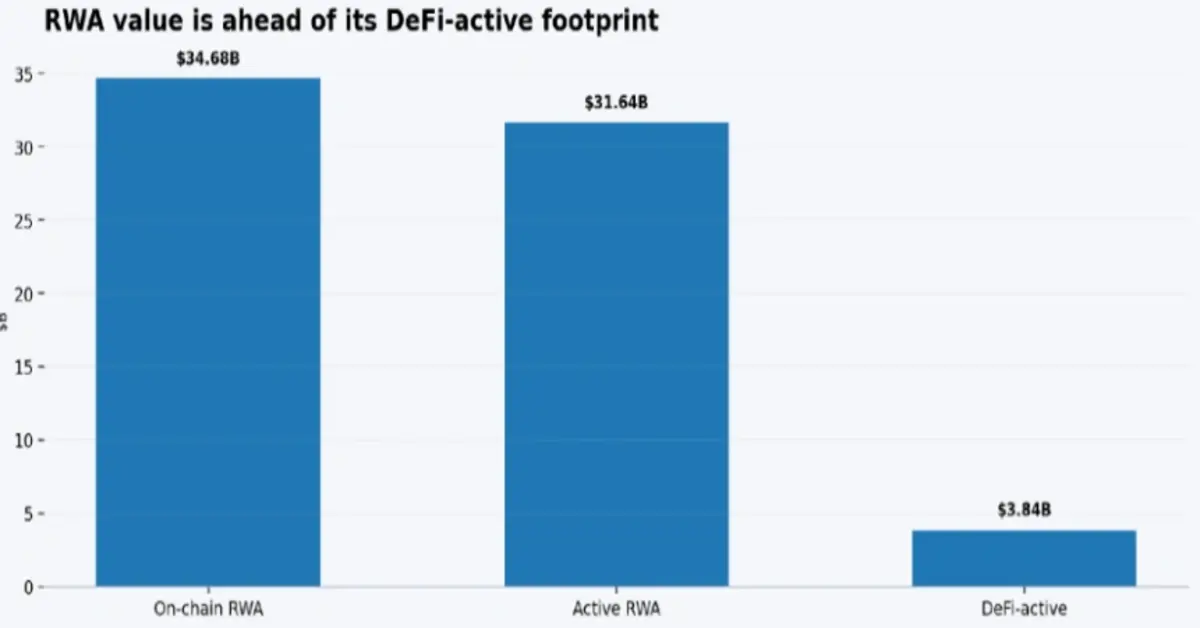
RWA adoption becomes a stronger liquidity signal if the DeFi-active share begins expanding alongside overall RWA market capitalization. Rising TVL, lending activity and secondary-market volume would provide stronger evidence that tokenized assets are moving from issuance into active on-chain capital markets.
Where the Next Liquidity Wave Could Form
The latest on-chain data points to an increasingly specialized liquidity landscape. Ethereum remains the largest stablecoin reserve, Solana has the strongest spot-market footprint, and Hyperliquid leads on-chain derivatives activity. RWAs add another potential liquidity channel, although their integration with DeFi remains relatively early.
The next liquidity wave should therefore be tracked through three signals: stablecoin growth, capital deployment and sustained market activity. When all three rise together, the evidence for a broader liquidity expansion becomes stronger; when trading volume rises without deeper liquidity, the move may reflect short-term capital turnover instead.
FAQs
Where is crypto liquidity concentrated right now?
Ethereum holds the deepest stablecoin liquidity, while Solana leads spot DEX activity and Hyperliquid dominates on-chain perpetual trading.
Is stablecoin growth a reliable signal of new liquidity?
Not by itself; rising stablecoin supply needs to be backed by stronger deployment, trading activity or DeFi utilization.
Which crypto sector is attracting the strongest liquidity activity?
Spot DEXs and derivatives currently show the strongest activity, led by Solana and Hyperliquid respectively.
Why is Solana important for the next liquidity wave?
Solana combines a substantial stablecoin base with the highest tracked 30-day DEX volume.
What does Hyperliquid’s derivatives activity tell us?
Its volume and open interest show that on-chain derivatives liquidity is increasingly concentrated on specialized venues.
Are RWAs becoming a major source of crypto liquidity?
RWAs are expanding rapidly, but their DeFi-active footprint remains much smaller than their total tokenized market value.
What would confirm a broader liquidity rotation?
A simultaneous rise in stablecoin balances, DeFi deployment and sustained trading activity would provide the strongest confirmation.
What should investors watch next?
Track chain-level stablecoin flows, DEX volume, derivatives open interest and RWA utilization together for clearer liquidity signals.