
What Are Bitget Compute Perpetuals? A New Way to Trade AI Infrastructure
Artificial intelligence may run on software, but behind every model is something physical: computing power. Training large AI models, serving millions of inference requests, and expanding AI data centers all depend on high-performance GPUs such as NVIDIA’s H100 and B200. As demand for these chips grows, their rental prices are becoming a market signal of their own, reflecting how scarce or abundant AI computing capacity is at any given time.
Bitget is bringing that market directly to traders through H100USDT and B200USDT Pre-Market Compute Perpetuals, allowing users to trade changes in GPU rental prices without buying hardware or signing cloud contracts. This opens a new way to gain exposure to the AI boom, not through an AI token or NVIDIA stock, but through the cost of the infrastructure powering AI itself.
In this guide, we will learn what Bitget Compute Perpetuals are, how H100 and B200 GPU rental prices work, what moves compute prices, how to trade them on Bitget, and the key risks beginners should understand before getting started.
Key Takeaways
-
Bitget Compute Perpetuals let users trade GPU rental prices directly, turning the cost of AI computing power into a 24/7 tradable market.
-
H100USDT and B200USDT track price movements related to NVIDIA H100 and B200 GPU computing capacity, with rental prices measured in USD per GPU-hour.
-
Traders do not buy GPUs or rent cloud servers. They take long or short positions based on whether they expect GPU rental prices to rise or fall.
-
Bitget Compute Perpetuals are settled in USDT and currently support up to 10x leverage, making AI infrastructure accessible through a familiar crypto perpetual format.
-
Compute prices can move with AI training and inference demand, GPU supply, cloud capacity, data-center expansion, and new chip releases, while leverage, funding, liquidity, and volatility remain important risks.
What Are Bitget Compute Perpetuals?
Bitget Compute Perpetuals are derivative contracts that let traders take positions on changes in GPU computing rental prices. Instead of tracking a cryptocurrency or a company’s stock price, these contracts focus on the cost of accessing the high-performance computing power used to train and run AI models.
Bitget currently offers two Pre-Market Compute Perpetuals:
-
H100USDT: Tracks price movements related to NVIDIA H100 GPU rental capacity.
-
B200USDT: Tracks price movements related to NVIDIA Blackwell B200 GPU rental capacity.
The key point is that traders are not buying an H100 or B200 GPU. They are also not renting computing capacity from a cloud provider. Instead, they trade a financial contract whose price is linked to standardized GPU rental-price benchmarks.
Because the contracts are perpetual, they do not have the fixed monthly expiration commonly found in traditional futures. Traders can take a long position when they expect GPU rental prices to rise or a short position when they expect prices to fall, giving them a direct way to express a view on the supply and demand for AI computing power.
For Bitget users, this brings a new type of underlying asset into a familiar crypto trading format. Rather than only trading the companies and tokens associated with AI, Compute Perpetuals provide exposure to something closer to the industry's underlying resource: the price of compute itself.
Understanding GPU Compute and Rental Prices
Before understanding Compute Perpetuals, it helps to know what GPU compute means. A GPU, or graphics processing unit, is a computer chip designed to handle many calculations at the same time. While GPUs were originally built for graphics, powerful models such as NVIDIA’s H100 and B200 are now widely used for training AI models and running AI applications.
Buying these high-end GPUs can be expensive, so many companies choose to rent GPU computing power from cloud providers and data centers instead. The amount they pay to access this computing power is known as the GPU rental price.
GPU rental prices are commonly quoted in USD per GPU-hour. A GPU-hour simply means using one GPU for one hour. For example, if an H100 costs $2.50 per GPU-hour, using one H100 for 10 hours would represent about $25 in GPU rental costs before other service charges.
Just like airline tickets, GPU rental prices can change depending on supply and demand. Some of the main factors include:
-
AI demand: More AI training and inference can increase demand for GPU capacity.
-
GPU availability: Limited H100 or B200 supply can push rental prices higher.
-
Cloud capacity: New data centers and GPU clusters can add supply and reduce shortages.
-
Location and rental terms: Prices can vary between providers, regions, and contract lengths.
-
New GPU generations: Newer chips can shift demand away from older models and affect their rental prices.
Because GPU prices can differ widely across providers, GPU rental-price indices combine and standardize market data into a common benchmark. These indices make it easier to see whether the overall cost of AI computing power is rising or falling, and they provide the price reference behind products such as Bitget Compute Perpetuals.
What Do the H100 and B200 Rental Price Indices Track?
GPU rental prices can vary significantly across cloud providers, regions, hardware configurations, and contract terms. To make these prices easier to compare, the market uses standardized GPU rental-price indices as reference benchmarks.
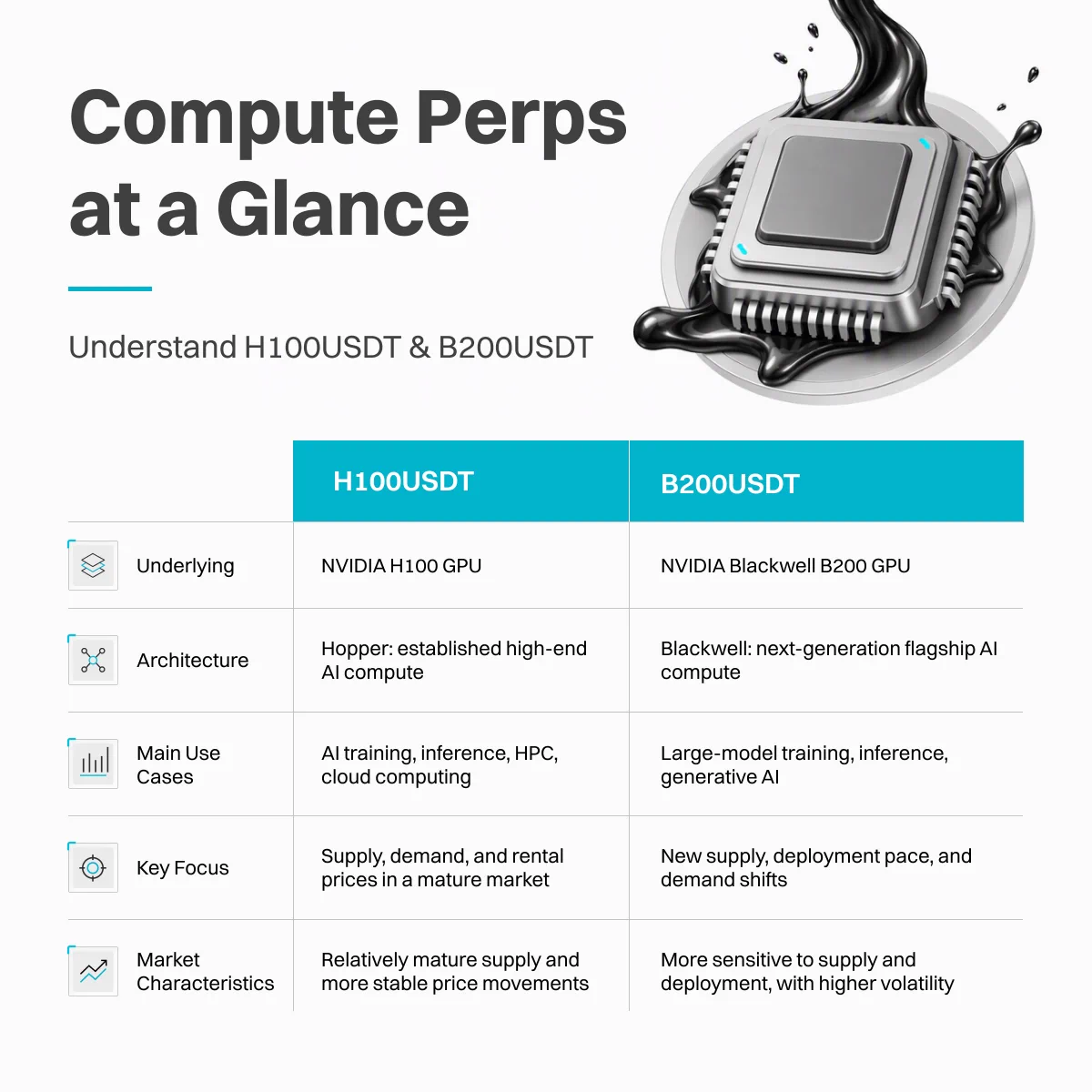
Bitget’s H100USDT and B200USDT Compute Perpetuals reference rental-price indices published by Silicon Data:
-
H100 Rental Price Index: Tracks the standardized hourly rental cost of NVIDIA H100 GPU computing capacity.
-
B200 Rental Price Index: Tracks the standardized hourly rental cost of NVIDIA Blackwell B200 GPU computing capacity.
Silicon Data collects pricing data from multiple segments of the GPU rental market and standardizes the observations to account for differences in factors such as GPU specifications, rental terms, geographic location, and machine configurations. This process helps convert a fragmented set of market prices into a more consistent benchmark.
The indices therefore serve as a reference for changes in the cost of AI computing power. A rising H100 index suggests that standardized H100 rental costs are increasing, while a declining index indicates that those costs are falling.
How Do Bitget Compute Perpetuals Work?
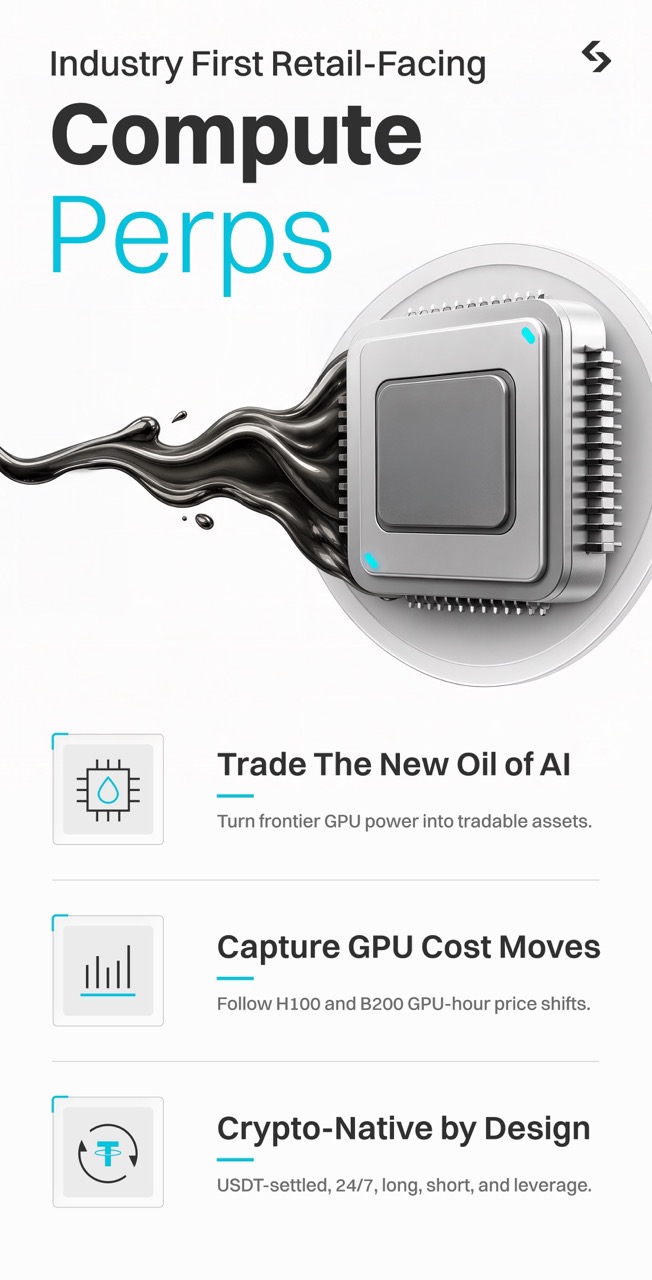
Bitget Compute Perpetuals turn movements in GPU rental prices into a familiar perpetual trading format. Instead of buying computing hardware or paying to use cloud capacity, traders open a position based on whether they expect the price of H100 or B200 compute to rise or fall.
The two available Pre-Market Compute Perpetuals are:
| Feature |
H100USDT |
B200USDT |
| Underlying market |
NVIDIA H100 GPU rental price |
NVIDIA B200 GPU rental price |
| Settlement asset |
USDT |
USDT |
| Trading hours |
24/7 |
24/7 |
| Maximum leverage |
Up to 10x |
Up to 10x |
| Funding settlement |
Every 8 hours |
Every 8 hours |
| Physical GPU delivery |
No |
No |
Traders can take a long position if they expect GPU rental prices to increase or a short position if they expect prices to decline. For example, a trader expecting stronger demand for H100 computing capacity may go long H100USDT. If H100 rental prices rise, the position may gain value; if they fall, the position may lose value.
Unlike traditional futures contracts with a fixed expiration date, perpetual contracts are designed to remain open as long as the trader maintains sufficient margin and the position is not closed or liquidated. A funding mechanism helps keep the perpetual market aligned with its underlying reference price.
Settlement is financial rather than physical. Profits and losses are settled in USDT, so trading H100USDT or B200USDT does not result in ownership, delivery, or access to an actual GPU. This allows traders to gain exposure to AI compute pricing through the same type of interface and trading mechanics commonly used for crypto perpetual futures.
How to Trade Bitget Compute Perpetuals
Trading Bitget Compute Perpetuals follows a process similar to other perpetual futures on Bitget. The main difference is the underlying market: instead of trading the price of a cryptocurrency, users are taking a position on changes in H100 or B200 GPU rental prices.
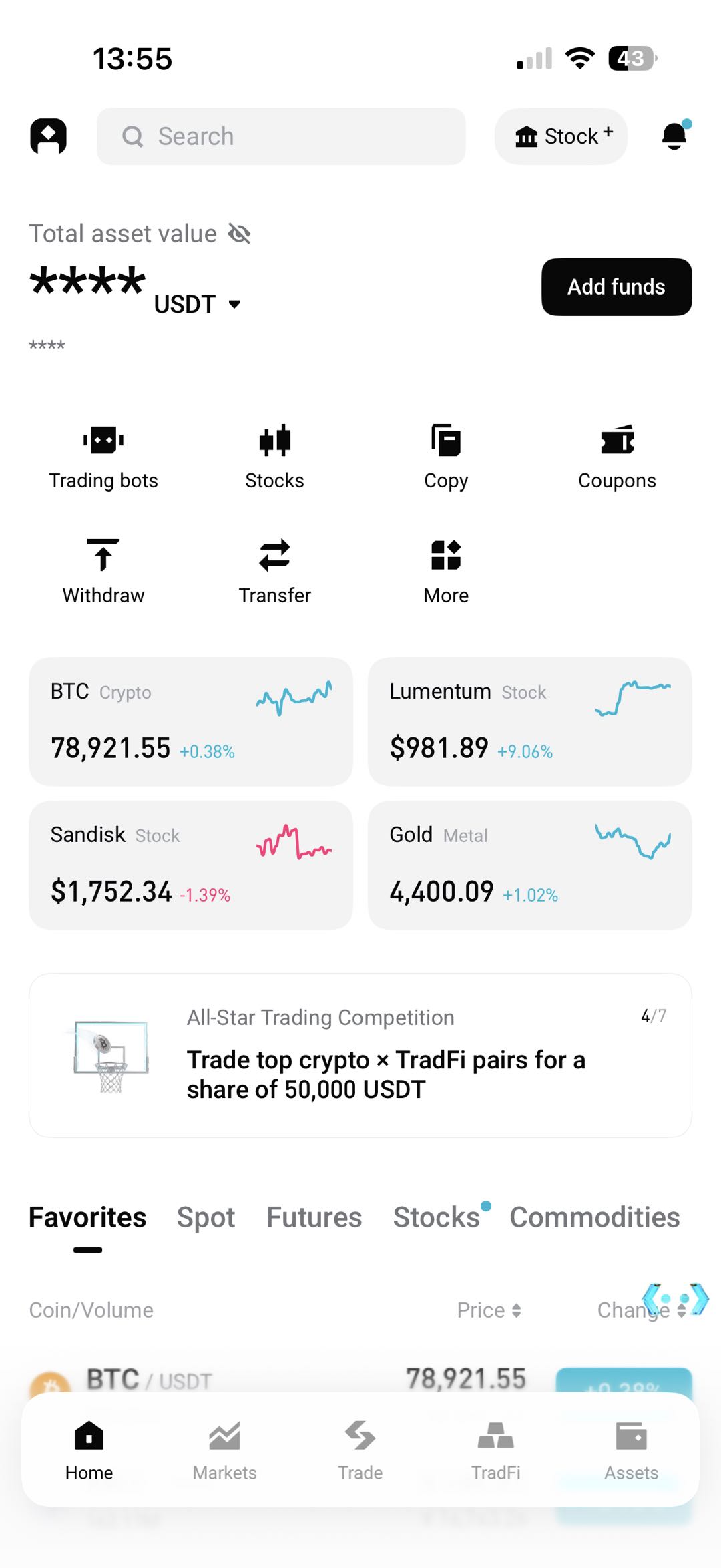
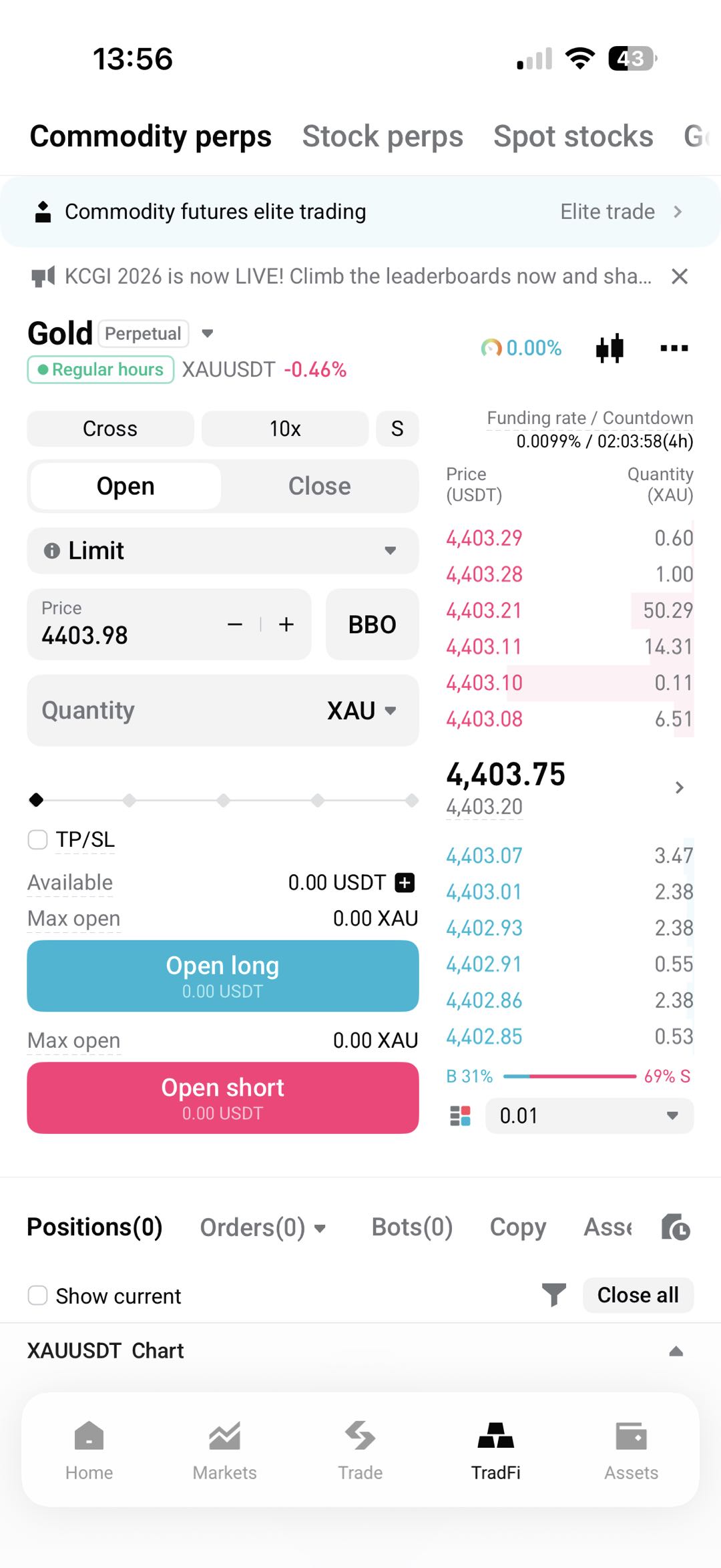
Step 1: Open the TradFi Section
Open the Bitget app and tap TradFi in the bottom navigation bar to access the available TradFi markets, including Compute Perpetuals.
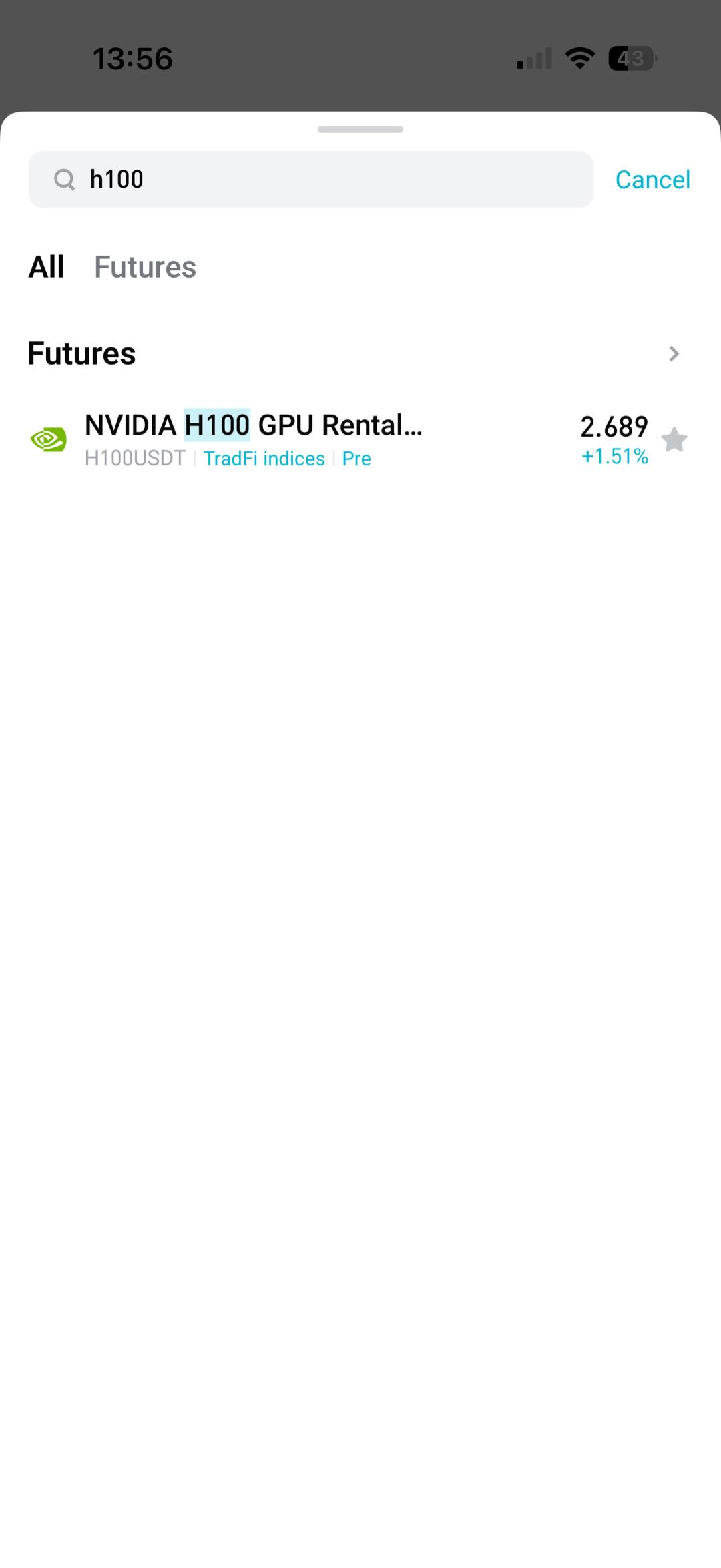
Step 2: Choose a Compute Perpetual
Select the market that matches the GPU rental price you want to trade:
-
H100USDT: Exposure to NVIDIA H100 GPU rental prices.
-
B200USDT: Exposure to NVIDIA B200 GPU rental prices.
Before opening a position, review the current price, contract specifications, funding rate, and available market liquidity.
Step 3: Decide Whether to Go Long or Short
Your position depends on your view of the underlying compute market.
-
Go long if you expect GPU rental prices to rise.
-
Go short if you expect GPU rental prices to fall.
For example, a trader who expects stronger AI training demand and limited H100 availability may consider a long H100USDT position. If new GPU capacity enters the market and rental prices are expected to decline, the trader may instead take a short position.
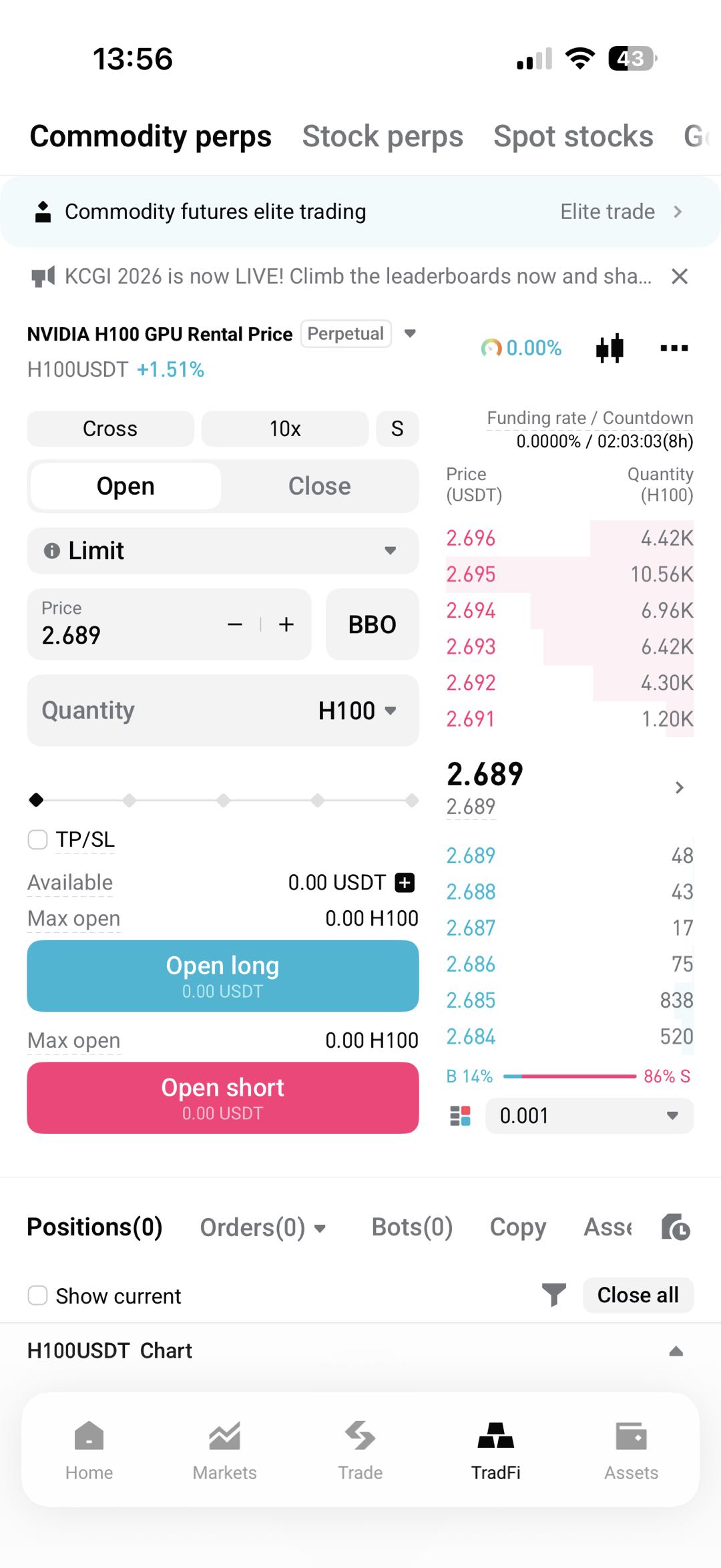
Step 4: Choose Your Leverage and Position Size
Bitget Compute Perpetuals currently support leverage of up to 10x. Leverage allows traders to gain greater market exposure with a smaller amount of margin, but it also increases both potential gains and potential losses.
Choosing an appropriate position size is therefore just as important as predicting the direction of the market.
Step 5: Select an Order Type
Choose how you want to enter the market. Common order types include:
-
Market order: Executes at the best available market price.
-
Limit order: Executes only at your selected price or better.
Enter the amount you want to trade, review the order details, and open the position.
Step 6: Monitor and Manage the Position
Once the trade is open, monitor factors such as:
-
Entry and current market price
-
Position size and margin
-
Unrealized profit or loss
-
Liquidation price
-
Funding rate and funding costs
-
Changes in GPU supply and AI compute demand
Bitget’s H100USDT and B200USDT Compute Perpetuals currently use an eight-hour funding settlement interval. Traders holding positions over longer periods should therefore consider funding costs alongside price movements.
Because Compute Perpetuals use leverage and track a relatively new underlying market, risk management should remain part of every trade. Stop-loss orders, moderate position sizing, and careful use of leverage can help limit exposure when the market moves unexpectedly.
Example of a Compute Perpetual Trade
Suppose a trader expects demand for NVIDIA H100 computing power to increase as more AI companies expand model training and inference. H100 compute is currently priced at $2.50 per GPU-hour, and the trader believes rental prices will move higher.
The trader opens a long H100USDT position on Bitget with $100 in margin and 5x leverage, giving them $500 of market exposure.
-
Entry price: $2.50 per GPU-hour
-
Position: Long H100USDT
-
Margin: $100
-
Leverage: 5x
-
Position value: $500
-
H100 price rises to: $2.75 per GPU-hour
-
Price increase: 10%
-
Approximate profit: $50, before trading fees and funding costs
Because the underlying price increased by 10%, the $500 position would gain approximately $50. Relative to the trader’s $100 margin, that represents a 50% gain before fees and funding.
The same leverage also works in the opposite direction. If H100 compute fell 10% instead, the position would lose approximately $50. This is why leverage can magnify both profits and losses.
Traders can also take a short H100USDT position when they expect compute rental prices to fall. In that case, a decline in the underlying price could generate a profit, while an increase would result in a loss.
The trader never needs to buy or rent an actual H100 GPU. Bitget Compute Perpetuals allow a market view on AI compute prices to be turned into a long or short trading position.
Compute Perpetuals vs. NVIDIA Stock and AI Tokens
Compute Perpetuals give traders exposure to a different part of the AI market. NVIDIA stock reflects the performance and valuation of NVIDIA as a company, while AI tokens are influenced by individual project fundamentals, tokenomics, crypto liquidity, and market sentiment. Compute Perpetuals focus more directly on the price of GPU computing capacity.
| Instrument |
What You Are Trading |
Main Price Drivers |
| Compute Perpetuals |
GPU rental-price exposure |
Compute demand, GPU supply, cloud capacity, AI infrastructure |
| NVIDIA stock |
Equity in NVIDIA |
Revenue, earnings, margins, valuation, chip demand, broader stock market |
| AI tokens |
Crypto assets linked to AI projects or narratives |
Project fundamentals, tokenomics, crypto liquidity, market sentiment |
These markets can be related, but they do not necessarily move together. For example, stronger AI demand could increase H100 rental prices because available compute becomes scarce. At the same time, NVIDIA stock may react to earnings expectations, margins, valuation, or broader equity-market conditions.
The same applies to AI tokens, which may rise or fall because of project-specific news or crypto market sentiment even when GPU rental prices remain unchanged.
This distinction is what makes Bitget Compute Perpetuals different. Instead of trading an AI company or an AI-themed crypto asset, traders can take a more direct position on the cost of the computing infrastructure that powers AI.
What Affects GPU Compute Prices?
GPU compute prices move with the balance between demand for AI computing power and the supply of available GPU capacity. When demand for high-performance GPUs grows faster than available supply, rental prices can rise. When new capacity enters the market or demand slows, prices can fall.
Several factors can influence this balance:
-
AI training demand: Building larger and more advanced AI models requires significant computing power, which can increase demand for GPUs such as the H100 and B200.
-
AI inference demand: Running AI applications for millions of users also requires compute. As AI services scale, inference can become a major source of GPU demand.
-
GPU supply: Limited availability of high-end GPUs can keep rental prices elevated, while increased production and wider deployment can add supply.
-
Cloud and data-center expansion: New GPU clusters and data centers can increase available compute capacity and ease shortages.
-
New chip generations: The arrival of newer GPUs can shift demand between models. For example, broader adoption of newer Blackwell GPUs could affect demand for existing H100 capacity.
-
AI capital spending: Higher investment by technology companies, cloud providers, and AI labs can increase demand for compute infrastructure.
-
Infrastructure constraints: Electricity, cooling, networking, and available data-center space can limit how quickly new GPU capacity comes online.
These factors can work together. Strong AI demand does not automatically mean rental prices will rise if GPU supply is expanding just as quickly. Likewise, even modest demand growth can push prices higher when available capacity is tight.
For traders, this means that understanding Compute Perpetuals requires looking beyond crypto charts. Developments in AI models, cloud infrastructure, GPU supply, and data-center investment can all influence expectations for H100 and B200 rental prices.
What Are Compute Perpetuals Used For?
Compute Perpetuals can serve several purposes, depending on a trader’s view of the AI infrastructure market. Their main advantage is that they provide a way to trade changes in GPU rental prices without owning hardware or entering a cloud-computing contract.
Common use cases include:
-
Trading AI compute trends: Traders can go long when they expect demand for H100 or B200 computing capacity to increase, or go short when they expect rental prices to fall.
-
Gaining direct AI infrastructure exposure: Instead of relying only on NVIDIA stock or AI-related tokens, traders can take a position on the cost of the computing power used to run AI.
-
Diversifying trading opportunities: GPU rental prices are driven by factors such as AI workloads, chip availability, cloud capacity, and data-center investment, giving traders exposure to a different set of market drivers.
-
Managing compute-related price risk: AI companies, GPU cloud operators, data centers, and other industry participants may use compute-linked derivatives to help manage exposure to changing GPU rental costs or revenues.
-
Exploring relative-value opportunities: Professional traders can compare movements across GPU rental prices, NVIDIA stock, AI tokens, and other AI-related markets to identify differences in pricing and market expectations.
Bitget packages this emerging market into a familiar crypto-native format with USDT settlement, 24/7 trading, long and short positions, and leverage. This makes it possible to turn a view on AI infrastructure demand into a tradable position without directly participating in the physical GPU rental market.
Risks of Trading Compute Perpetuals
Compute Perpetuals provide a new way to trade AI infrastructure, but they also come with risks that differ from more established crypto, stock, and commodity markets. Traders should understand both the perpetual contract and the underlying GPU rental market before opening a position.
Key risks include:
-
Leverage risk: Bitget Compute Perpetuals currently support leverage of up to 10x. Leverage can increase potential returns, but it also magnifies losses when the market moves against a position.
-
Liquidation risk: If losses reduce a trader’s margin below the required level, a leveraged position may be liquidated.
-
Funding costs: Perpetual contracts use funding payments to help keep market prices aligned with their reference prices. H100USDT and B200USDT currently settle funding every eight hours, which can affect the cost of holding a position.
-
Liquidity risk: GPU compute is still a relatively new financial market. Trading depth may be lower than in mature markets such as Bitcoin, major stocks, or commodities, which can lead to wider spreads and greater price volatility.
-
Index and pricing risk: Real-world GPU rental prices vary across providers, regions, hardware configurations, and contract terms. Standardized indices help create a common benchmark, but they may not perfectly represent every individual rental market.
-
Pre-Market volatility: H100USDT and B200USDT are currently offered as Pre-Market Compute Perpetuals. Prices can be volatile, and Bitget may adjust leverage limits, margin requirements, or other parameters as market conditions change.
Compute prices can also react to developments outside traditional crypto markets, including AI demand, new GPU releases, cloud capacity, and data-center investment. Traders should therefore monitor both the contract itself and the broader AI infrastructure market when managing a position.
The Bottom Line
AI trading is no longer limited to AI tokens or technology stocks. With Bitget Compute Perpetuals, traders can now take a position on something closer to the engine of the AI economy: the cost of computing power itself. H100USDT and B200USDT turn NVIDIA H100 and B200 GPU rental-price movements into 24/7 tradable markets, without requiring users to buy GPUs or sign cloud-computing contracts.
For Bitget users, this opens a new way to trade the growth of AI infrastructure. Whether a trader expects rising AI demand to push compute prices higher or expanding GPU supply to bring them down, Compute Perpetuals provide the flexibility to express that view through long or short positions, USDT settlement, and leverage of up to 10x.
Compute remains an emerging asset class, and leveraged trading carries significant risk. But as GPU pricing becomes increasingly important to the AI economy, Bitget is bringing this new market directly to crypto traders, turning the cost of AI infrastructure into a tradable opportunity.
Frequently Asked Questions About Bitget Compute Perpetuals
1. What are Compute Perpetuals?
Compute Perpetuals are derivative contracts that allow traders to take positions on changes in GPU computing rental prices. Instead of tracking a cryptocurrency or stock, they provide exposure to the cost of high-performance computing resources used for AI.
2. What are Bitget Compute Perpetuals?
Bitget Compute Perpetuals are USDT-settled perpetual contracts linked to GPU rental-price markets. Bitget currently offers H100USDT and B200USDT Pre-Market Compute Perpetuals, allowing traders to go long or short on changes in NVIDIA H100 and B200 compute prices.
3. What does H100USDT track?
H100USDT provides exposure to changes in the rental price of NVIDIA H100 GPU computing capacity. Its underlying reference is linked to standardized H100 rental-price data.
4. What does B200USDT track?
B200USDT provides exposure to the rental-price market for NVIDIA Blackwell B200 GPU computing capacity.
5. Do I own a GPU when I trade Compute Perpetuals?
No. Trading H100USDT or B200USDT does not give you ownership of a physical GPU or access to computing capacity. You are trading a financial contract based on movements in GPU rental prices.
5. What does USD per GPU-hour mean?
USD per GPU-hour represents the cost of using one GPU for one hour. For example, a rental price of $2.50 per GPU-hour means one hour of GPU computing capacity is valued at about $2.50 before other service costs.
6. Can I profit if GPU rental prices fall?
Yes. Bitget Compute Perpetuals support both long and short positions. Traders can go long when they expect compute prices to rise or short when they expect prices to fall.
7. Are Compute Perpetuals the same as NVIDIA stock?
No. NVIDIA stock represents equity exposure to NVIDIA as a company. Compute Perpetuals focus more directly on GPU rental prices and AI compute supply and demand.
7. Do Bitget Compute Perpetuals expire?
Perpetual contracts do not have a fixed expiration date like traditional futures. Positions can remain open as long as margin requirements are met and the position is not closed or liquidated.
8. How much leverage do Bitget Compute Perpetuals offer?
Bitget currently supports leverage of up to 10x for H100USDT and B200USDT. Higher leverage increases both potential gains and potential losses.
9. What affects GPU rental prices?
GPU rental prices can be influenced by AI training and inference demand, GPU availability, cloud and data-center capacity, new chip generations, infrastructure constraints, and broader AI capital spending.
10. Are Bitget Compute Perpetuals available 24/7?
Yes. H100USDT and B200USDT are currently available for 24/7 trading on Bitget.
AI needs GPUs, and GPU prices move. Join Bitget and turn that movement into a tradable opportunity with Compute Perpetuals.
Disclaimer: This article is for informational purposes only and does not constitute financial advice. Compute Perpetuals involve leverage and significant risk, which can magnify both gains and losses. Product availability and trading conditions may vary by market and jurisdiction. Always review the latest Bitget information and trade according to your own risk tolerance.
Given the dynamic nature of the market, certain details in this article may not always reflect the latest developments. For any inquiries or feedback, please reach out to us at geo@bitget.com.


- Key Takeaways
- What Are Bitget Compute Perpetuals?
- Understanding GPU Compute and Rental Prices
- What Do the H100 and B200 Rental Price Indices Track?
- How Do Bitget Compute Perpetuals Work?
- How to Trade Bitget Compute Perpetuals
- Example of a Compute Perpetual Trade
- Compute Perpetuals vs. NVIDIA Stock and AI Tokens
- What Affects GPU Compute Prices?
- What Are Compute Perpetuals Used For?
- Risks of Trading Compute Perpetuals
- The Bottom Line
- Frequently Asked Questions About Bitget Compute Perpetuals