
Profit Without Betting on NVDA's Direction: How to Use Bitget Stock Arbitrage to Amplify Capital Efficiency
NVDA's earnings report will reveal the truth tonight—going long risks a black swan event, going short risks missing out, and staying out of the market means no profit. The real solution is not to pick a side, but to use the core strategy long employed by institutions: zero directional risk and consistent funding rate income.This strategy is called Delta Neutral (market neutral).
A closer look at the key advantages of Delta Neutral
In traditional financial markets, Delta Neutral (market neutral) strategies have long been dominated by institutional investors. The reason is simple: they require simultaneous management of spot and futures/perpetual futures accounts, frequent margin transfers, and real-time hedging of directional risk. The operational barrier is high, and capital efficiency is low, making it nearly inaccessible to retail investors. On Bitget, however, this strategy has been greatly simplified, truly delivering “institutional-grade strategies with retail-level accessibility.” Its advantages include:
1. Unified trading account: complete all operations in one place, without the hassle of multiple accounts
Bitget unified trading accountfully integrates spot and perpetual futures into one account system. Users only need to:
-
Buy rNVDA spot
-
Directly open an equivalent NVDA perpetual futures short position in the same account
The entire process requires no platform switching or additional transfers. The workflow is extremely streamlined, allowing you to manage everything with one account. For traders looking to quickly establish positions ahead of earnings, efficiency and responsiveness are significantly improved.
2. Multi-Asset Margin: use spot directly as margin to significantly improve capital efficiency
Bitget Multi-Asset Marginallows rToken spot assets in your account, such as rNVDA, to be used directly as cross margin. In other words:
-
You do not need to prepare a large amount of additional USDT
-
You do not need to sell spot assets to obtain margin
-
Your spot position itself can support the corresponding short position
This directly improves capital efficiency, enabling the same principal to support a larger hedge or requiring less cash for the same position size. For traders pursuing capital efficiency, this effectively puts the value of “idle” spot assets to work.
Why is Delta Neutral particularly suitable before NVDA earnings?
Perpetual futures settle funding rates every 8 hours. Their core function is to keep futures prices close to spot prices:
-
When market sentiment is extremely bullish and leveraged longs are crowded, the funding rate is positive → longs pay shorts.
-
When market sentiment is bearish and shorts are crowded, the funding rate is negative → shorts pay longs.
As the undisputed leader among AI stocks, NVDA often sees bullish market sentiment before earnings. Leveraged longs tend to cluster, making funding rates more likely to rise. The more others aggressively go long in anticipation of strong earnings, the more funding fees perpetual futures shorts receive.
If you simultaneously hold a rNVDA spot long position, you can fully offset the directional risk from shorting, leaving only stable funding rate income. Whether earnings beat or disappoint, the strategy can continue profiting by collecting funding rates, truly allowing you to profit without betting on price direction.
How to build an NVDA arbitrage system with rToken?
The process is clear and simple, and can be completed in three steps:
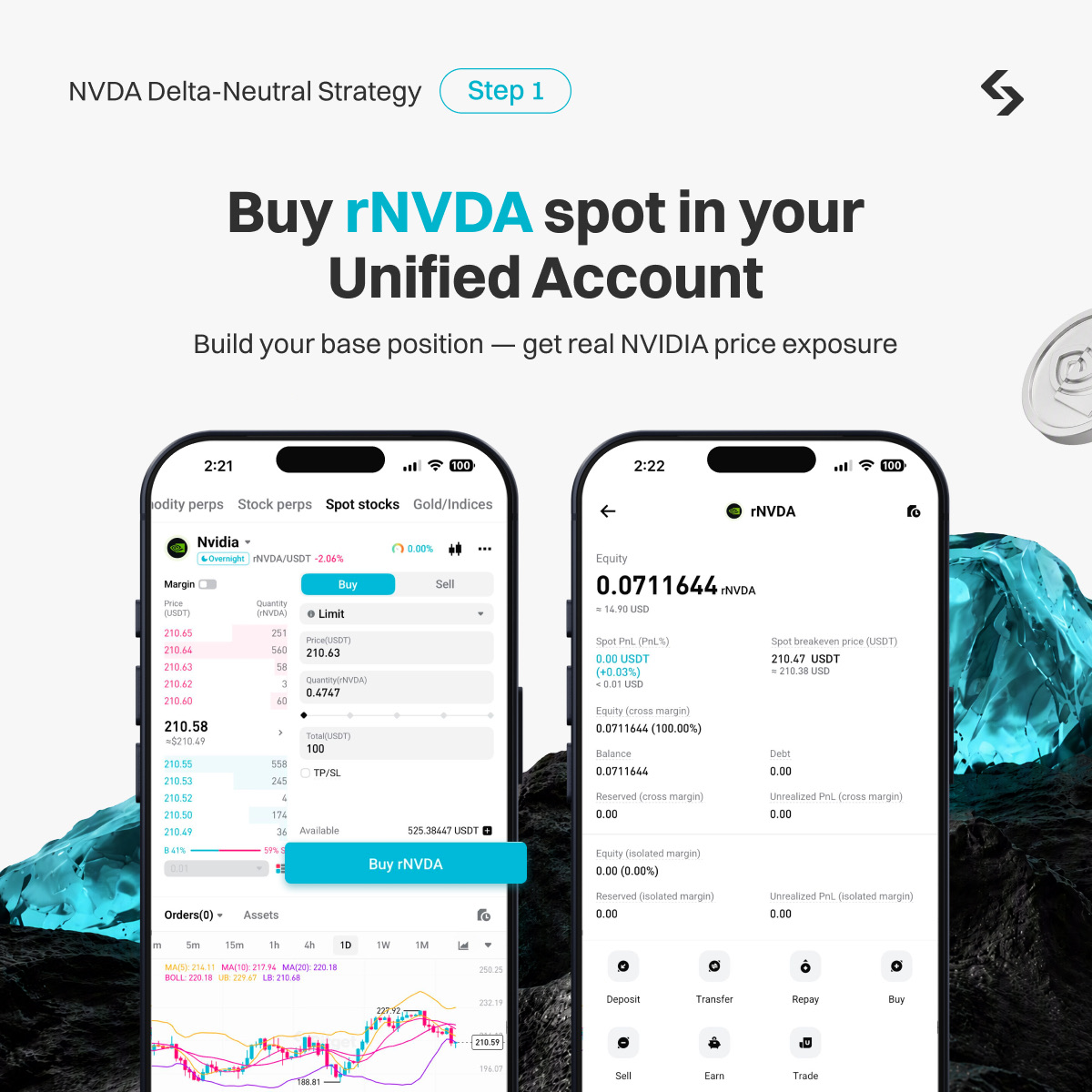
1. Buy rNVDA spot
Buy the corresponding amount of rNVDA spot on Bitget to establish a spot long position and gain exposure directly linked to NVDA's actual price.
2. Open an equivalent NVDA perpetual futures short position
Open an NVDA Perps short position equal in value to your spot holdings. If your account has insufficient USDT margin, you can directly enable the Multi-Asset Margin feature in Bitget's unified trading account. The rNVDA spot holdings in your account can be used directly as cross margin without selling them, significantly improving capital efficiency and allowing you to complete the entire hedge with less cash tied up.
3. Spot long + futures short = near-zero risk
The opposing directions offset each other, leaving only funding rate income settled every 8 hours:
-
NVDA rises → spot profits, futures incur losses → gains and losses offset
-
NVDA falls → futures profit, spot incurs losses → gains and losses offset
Regardless of the earnings outcome, this strategy can continue earning funding rates, truly making price direction irrelevant while the funding rate is yours.
What is the return on this strategy? (Example only)
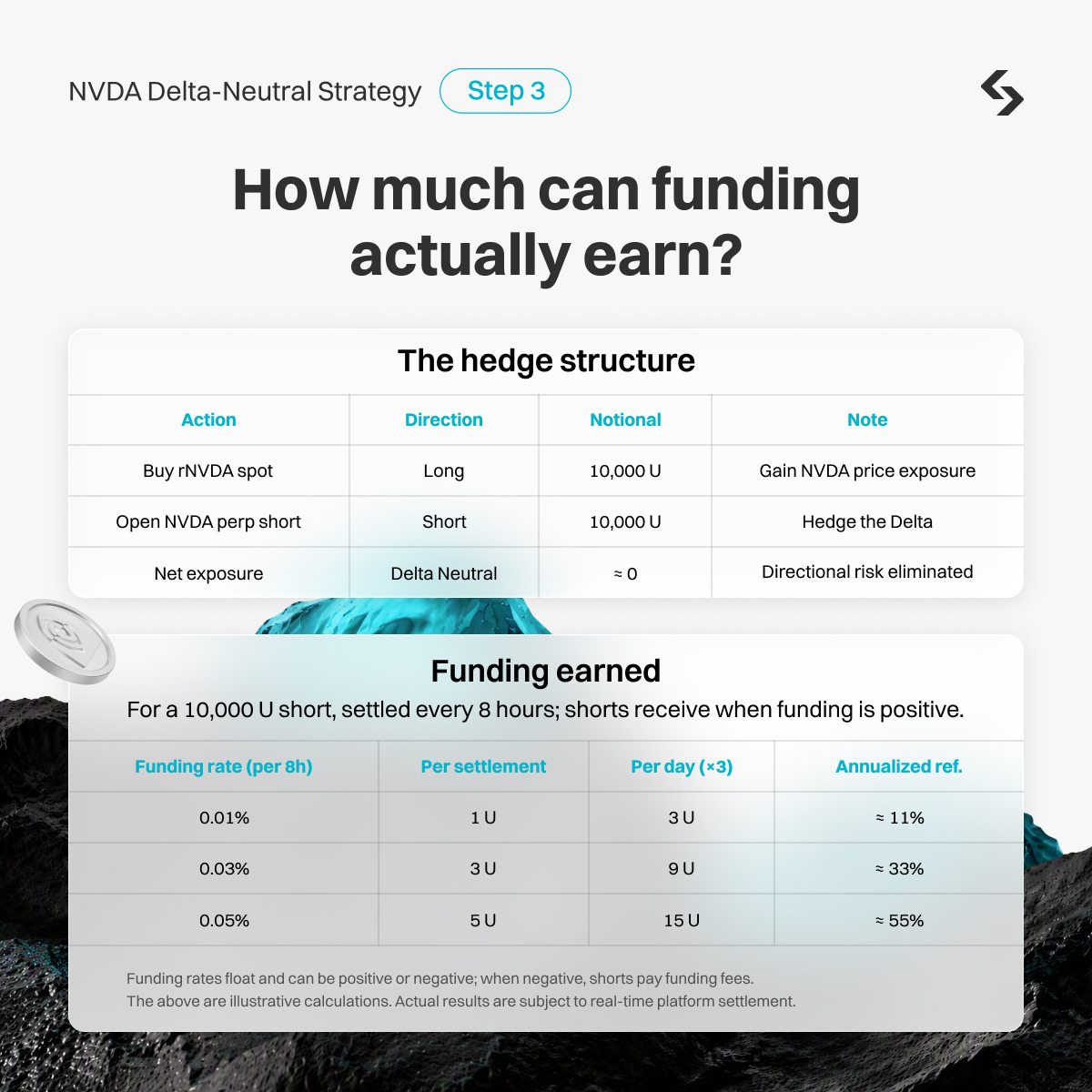
Assume you hold rNVDA spot worth 10,000 USDT + an equivalent 10,000 USDT short position:
| Funding rate (every 8 hours) |
Return per settlement |
Daily (×3) |
Annualized reference |
| 0.01% |
1 USDT |
3 USDT |
≈ 11% |
| 0.03% |
3 USDT |
9 USDT |
≈ 33% |
| 0.05% |
5 USDT |
15 USDT |
≈ 55% |
Actual returns will vary with funding rate fluctuations. During periods of bullish market sentiment and higher rates, such as before earnings, the strategy generally performs better. Over the long term, as long as funding rates remain positive overall, it can accumulate considerable non-directional returns.
Conclusion
This is a strategy with nearly zero directional risk/exposure, and its annualized return can easily reach double digits—the core reason institutions have long adopted Delta Neutral. Now, anyone with a Bitget account can enjoy the same strategic advantages, without complex multi-account operations and cumbersome fund transfers.


- A closer look at the key advantages of Delta Neutral
- Why is Delta Neutral particularly suitable before NVDA earnings?
- How to build an NVDA arbitrage system with rToken?
- What is the return on this strategy? (Example only)
- Conclusion