Oil Prices Slide Sharply: Iran Launches Regional Talks as Markets Reassess Middle East Risk Premiums
International oil prices opened lower on Monday (the 26th). Although geopolitical risks in the Middle East remain unresolved, market concerns over an immediate escalation appear to have eased. Brent crude briefly fell below US $110 per barrel, down nearly 2%, while West Texas Intermediate (WTI) retreated toward US $100 per barrel, declining about 2.4%.
The pullback primarily reflects a repricing of the geopolitical risk premium associated with the Middle East conflict. Iran announced that it would hold talks in Tehran with senior officials from Saudi Arabia, Türkiye, and Pakistan. Combined with signals from U.S. President Trump that Washington could pursue either military action or negotiations, traders see some room for diplomatic de-escalation in the region.
However, rising attacks on vessels near the Strait of Hormuz, surging crude freight costs, and low global inventories continue to support oil prices over the medium to long term. For the oil market, a short-term correction does not mean that risks have disappeared; instead, it may indicate that volatility could intensify further.
Iran Holds Talks with Saudi Arabia, Türkiye, and Pakistan as Markets Watch for De-escalation
According to Iranian state television, Ali Bagheri Kani, Deputy Secretary of Iran’s Supreme National Security Council, said that officials from Saudi Arabia, Pakistan, and Türkiye would travel to Tehran to discuss regional security and related issues with Iranian representatives.
Saudi Defense Minister Khalid bin Salman, Pakistan’s Chief of Army Staff Asim Munir, and Turkish National Intelligence Organization chief Ibrahim Kalin are reportedly expected to lead their respective delegations to the meeting.
The talks have attracted close market attention, as they represent a rare high-level engagement between Iran and members of the Mecca Joint Defense Agreement since tensions in Yemen escalated and clashes between Saudi Arabia and Houthi forces became more frequent.
Iran has long argued that regional security should be maintained by Middle Eastern countries themselves and has opposed intervention by external military powers. If the meeting helps establish communication channels among Saudi Arabia, Iran, and relevant Yemeni parties, expectations of a disruption to oil supplies may decline further, potentially curbing safe-haven buying in crude markets in the short term.
Nevertheless, diplomatic engagement does not mean that conflict risks have been eliminated. Markets will still need to assess whether the parties can introduce concrete de-escalation measures and whether shipping security in the Red Sea, Arabian Sea, and Strait of Hormuz genuinely improves.
Trump Keeps Military and Diplomatic Options Open, Leaving Oil Markets with Policy Uncertainty
The direction of U.S. policy remains a key variable for oil prices. Trump recently said that the United States would not attack Iran that day, while also leaving open the possibility of further military action or a shift toward negotiations.
This combination of firmness and restraint makes it difficult for markets to form a single conclusion regarding the Middle East outlook. On one hand, the absence of an immediate escalation in U.S. military action has reduced concerns over a sudden disruption in oil supply. On the other hand, if sanctions, military deployments, or attacks on economic infrastructure intensify, oil prices could rapidly reprice geopolitical risks.
In addition, the United States has ordered a reduction in staffing at some embassies in the Middle East, including those in Saudi Arabia, Jordan, Lebanon, Qatar, and the United Arab Emirates. Such diplomatic and security measures often heighten market concerns that regional conflict could broaden.
Key developments for oil traders to monitor include:
-
Whether the United States adjusts its military or sanctions policy toward Iran after the election
-
Whether talks between Iran and regional countries yield meaningful progress
-
Whether vessel security deteriorates in the Strait of Hormuz and Red Sea shipping routes
-
Whether oil facilities, ports, or shipping hubs come under attack
-
How OPEC+ and major oil-producing countries respond to supply risks
Rising Attacks Near the Strait of Hormuz Make Freight Costs Another Driver of Oil Prices
Even as crude futures move lower in the short term, transportation pressure in the physical oil market remains substantial.
Data show that multiple confirmed attacks on vessels have occurred near the Strait of Hormuz in October, pushing the monthly total to a record high. Since the conflict involving the United States, Israel, and Iran began, maritime security incidents in the region have continued to accumulate, increasing risk costs for shipowners, insurers, and refiners.
Goldman Sachs noted that average global crude freight rates have climbed from around US $3 per barrel a year ago to more than US $20 per barrel currently. Freight costs on some Middle East routes have exceeded US $35 per barrel. Although rates have eased from recent highs, they remain well above historical averages.
The impact of higher freight rates extends beyond increased logistics costs; it could also reshape global crude trade flows.
For example, sharply higher long-haul transportation costs from the U.S. Gulf Coast to Asia have reduced Asian refiners’ appetite for U.S. crude. Some traders noted that Asian purchases of U.S. crude scheduled to arrive in November have fallen substantially from the previous month.
This means that future oil prices will be influenced not only by production and demand, but also by whether crude can be delivered smoothly to its destination. When shipping is disrupted, insurance premiums rise, or vessels are forced to reroute, regional price differentials may widen, and Brent and WTI could diverge.
Bridgewater Raises Crude Exposure as Low Inventories and Supply Disruption Risks Remain in Focus
The outlook of major investment institutions toward crude oil also deserves attention. Bridgewater Associates said it gradually increased its crude exposure during the third quarter, largely because some segments of demand remained resilient while supply disruption risks and low inventory levels expanded the upside potential for oil prices.
In an environment of low global inventories, the oil market is generally more sensitive to unexpected events. If new disruptions emerge in Middle Eastern supply, shipping, or refining operations, the market may have limited buffer capacity, potentially triggering rapid price swings.
That said, whether oil prices continue to rise in the short term will still depend on whether risk events actually affect physical supply. If diplomatic talks advance, shipping security improves, or major producers raise output, the geopolitical premium accumulated earlier could unwind further.
As a result, the current crude market is neither a straightforward bullish nor bearish environment. It is a classic high-volatility market, where news developments can quickly alter expectations and drive significant intraday moves in both WTI and Brent crude.
Crude Oil Trading Outlook: Watch Support, Resistance, and News-Driven Moves
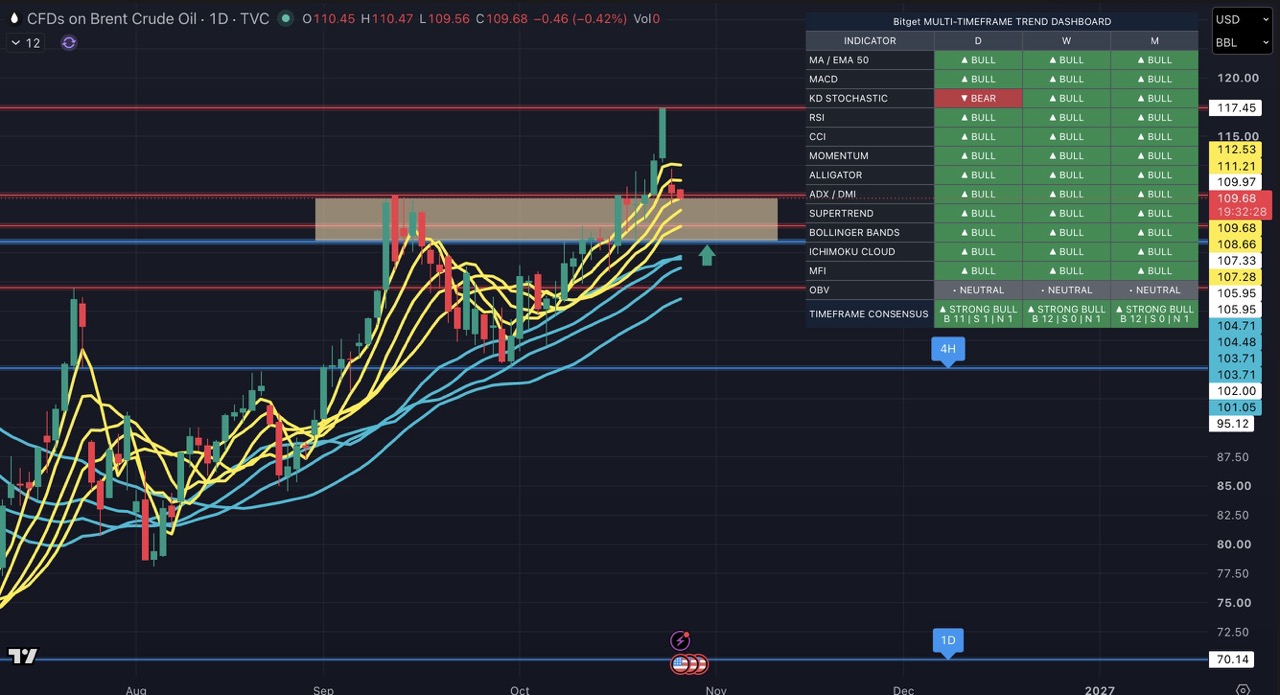
For CFD traders, the key themes in the current crude market are event-driven trading and rising volatility.
If markets believe that talks between Iran and neighboring countries could help ease tensions, and if the United States delays military action, oil prices may remain under pressure from profit-taking and declining risk premiums. Conversely, news of vessel attacks, damage to energy infrastructure, escalating sanctions, or expanded military deployments could quickly bring bullish momentum back into the oil market.
Traders may continue to watch:
1. Market reaction around US$100 per barrel for WTI: This area may act as an important short-term psychological level for bulls and bears.
2. Brent crude near US$110 per barrel: If prices fail to regain this level, it may suggest that the market is reducing its pricing of supply risks.
3. Shipping developments in the Strait of Hormuz and the Red Sea: Deteriorating maritime security typically pushes up both oil prices and freight costs.
4. Policy statements from the United States and Iran: Unexpected comments can amplify intraday volatility.
5. The U.S. dollar, inventories, and OPEC+ developments: These fundamental factors will continue to influence medium-term price direction.
Crude oil CFDs offer two-way trading opportunities, allowing traders to seek opportunities in both rising and falling markets. However, because CFDs use leverage, price fluctuations can also magnify gains and losses. Traders should set stop-loss levels, manage position sizes, and avoid excessive concentration of risk before major announcements.
Conclusion
High-level talks between Iran, Saudi Arabia, Türkiye, and Pakistan have introduced limited expectations of diplomatic de-escalation in the Middle East, becoming one of the key factors behind the latest pullback in oil prices. However, uncertainty remains elevated due to possible changes in U.S. policy toward Iran, vessel security in the Strait of Hormuz, elevated crude freight costs, and low global inventories.
In a market characterized by frequent headlines and rising volatility, traders should closely monitor geopolitical developments and key technical levels while applying disciplined risk management to navigate potentially sharp moves in either direction.
Looking to capture two-way opportunities in WTI and Brent crude price movements? Visit Bitget CFD to track oil markets and flexibly position for both long and short trades. CFDs are high-risk leveraged products—please ensure you fully understand the risks before trading.
All trading education provided by Bitget is for educational purposes only and should not be considered financial advice. The strategies and examples shared are for reference only and may not reflect actual market conditions. CFD trading involves significant risk, including the potential loss of capital. Past performance does not guarantee future results. Please conduct thorough research and ensure that you understand the risks involved. Bitget is not responsible for any trading decisions made by users.


- Iran Holds Talks with Saudi Arabia, Türkiye, and Pakistan as Markets Watch for De-escalation
- Trump Keeps Military and Diplomatic Options Open, Leaving Oil Markets with Policy Uncertainty
- Rising Attacks Near the Strait of Hormuz Make Freight Costs Another Driver of Oil Prices
- Bridgewater Raises Crude Exposure as Low Inventories and Supply Disruption Risks Remain in Focus
- Crude Oil Trading Outlook: Watch Support, Resistance, and News-Driven Moves
- Conclusion

 Gold Speculators Hit the Exit — Can $4,000 Survive the Fed?2026-10-27 | 5m