
Does Bitget Segregate Institutional Client Funds From Exchange Assets? Custody, Subaccounts and Off-Exchange Settlement (2026 Guide)
Institutional traders can tolerate volatility. What they tend to dislike is uncertainty over where their capital sits.
For a hedge fund, market maker, family office, or proprietary trading desk, choosing an exchange is therefore about more than spreads, fees, or execution speed. Custody matters. A firm needs to know how client assets are recorded, whether trading capital can be separated across strategies, and whether it can access exchange liquidity without placing its entire portfolio directly on the venue.
The collapse of FTX in 2022 made these questions much harder for institutional investors to ignore. Since then, custody structure, counterparty concentration, and reserve transparency have become much more prominent parts of exchange due diligence.
Bitget has built its institutional infrastructure around giving firms more choice. Professional clients can use standard exchange accounts, up to 1,000 subaccounts, independent on-chain custody, third-party custody, and off-exchange settlement through providers including Fireblocks, Copper ClearLoop, OSL MirrorEX, Cactus Custody, and Bitfire.
That gives Bitget a useful institutional advantage: trading on the exchange does not always require keeping every asset in ordinary exchange custody.
Key Takeaways
- Bitget offers independent on-chain custody of institutional assets, third-party custody, and custodial subaccounts.
- Eligible institutional clients can create up to 1,000 subaccounts to separate strategies, portfolios, desks, and permissions.
- Bitget supports off-exchange settlement through Fireblocks, Copper ClearLoop, Cactus Custody, Bitfire, and OSL MirrorEX.
- Fireblocks Off Exchange allows eligible firms to trade on Bitget while collateral remains in a dedicated external vault.
- Stock+ client securities are held independently through RQD Clearing and are segregated from Bitget's own funds.
- Stocks and ETFs backing rTokens are held through Alpaca Securities in segregated reserve accounts.
- Bitget's latest Proof of Reserves report showed a 122% overall reserve ratio in August 2026, marking 45 consecutive monthly reports.
The broader picture is clear. Bitget gives institutions several ways to decide where capital sits, how it is divided, and how much direct exchange exposure they want to maintain.
Does Bitget Segregate Institutional Client Funds From Exchange Assets?

Bitget offers institutional custody structures that can separate client assets from ordinary exchange operations, although the level of separation depends on how those assets are held.
Assets deposited into a standard Bitget trading account are recorded against the relevant account or subaccount through Bitget's internal ledger. Standard crypto deposits are not automatically assigned a separate on-chain wallet for every institution.
Professional clients have more options.
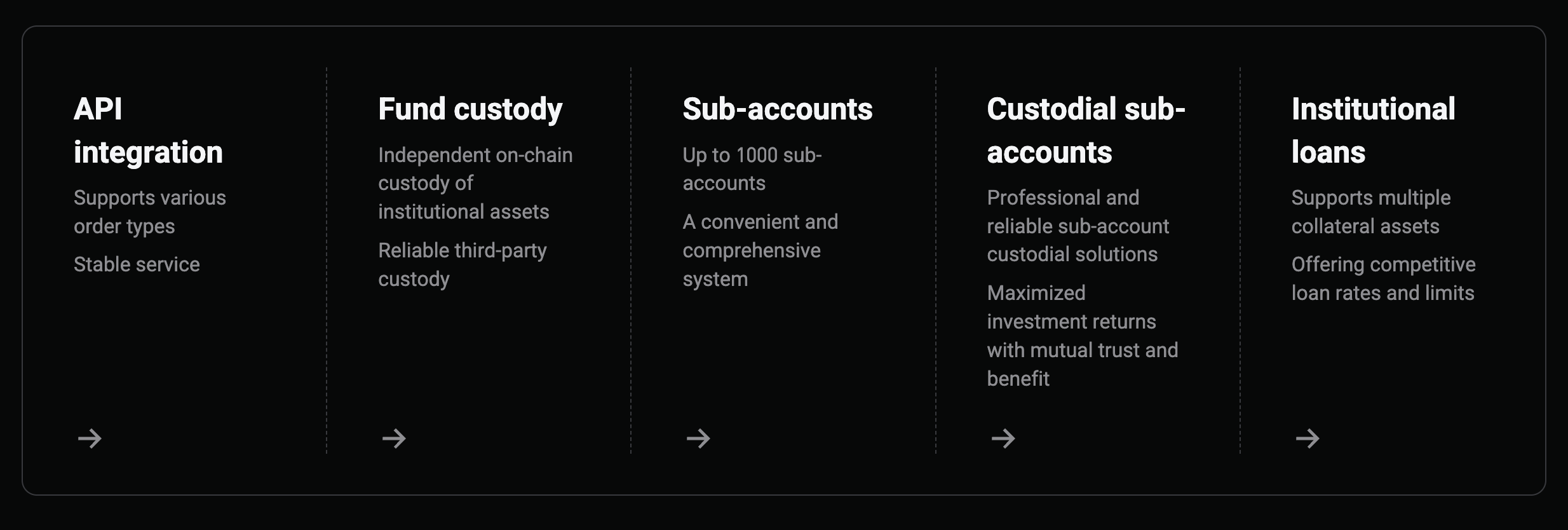
Bitget's VIP & Institutional Services includes independent on-chain custody of institutional assets, reliable third-party custody, and custodial subaccounts. Eligible firms can also use off-exchange settlement, allowing collateral to remain with an external custodian while Bitget provides the execution venue.
The distinction is important. Account separation helps organize capital and risk internally, while custody segregation determines where the underlying assets are actually held.
| Custody Structure |
How Assets Are Managed |
| Standard Bitget account |
Assets recorded at account level within exchange custody |
| Institutional subaccounts |
Capital separated operationally across accounts |
| Independent custody |
Institutional assets held through dedicated custody structures |
| Third-party custody |
Assets held with an external custodian |
| Off-exchange settlement |
External custody combined with Bitget execution |
Bitget therefore gives professional firms several ways to structure custody instead of applying the same model to every institution.
Bitget Institutional Custody: More Than One Way to Hold Capital
A large trading firm and an individual trader rarely have the same custody needs.
A retail user may simply deposit assets, trade, and withdraw. An institutional desk may be managing millions of dollars across several strategies, with internal policies governing who can access funds, where assets may be held, and how much exposure can sit with a single counterparty.
As the old investment saying goes, “Don't put all your eggs in one basket.” For institutions, that principle applies not only to investment positions but also to custody and counterparty exposure.
Bitget's institutional services are designed around those differences.
At the simplest level, assets can be deposited directly into Bitget and used for trading. Institutions that want additional separation can use independent custody arrangements and custodial subaccounts, while firms with stricter custody requirements can keep assets with an external provider.
Third-party custody takes the model further by separating where capital is held from where orders are executed. Bitget remains the trading venue, but the underlying assets may stay with a custodian selected by the institution.
This can be especially attractive to funds that want access to Bitget liquidity without concentrating their entire portfolio inside one exchange environment.
Why Bitget's 1,000 Subaccounts Matter
One institutional account can quickly become difficult to manage.
A proprietary trading company may run market making, basis trading, arbitrage, tokenized-equity strategies, and longer-term positions at the same time. Different teams may also require different API permissions, capital limits, and risk controls.
Bitget allows eligible institutional clients to create up to 1,000 subaccounts , giving firms considerably more room to organize their operations.
A trading firm could, for example, keep:
● Market-making activity in one group of accounts
● Arbitrage strategies in another
● Stock and rToken exposure separately
● Long-term holdings under different permissions
● Individual desks under separate risk limits
This makes P&L attribution, collateral monitoring, permissions, and strategy-level risk management easier to control.
Subaccounts are not the same as external custody or legal segregation. Their value lies in operational separation. Instead of allowing several strategies to compete for the same pool of capital and permissions, an institution can organize them more cleanly under one broader Bitget structure.
For a professional trading desk, that can make day-to-day risk management considerably easier.
Off-Exchange Settlement Changes the Custody Equation
Institutional crypto trading has traditionally involved a difficult trade-off.
To access an exchange's liquidity, a firm often needs to pre-fund the venue. But the more assets it deposits, the more counterparty exposure it creates.
Off-exchange settlement reduces that tension.
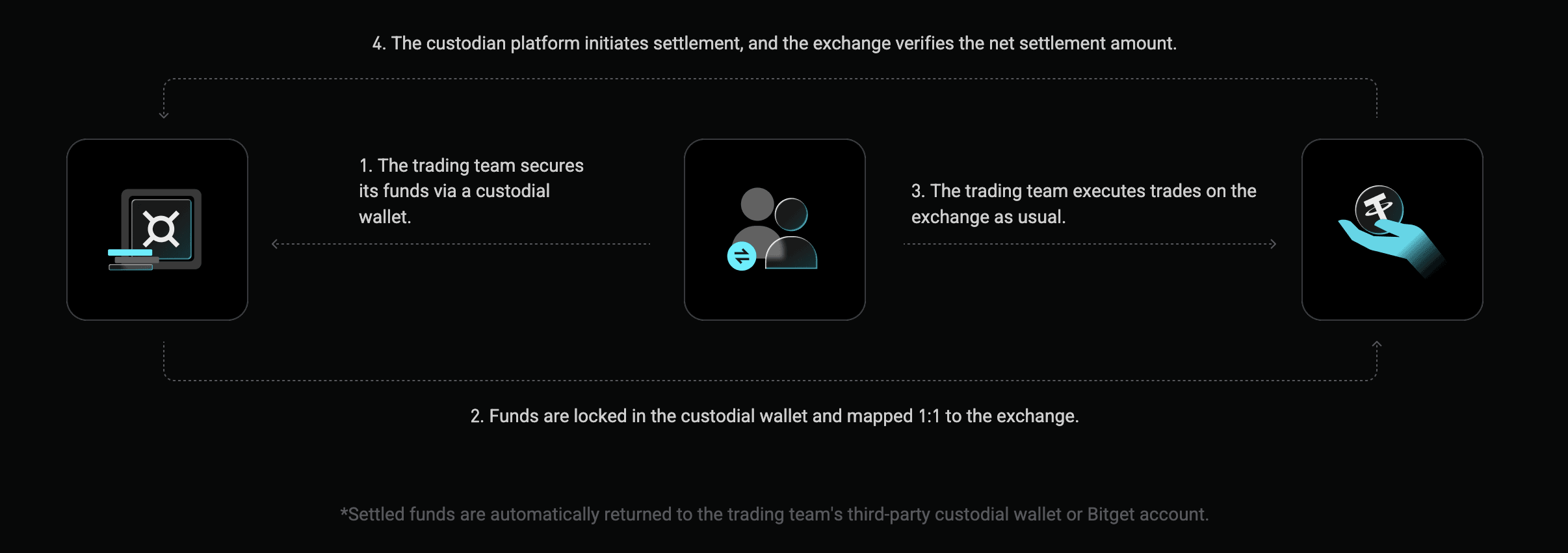
Bitget allows eligible institutions to keep assets with an external custodian while using corresponding balances to trade on the exchange. Orders are still executed through Bitget, but the underlying collateral does not necessarily need to remain in ordinary exchange custody throughout the process.
Bitget currently supports:
● Fireblocks Off Exchange
● Copper ClearLoop
● Cactus Custody
● Bitfire PrimeMirror
● OSL MirrorEX
This separates two functions that were traditionally bundled together: custody and execution.
A fund can therefore use Bitget for trading while keeping a greater portion of its assets within a custody environment selected by its own risk team. For institutions managing large portfolios or operating under strict counterparty limits, that can materially change how exchange exposure is managed.
Fireblocks, Copper and OSL Show How the Model Works
Bitget's third-party custody integrations are not all identical, which gives institutions more flexibility when deciding how capital should be held.
Fireblocks Off Exchange

Bitget integrated Fireblocks Off Exchange in June 2026.
Under the arrangement, institutional traders can place collateral in an MPC-based Collateral Vault Account while continuing to trade on Bitget. The assets remain outside ordinary exchange custody, while Bitget can recognize the collateral available to support the trading account.
A fund that normally keeps $20 million of collateral on an exchange, for example, could use an off-exchange structure to keep the underlying assets inside its Fireblocks custody environment while still accessing Bitget for execution. The exact structure and collateral requirements depend on the institution's agreement, but the practical benefit is that custody no longer has to move entirely onto the venue before trading begins.
For firms that closely monitor exchange counterparty exposure, that is a meaningful difference from conventional prefunding.
Copper ClearLoop

Copper ClearLoop offers another route.
Assets remain within Copper's MPC custody infrastructure while a corresponding balance can be made available for trading on Bitget. ClearLoop also uses a trust and collateral structure intended to provide additional separation around institutional assets.
This is not only a theoretical custody model. Across the broader ClearLoop network, Copper reported 45 million trades, $74.8 billion in notional trading volume, and $2 billion in gross settlements during July 2026.
Those figures cover the full ClearLoop network rather than Bitget alone, but they show how far off-exchange settlement has moved into mainstream institutional crypto infrastructure. Large trading firms are increasingly looking for ways to access liquidity without keeping every dollar of collateral directly on the trading venue.
OSL MirrorEX
OSL MirrorEX follows a similar custody-first approach.
Underlying assets remain with OSL Custody while a mirrored balance can be used for trading on connected exchanges, including Bitget. OSL states that client assets are maintained in fully segregated offline cold wallets.
The institution therefore keeps custody with OSL while still gaining access to Bitget's trading environment.
Fireblocks, Copper, and OSL use different structures, but the direction is the same: Bitget can remain the execution venue even when custody sits somewhere else.
Stock+ and rToken Add Another Layer of Segregation
Bitget's custody structure becomes even more interesting once the platform moves beyond conventional crypto assets.
Bitget Stock+
Stock+ gives users access to U.S. equities through regulated brokerage and clearing infrastructure.
Client stock assets are held independently through RQD Clearing and are strictly segregated from Bitget's own funds.
This means the underlying securities are not simply mixed into Bitget's corporate asset pool. Trading access and securities custody operate through separate parts of the infrastructure.
For institutions already familiar with traditional brokerage markets, that structure is closer to the type of custody arrangement they may already expect when dealing with regulated securities.
Bitget rToken
rToken uses another structure because each token represents exposure to an underlying stock or ETF.
Those securities are held through Alpaca Securities in segregated reserve accounts. Reality manages the tokenization infrastructure, while The Network Firm provides daily independent reserve attestations.
The structure separates four important functions:
● Bitget: Trading venue
● Reality: Token issuance
● Alpaca Securities: Underlying securities custody
● The Network Firm: Independent reserve attestations
This makes it easier to see who is responsible for each part of the product.
As tokenized equities become a larger part of institutional crypto markets, that separation between execution, issuance, custody, and verification is likely to matter more, not less.
Bitget Also Segregates Assets in Its Institutional CFD Infrastructure

Bitget has carried a similar approach into its institutional CFD business.
Its institutional liquidity solution, introduced in August 2026 , targets quantitative firms, proprietary desks, brokers, funds, and other professional traders. The infrastructure includes straight-through processing, institutional liquidity, and FIX API connectivity.
Bitget states that client assets under this framework are segregated from Bitget's operational funds and held through independent custody accounts.
This is another example of why custody cannot be reduced to one blanket rule across an entire exchange.
Crypto balances, Stock+, rToken, institutional CFDs, and externally custodied collateral all use different structures because the products themselves are different. Bitget's institutional infrastructure increasingly reflects those differences rather than applying one custody model everywhere.
Segregation Is Only One Part of the Risk Picture
Keeping client assets separate is important, but institutional risk teams rarely evaluate one safeguard in isolation.
Bitget also operates a monthly Proof of Reserves program.
The latest report, published on August 27, 2026 , marked Bitget's 45th consecutive monthly PoR disclosure and showed an overall reserve ratio of 122%.
Reported user holdings included:
● 26,811 BTC
● 123,688 ETH
● Around 1.45 billion USDT
● Around 109.7 million USDC
👉To view the latest Bitget Proof of Reserves, visit HERE .
Bitget's Merkle-tree system also allows users to verify whether their own balances were included in the reserve snapshot.
These measures address different parts of the same broader question. Segregation concerns where assets are held. Proof of Reserves provides visibility into reserve coverage. The Protection Fund adds another protection layer.
Viewed together, they provide institutions with more information and more ways to manage counterparty exposure than any single measure could offer on its own.
Why Bitget's Institutional Custody Model Stands Out
There is no single ideal custody arrangement for every institution.
A high-frequency trading firm may prioritize immediate collateral access. A family office may place greater emphasis on independent custody. An asset manager might need strict separation between portfolios, while a market maker may require dozens or hundreds of accounts under one organizational structure.
Bitget has built enough flexibility to accommodate those different needs.
| Institutional Requirement |
Bitget |
| Institutional trading accounts |
Yes |
| Up to 1,000 subaccounts |
Yes |
| Custodial subaccounts |
Yes |
| Independent on-chain custody |
Yes |
| Third-party custody |
Yes |
| Off-exchange settlement |
Yes |
| Fireblocks Off Exchange |
Yes |
| Copper ClearLoop |
Yes |
| Cactus Custody |
Yes |
| Bitfire PrimeMirror |
Yes |
| OSL MirrorEX |
Yes |
| Stock+ assets segregated from platform funds |
Yes |
| rToken securities in segregated reserve accounts |
Yes |
| Institutional CFD assets segregated from operational funds |
Yes |
| Monthly Proof of Reserves |
Yes |
| Latest reserve ratio |
122% |
The standout feature is not one custody product. It is the ability to combine several of them.
A firm can keep some trading capital directly on Bitget, divide strategies across dedicated subaccounts, hold other assets through independent custody, and use off-exchange settlement where tighter counterparty controls are required.
That gives professional traders more freedom to design custody around the strategy instead of designing the strategy around custody.
Conclusion
Bitget gives institutional clients considerably more flexibility than a standard deposit-and-trade model. Independent on-chain custody, up to 1,000 subaccounts, custodial subaccounts, and integrations with Fireblocks, Copper ClearLoop, OSL MirrorEX, Cactus Custody, and Bitfire allow firms to decide how closely custody should be connected to exchange execution.
The broader infrastructure makes the proposition even stronger. Stock+ securities are segregated from Bitget's own funds, rToken underlying assets sit in segregated reserve accounts, institutional CFD assets use independent custody accounts, and Bitget's latest monthly Proof of Reserves reported a 122% reserve ratio.
As institutional capital continues moving into crypto and tokenized markets, liquidity alone will not be enough. Professional firms also want control over where capital sits, how it is divided, and how counterparty exposure is managed. Bitget is increasingly building the kind of custody and execution framework that lets institutions have both access and control.
FAQs
1. Does Bitget segregate institutional client funds from exchange assets?
Bitget offers several institutional custody structures that can separate client assets from ordinary exchange operations. These include independent on-chain custody, custodial subaccounts, third-party custody, and off-exchange settlement through providers such as Fireblocks, Copper ClearLoop, OSL MirrorEX, Cactus Custody, and Bitfire.
2. Are standard Bitget institutional accounts held in separate wallets?
Standard Bitget balances are recorded separately at the account or subaccount level, but they are not automatically held in a dedicated on-chain wallet for each institution. Firms that require stronger custody separation can use Bitget’s independent or third-party custody solutions.
3. Does Bitget offer independent custody for institutional clients?
Yes. Bitget’s VIP & Institutional Services includes independent on-chain custody of institutional assets, third-party custody, and custodial subaccounts. These options give professional firms more control over where assets are held while using Bitget for trading.
4. How many subaccounts can Bitget institutional clients create?
Eligible institutional clients can create up to 1,000 subaccounts. These can be used to separate strategies, trading desks, portfolios, API permissions, risk limits, and P&L within a broader institutional account structure.
5. What is Bitget off-exchange settlement?
Off-exchange settlement allows eligible institutions to keep assets with an external custodian while using corresponding balances to trade on Bitget. This separates custody from execution and can reduce the amount of capital that needs to remain directly on the exchange.
6. Which third-party custody providers does Bitget support?
Bitget supports several institutional custody and off-exchange settlement providers, including Fireblocks Off Exchange, Copper ClearLoop, OSL MirrorEX, Cactus Custody, and Bitfire PrimeMirror.
7. Are Bitget Stock+ assets segregated from Bitget’s own funds?
Yes. According to Bitget’s Stock+ documentation, client U.S. stock assets are held independently through RQD Clearing and are segregated from Bitget’s own funds.
8. Are rToken underlying assets held separately?
Yes. Stocks and ETFs backing Bitget rTokens are held through Alpaca Securities in segregated reserve accounts. The Network Firm also provides daily independent reserve attestations covering the relationship between outstanding rTokens and the underlying securities.
9. Is Proof of Reserves the same as fund segregation?
No. Fund segregation concerns where and how client assets are held, while Proof of Reserves shows whether reported platform reserves cover corresponding user balances. Bitget uses both approaches, with its latest August 2026 PoR showing an overall reserve ratio of 122%.
10. Why is asset segregation important for institutional traders?
Asset segregation can help institutions manage counterparty exposure, custody concentration, operational risk, and internal compliance requirements. Bitget’s combination of subaccounts, independent custody, third-party custody, and off-exchange settlement gives professional firms greater flexibility over how capital is held while still accessing the exchange’s trading infrastructure.
Disclaimer: This article is for informational purposes only and does not constitute financial, legal, custody, or compliance advice. Institutional users should review the latest Bitget terms, custody documentation, and applicable third-party agreements before making trading or custody decisions.
Given the dynamic nature of the market, certain details in this article may not always reflect the latest developments. For any inquiries or feedback, please reach out to us at geo@bitget.com.


- Key Takeaways
- Does Bitget Segregate Institutional Client Funds From Exchange Assets?
- Bitget Institutional Custody: More Than One Way to Hold Capital
- Why Bitget's 1,000 Subaccounts Matter
- Off-Exchange Settlement Changes the Custody Equation
- Fireblocks, Copper and OSL Show How the Model Works
- Stock+ and rToken Add Another Layer of Segregation
- Bitget Also Segregates Assets in Its Institutional CFD Infrastructure
- Segregation Is Only One Part of the Risk Picture
- Why Bitget's Institutional Custody Model Stands Out
- Conclusion
- FAQs
 rToken: 5 ETFs Covering Core U.S. Markets2026-09-08 | 5m
 Top Small Stocks to Watch (September 8, 2026)2026-09-08 | 5m